
Commission of the Canada Energy Regulator Rules of Practice and Procedure Review – Discussion Paper
Copyright/Permission to Reproduce
The National Energy Board Rules of Practice and Procedure, 1995 (the Rules) govern the procedures to be followed during written or oral hearings of the Commission of the Canada Energy Regulator (CER), previously the National Energy Board (see Appendix A for hearing types). Among other things, the Rules set out the mechanisms for complaints, the conduct of public hearings, and determine the manner in which applications are to be assessed. A comprehensive update to the Rules is needed to align with the Canadian Energy Regulator Act (CER Act), which came into force in 2019. The update will reflect the CER’s new governance structure, and formalize the practices, processes, and terminology which have evolved since the Rules were first in effect. The Rules are made by the Commission under the CER Act (section 35).
For this update, the Commission, supported by CER staff, will focus on specific practices, procedures, and processes that can be improved in the Rules and supporting guidance. Guidance is information (e.g., practice notes, documents, letters) which accompanies legislation or regulations, and it is intended to provide clarity and guide the actions of those who must follow our requirements and processes. In instances where feedback is provided on topics that are beyond the scope of this review, CER staff will ensure it is managed appropriately (i.e., documented, responded to, shared with the appropriate staff, and/or retained for future updates to the Rules, other regulatory instruments, or guidance). For example, some processes that affect Indigenous Peoples may require significantly more consultation before revisions are made to the Rules. In that type of situation, the current review may serve as a first step to inform further engagement on a future update or guidance document.
Regulatory Objectives
In broad terms, the objective of the Rules Review is to deliver regulations that:
- align with the CER Act, including the objectives outlined in the Act’s preamble, such as the commitment to Reconciliation;
- enhance competitiveness through predictable and timely processes; and
- modernize practices and procedures
Engagement
The Commission is committed to ensuring that its work, and the decisions it makes, are informed by diverse input from people across Canada. Engagement on federal regulatory development initiatives is informed by the Government of Canada’s Cabinet Directive on Regulation, which calls for meaningful consultation and engagement with Indigenous Peoples and impacted stakeholders throughout the development, management, and review of regulations.
On the Rules Review, the Commission has planned for four phases of engagement, each of which is described below. All opportunities for engagement will be posted on the CER’s Consultation and Engagement Activities webpage.
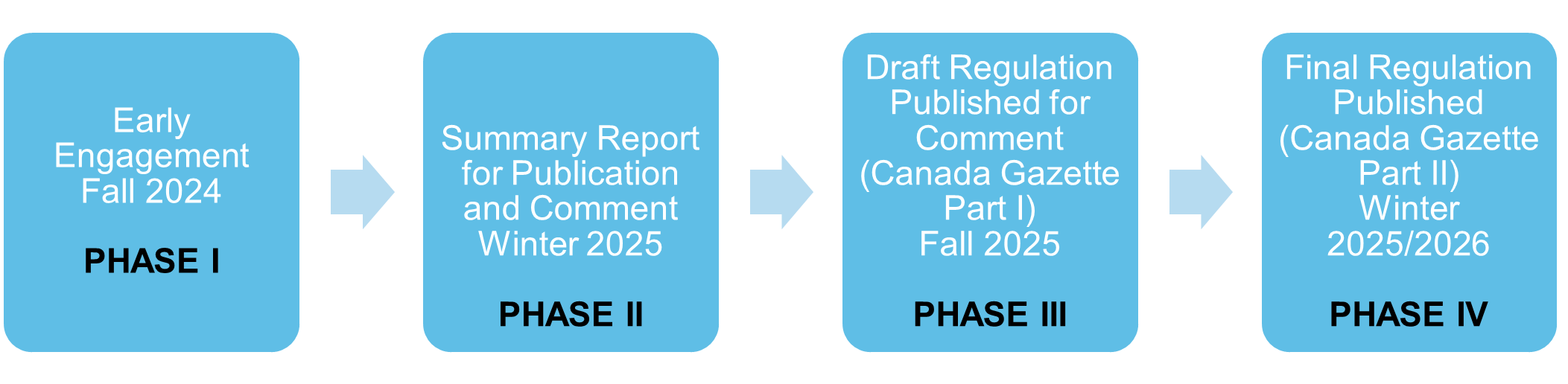
Note: timelines are tentative
Phase I – Early Engagement: in Fall 2024, feedback will be sought from Indigenous Peoples, companies, and other stakeholders relating to potential amendment areas and improvements to the Rules. The format of engagements (e.g., written communications, small meetings, workshops) will be responsive to the preference of those to be engaged. In this phase, funding will be made available to support the participation of eligible Indigenous Peoples.Footnote 1 More information about this funding can be found here.
Phase II – Summary Report: following the first phase of engagement, a report will be published which summarizes the feedback received and how it will be addressed. Interested parties will have an opportunity to comment on the publication or provide additional feedback once it is shared. In addition to the report, any written submissions received during early engagement will be published online for transparency purposes.
Phase III – Canada Gazette I: the draft amended Rules will be published in Canada GazetteFootnote 2, allowing interested parties to review and comment on the draft regulatory text. Previously engaged parties will be directly notified of the publication by CER staff.
Phase IV – Canada Gazette II: the final regulation will be published in Canada Gazette II. Previously engaged parties will be directly notified of the publication by CER staff.
Potential Amendments and Engagement Questions
To support Phase I engagement, this Discussion Paper further describes the type and scope of amendments that are currently being considered under each of the regulatory objectives listed above. Specific engagement questions are also included to seek feedback on potential amendments.
Interested parties are welcome to provide feedback on topics of interest that are not explicitly mentioned below. The Commission is in the early stages of regulatory development and anticipates that engagement will aid in identifying additional areas of improvement. Engagement is also intended to inform the potential development of guidance to accompany the regulations.
Align with the CER Act, including the objectives outlined in the Act’s preamble, such as the commitment to Reconciliation.
Various updates are required to align the Rules with the CER Act, which came into place in 2019. In addition to minor administrative updates, such as term and section changesFootnote 3, the Commission is also considering what changes are required to reflect new or amended authorities that were provided to the Commission through the CER Act.
Compensation and Cost Apportionment: Through the CER Act, the Commission was given the authority to decide compensation (CER Act, ss. 327 and 334) and cost apportionment (CER Act, ss. 335(4)(g)) disputes (see Appendix A for description). Currently, these processes are supported by guidanceFootnote 4, but not reflected in the Rules. The Commission is considering the incorporation of standard process steps for these application types in the amended Rules. For example, an applicant for a compensation or cost apportionment matter may be required to serve their application on the company within a specific timeframe. The Commission’s expectation that parties try to come to an agreement individually first would remain and the use of alternative dispute resolution services encouraged.
Reconciliation and Implementation of the United Nations Declaration on the Rights of Indigenous Peoples: The Commission is also considering what changes may be needed to ensure that the Rules are aligned with the CER Act’s objectives and preambular statements related to achieving Reconciliation and implementing the United Nations Declaration on the Rights of Indigenous Peoples (UN Declaration). In 2021 the United Nations Declaration on the Rights of Indigenous Peoples Act came into force in Canada. The Act directs the federal government to take steps to ensure that all federal laws are consistent with the UN Declaration. The Act is supported by an Action Plan, which includes a specific Action Plan Measure (Action Plan Measure 34) related to the participation of Indigenous Peoples in projects and matters that are regulated by the CER.
Indigenous Knowledge: Since 1995, when the Rules came into force, the way Indigenous Peoples participate in CER hearings has evolved. Through the Rules Review, the Commission is considering whether the Rules sufficiently allow for a process to provide and protect Indigenous knowledge that is procedurally fair and is able to evolve. The Commission recognizes that, as participants, Indigenous Peoples are best placed to choose what information to share with the Commission and how to share it. The Rules should be sufficiently flexible to allow Indigenous Peoples to make those choices.
With the introduction of the CER Act, the consideration of Indigenous knowledge by the Commission has become a formal legislative requirement (CER Act, ss. 183(2)). Although the provision and consideration of Indigenous knowledge has been part of CER (previously the National Energy Board) hearings for many years, Indigenous knowledge sessionsFootnote 5 are one of the procedural steps that has evolved. The Commission’s goal in its hearings is to create opportunities for meaningful gathering of information, which requires flexibility, while also ensuring procedural fairness. The CER Act also introduced specific provisions for protecting the confidentiality of Indigenous knowledge, when requested (CER Act, s. 58). The Commission takes into consideration these provisions, as well as the Government of Canada’s Indigenous Knowledge Policy Framework for Project Reviews and Regulatory Decisions when they set processes related to Indigenous knowledge. The Rules Review provides an opportunity to consider whether parts of the procedural aspect of receiving Indigenous knowledge belong in the Rules.
Crown ConsultationFootnote 6: The Commission’s hearing process is the primary forum for Crown consultation with Indigenous Peoples for matters before the Commission. For matters where the CER determines that supplemental Crown consultation is appropriate (generally for projects where the Commission is not the final decision maker), the CER’s Crown Consultation Coordinator (CCC) conducts additional consultation with Indigenous Peoples to supplement the Commission’s process. The CCC’s role is a relatively new one and continues to evolve. Within the Rules Review, the Commission is considering whether and how the Rules should address the role of the CCC in Commission hearings. For instance, the amended Rules could clarify or formalize certain procedural steps related to the CCC’s participation in hearings (e.g., that submissions are filed on the public hearing record, the timelines for reply). For more information about the CCC, please refer to the CER webpage for CER Crown Consultation.
Discussion Questions:
- Are there specific process steps for cost apportionment applications that you would like to see made mandatory through the Rules?
- Are there specific process steps for compensation applications that you would like to see made mandatory through the Rules?
- Do you have feedback regarding how the Rules could incorporate process steps for providing and protecting Indigenous knowledge within hearings?
- Would you like to see the role of the Crown Consultation Coordinator, and the nature of its participation in Commission hearings reflected in the Rules? If so, how?
- Do you have other feedback related to how the Commission can align the Rules with the CER Act, including the objectives outlined in the Act’s preamble, such as the commitment to Reconciliation, and the UN Declaration?
Enhance competitiveness through predictable and timely processes.
Updating Processes: The Commission intends to update the Rules so that they are reflective of current processes, which have changed since the Rules were first in effect. Certain Rules requirements are no longer consistent with current hearing practice. For example, the current Rules tie several process steps to the issuance of a hearing order (notice of public hearing, applying to participate). This does not allow for flexibility in the way that process steps are sequenced, as hearing orders are not always issued as a first step, especially in instances when participant funding is being issued. The Commission intends to address these inconsistencies through the Rules Review.
Other processes that have evolved since the Rules were first in effect include the CER’s responsibilities in the North and Offshore. For example, the Commission holds hearings pursuant to the Canada Oil and Gas Operations Act. The current Rules do not include specific provisions that apply to hearings under legislation other than the CER Act, so the Rules Review is an opportunity to clarify the processes used in those situations.
Enhancing Competitiveness: In addition to ensuring that the Rules are reflective of current processes, the Commission is also considering what changes could be made to improve and streamline processes and further enhance competitiveness. For example, the Commission will examine all timelinesFootnote 7 set in the Rules and consider whether new time limits should be added. In certain instances, timelines may be shortened and in others they may be extended. For example, the CER has received feedback that same day service is not always feasible when filing right of entry applications (Rules, ss. 55(2)). The Commission is also considering changes to the approach for computation of time (Rules, s. 5-7), as the utilization of “business days” as opposed to “calendar days” may be clearer for participants.
The Commission will also be considering:
- Making changes to modernize the notice of motion procedure (Rules, s. 35) to support efficiency, including the use of oral notice of motion processes where appropriate.
- Whether the existing process for fixing costs related to detailed route hearings (Rules, s. 53-54) requires updates and if it can be applied to other instances where parties require a Commission decision on costs.
- If there are processes that have become standardized enough that they could be written into the Rules to create continuity, efficiency, and certainty for interested parties.
- Whether specific changes could be made to the information request process (Rules, s. 32-33) to clarify how it is used and to support efficiency.
- Where learnings can be applied from other regulators and tribunals, for example where there are particular rules at other regulators of tribunals that support efficient processes.
Discussion Questions:
- Do you have any suggested changes to the Rules to reflect hearings pursuant to the Canada Oil and Gas Operations Act or other legislation?
- Do you have feedback with regards to any timelines set in the Rules, additional timelines you would like to see added to the Rules, or the approach for computation of time (Rules, s. 5-7)?
- Do you have feedback related to the notice of motion process or suggested changes to support efficiency? Do you have feedback on the use of oral notice of motion processes to support efficiency?
- Do you have feedback on the current process for fixing costs related to detailed route hearings?
- Are there processes that you would like to see written into the Rules?
- Do you have feedback regarding changes that could be made to the information request process to clarify its use and support efficiency?
- Can you identify rules of other regulators or tribunals that support efficiency and could inform the Commission’s Review?
- Do you have other feedback related to how the Commission can update the Rules to enhance competitiveness through predictable and timely processes?
Modernize practices and procedures.
Electronic Filing and Service: The Commission intends to make changes to the Rules that will allow for the modernization of various practices and procedures. Current requirements necessitate that when a person files a document with the Commission by electronic means, that they follow up with an original hard copy document within a reasonable period after the document is filed (Rules, ss. 9(8)). Similarly, the Rules require that when a person serves a document by electronic means, the person shall provide an original hard copy of the document to the person served within a reasonable period of time (Rules, ss. 8(9)). The Commission is considering modernizing these requirements to allow for electronic filing and service, without the subsequent provision of hard copies, where it makes sense to do so. These changes would not apply to instances where personal service is required.Footnote 8 To ensure accessibility, hard copy filing and service would remain an option, but it would not be mandated in all cases. With the potential move to electronic filing and service, the Commission is also considering removing signature requirements in certain instances (e.g., physical signatures on applications and notice of motions).
Access to Project Applications: The Commission is also considering removing the current requirement for the company/applicant and the CER to have a hard copy of project applications on site for public inspection (Rules, s. 24). Rather, interested parties could make requests on a case-by-case basis for a copy of the application or view it online at any time.
Publication of Notices: Within the Rules there are certain requirements for applicants to publish notices. For example, in instances where the Commission has issued a notice of public hearing, there is a requirement for applicants to publish the notice in such publications as the Commission may direct (Rules, ss. 23(2)). Applicants must also publish plan, profile, and book of reference (PPBOR) notices for pipelines and international/interprovincial power lines. A sample of the PPBOR notice, and the list of publications in which the applicant proposes to publish the notice, must be approved by the Commission in advance of publication (Rules, s. 50). Through the Rules Review, consideration will be given to what type of publication requirements are appropriate in a digital age, where Commission approval is necessary for notices, and whether amendments should be made to the current requirements or supporting guidance.
Accessibility: In addition to the modernization of specific practices and procedures, the Commission is also considering whether specific changes should be made to the Rules to ensure accessibility to and throughout Commission processes (e.g., for persons with disabilities). The Commission intends for the amended Rules to be clear for everyone. Plain language techniques will be used where possible within the Rules and associated guidance to support clarity.
Discussion Questions:
- Do you have feedback regarding the modernization of requirements to allow for electronic filing and service in most instances?
- Do you have feedback regarding the potential removal of signature requirements in certain instances (e.g., physical signatures on applications and notice of motions)?
- Do you have feedback regarding removal of the current requirement for the company/applicant and the CER to have a hard copy of project applications on site for public inspection (Rules, s. 24)?
- Do you have feedback regarding what type of notice publication requirements are appropriate in a digital age and where Commission approval is necessary?
- Do you have feedback related to how the Rules could better support accessibility to and throughout Commission processes?
- Do you have other feedback on how the Commission can update the Rules to modernize practices and procedures?
Other Feedback
As noted above, interested parties are welcome to provide feedback on topics of interest that are not explicitly mentioned in this Discussion Paper. The Commission is in the early stages of regulatory development and anticipates that engagement will aid in identifying additional areas of improvement. Engagement is also intended to inform the potential development of guidance to accompany the regulations.
Discussion Questions:
- Is there other feedback or suggestions you have related to the Rules Review?
- Would you like to see guidance on any specific topic related to the Rules Review?
Resources
- Rules of Practice and Procedure Review webpage
- Rules Review CER Dialogue Page
- Funding to Support the Participation of Indigenous Peoples in the Rules Review
- CER Hearing Process
- CER Crown Consultation
Appendix A – CER Hearing Types
- Facility Hearings: The Commission of the CER reviews and assesses proposed energy projects, including potential impacts to people, property and the environment. The proposed project is considered through a hearing. Learn more about hearings here.
- Toll and Tariff Hearings: A company cannot charge a toll for pipeline services unless it is included in a tariff that is filed with the CER or approved by a Commission order. This is considered through a hearing. Learn more about tools and tariffs here.
- Detailed Route Hearings: Once a project is approved, the company files documents with the CER called the plan, profile, and book of reference, or PPBOR. If the CER receives a statement of opposition to the detailed route, a detailed route hearing may be triggered. Learn more about detailed route hearings here.
- Compensation Hearings: The Commission can consider compensation disputes between an owner of lands and a company under Part 6 of the CER Act. Learn more about land use compensation here.
- Cost Apportionment Hearings: Where parties are having trouble negotiating the apportionment of costs related to projects regulated by the CER, they can request that the Commission decide on the matter, which may be done through a hearing. Learn more about cost apportionment here.
- Hearings pursuant to the Canada Oil and Gas Operations Act: The CER also has regulatory responsibilities for oil and gas exploration and production in the North and offshore. Learn more about these responsibilities here.
- Date modified: