
Market Snapshot: Energy storage in Canada may multiply by 2030
Connect/Contact Us
Please send comments, questions, or suggestions for Market Snapshot topics to snapshots@cer-rec.gc.ca
Release date: 2025-07-23
The installed capacity of energy storage larger than 1 MW—and connected to the grid—in Canada may increase from 552 MW at the end of 2024 to 1,149 MW in 2030, based solely on 12 projects currently under constructionFootnote 1. There are an additional 27 projects with regulatory approval proposed to come online by 2030, which—if all were to be built—could further boost Canada’s energy storage capacity to 2,768 MW. For comparison, Alberta’s all-time hourly peak electricity demand was 12,384 MWFootnote 2 during a 2024 January cold snap.
The first energy storage project in Canada, the Sir Adam Beck Pump Generating Station, came online in 1957. However, the next project did not come online until 2013. There are three main types of energy storage currently commercially available in Canada:
- Pumped Storage Hydropower (PSH)
- Compressed Air Energy Storage (CAES)
- Battery Energy Storage Systems (BESS)
Storage is playing an increasingly important role in the electricity system by improving grid reliability and power quality, and by complementing variable renewable energy sources (VRES) like wind and solar. This is predominantly by recharging during periods of low demand, then discharging when demand is high—which can also correlate with cost fluctuations. Electricity demand is projected to increase over the next five years worldwideFootnote 3, with VRES projected to continue growing too,Footnote 4 indicating that energy storage’s role may keep increasing in the future.
Figure 1: Map of Canadian Pumped Storage Hydropower, Compressed Air Energy Storage, and Battery Energy Storage Systems Projects – Installed, Under Construction, and Proposed for 2030
Source and Text Alternative
Source: CER
Data: [EXCEL 29 kb]
Text Alternative: This figure shows a map of Canada, and the various energy storage project locations that are connected to the grid. The projects are identified as Pumped Storage Hydropower (PSH), Compressed Air Energy Storage (CAES), and Battery Energy Storage Systems (BESS), shown by coloured markers across the map. Blue markers represent the PSH projects, orange markers represent CAES projects, and purple markers represent the BESS projects. The status of the project is indicated by the shape of the marker, with “Installed projects” shown as circles, “Proposed by 2030” projects shown as triangles, and “Under Construction” projects shown as plus signs. The size of the marker indicates the magnitude of the project. This figure illustrates the geographic distribution and diversity of energy storage projects across Canada, with a noticeable concentration in Alberta, Ontario, and Quebec. Data is available in the link above as an Excel download.
BESS is the fastest growing energy storage technology in Canada and is also the dominant storage technology in terms of capacity and number of sites. All but four projects proposed to be commissioned by 2030 are battery storage, with two CAES and two PHS projects also proposed. BESS projects generally have smaller footprintsFootnote 5 (when compared to PSH and CAES) and they have the ability to scale up in size.Footnote 6
The storage of electricity, either directly in batteries or indirectly in other forms like compressed air or pumped storage hydro, can help balance electricity supply and demand. It allows electricity to be stored during periods of high production, low costs or low use, and then be used when other production is low, or use is high. Storage allows for a higher value-added use of existing generation and grid assets and provides the key service of complementing VRES like wind and solar in today’s rapidly changing grid.
Pumped Storage Hydropower
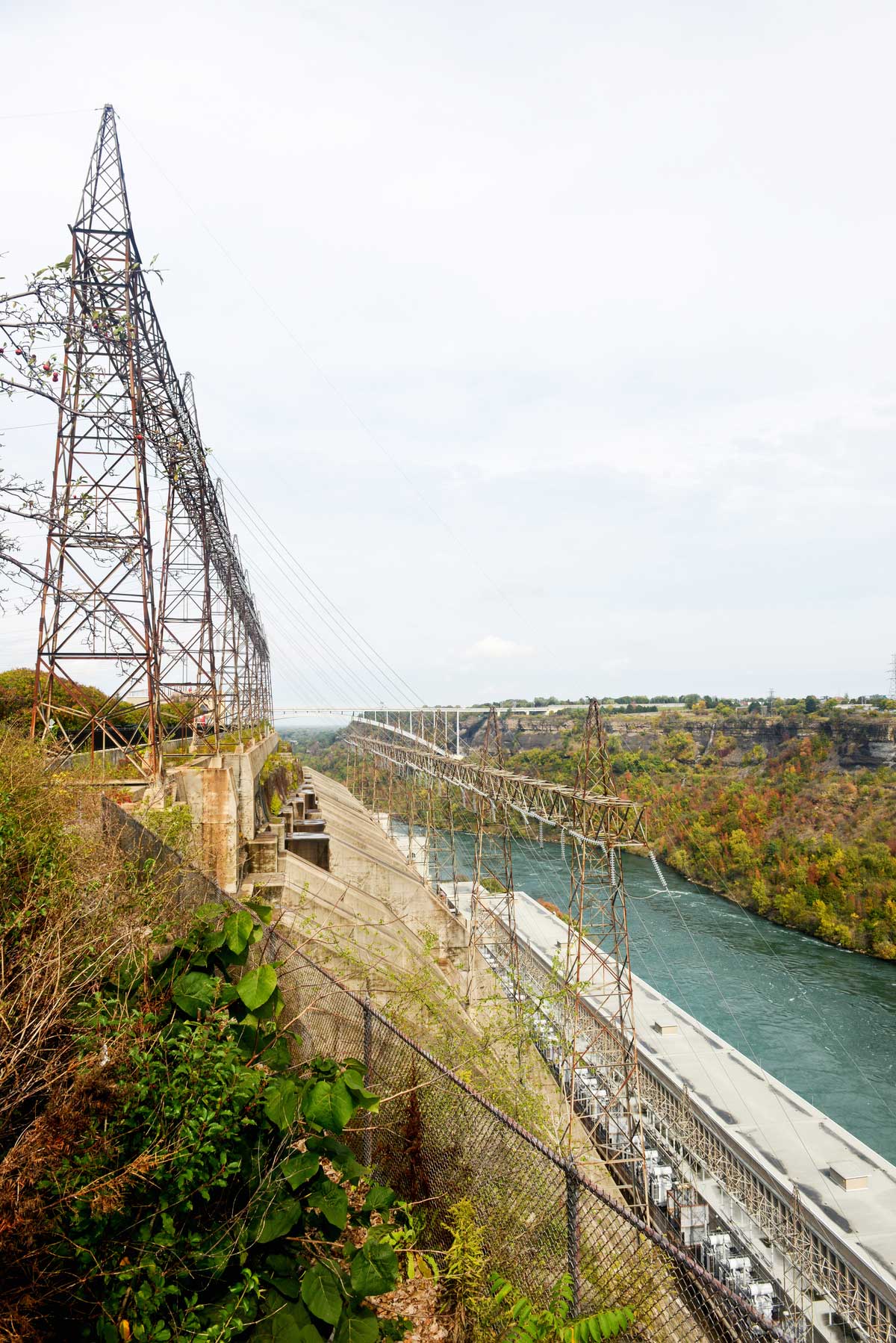
Canada’s only active Pumped Storage Hydropower (PSH) facility is the Ontario Power Generation’s 174 MW Sir Adam Beck Pump Generating Station.Footnote 7 PSH facilities use gravitational potential energy by pumping water into a reservoir at higher elevation during low-demand periods and releasing it through turbines during high-demand periods to generate electricity.
Energy can be stored in the form of potential energy in large quantities of water for longer periods of time than other storage methods. However, facilities require sizeable portions of specific geology with large elevation differences, which can limit the viability of PSH facility locations. As of June 2025, PSH is the earliest and largest form of energy storage in Canada.Footnote 8
Compressed Air Energy Storage
In Compressed Air Energy Storage (CAES), air is compressed and stored in underground structures like mines, aquifers, salt caverns or old oil reservoirs, or in aboveground pressure vessels. When electricity is needed, the air is released to power a turbine and generate electricity. There are two types of CAES: conventional compressed air energy storage (C-CAES) and adiabatic compressed air energy storage (A-CAES). When air is compressed, heat is produced. In C-CAES, the heat generated during the compression phase is released into the atmosphere. During the discharge phase, the compressed air is reheated by burning fuel, typically natural gas. The reheated compressed air drives a turbine, which is connected to an electricity generator. In A-CAES, the heat from the compression phase is captured and stored. This stored heat is then used to reheat the air before it enters the turbine where no additional fuel combustion is required.Footnote 9 As of June 2025, the Goderich A-CAES Facility in Goderich, Ontario is the only CAES project in Canada, able to store 1.75 MW.Footnote 10
Battery Energy Storage Systems
Battery Energy Storage Systems (BESS) are tools that store electrical energy. Within Canada, all energy storage projects currently under construction are BESS. Proposed and under-construction projects have a power range between 1 MW and 411 MW, with an average storage capacity range of 0.5 hours to 6 hours. There are different types of batteries used for large-scale energy storage, such as lithium-ion, lead acid, redox-flow, and molten salt.Footnote 11 Among these, lithium-ion batteries are the most commonly installed for new projects.Footnote 12 Challenges with batteries may vary with the type, such as cost or charging and discharging capacities.
Government funding for energy storage projects is increasing. The Smart Renewables and Electrification Pathways program (SREPs)—which supports clean electricity projects—recently announced $500 million in additional funding and a new round of intakes for the Utility Support Stream.Footnote 13 This stream of the SREP program is meant to support utilities and system operators in modernizing their systems and integrating renewables while maintaining reliability and affordability.
- Date modified: