
Market Snapshot: Canada’s federally regulated energy system by the numbers
Release date: 2026-10-21
A concise look at the energy sector and the infrastructure connecting Canadian energy to markets at home and abroad
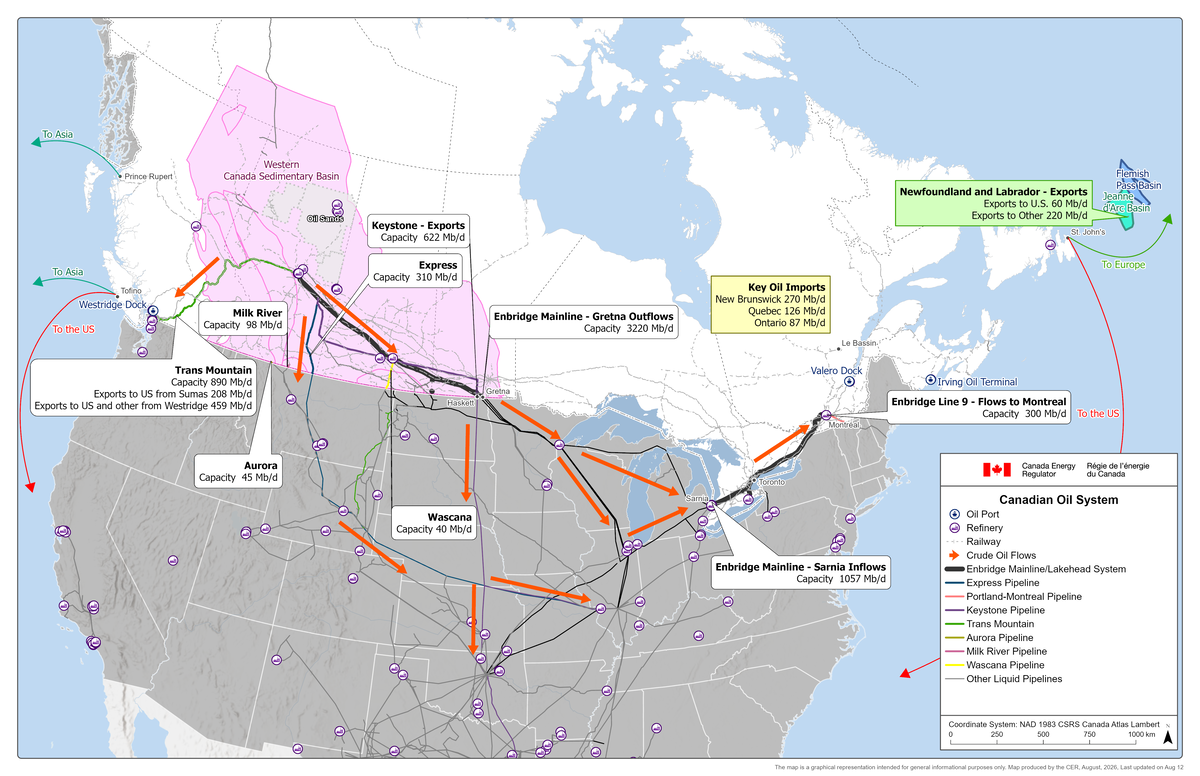
Figure 1: Canadian crude oil system
Source and Text Alternative
Source: CER
Text Alternative: This map shows the major CER-regulated oil pipelines, their capacities and the locations of refineries, ports and railways in Canada and the U.S.
Connect/Contact Us
Please send comments, questions, or suggestions for Market Snapshot topics to snapshots@cer-rec.gc.ca
Canada’s energy sector relies on a national network of pipelines and power lines to move energy between provinces and across international borders, connecting producers and consumers in Canada and around the globe. Much of this infrastructure is regulated by the Canada Energy Regulator (CER) which oversees interprovincial and international pipelines and international and power lines, pipeline tolls and tariffs and energy exports.
The CER currently regulates over 73,000 km of pipeline, including pipelines and facilities that are not operating (i.e., facilities that are abandoned, decommissioned, or deactivated, or that are in the process of these activities).
The following table provides a generalized overview of the length of CER-regulated pipelines in kilometers, by commodity, for all pipelines and for pipelines in operating status.
| Product type | All physical CER-regulated pipelinesFootnote 1 |
|---|---|
| Natural gas | 51,000 |
| Oil/RPP/NGL | 22,000 |
| Commodity/OtherFootnote 2 | 100 |
| Total | 73,000 |
Many pipelines carry two or more commodities. Pipeline systems can do so by segregating specific products on different parallel pipelines comprising the system and/or by batching products within the pipelines.
The statistics that follow illustrate the scale, reach and economic significance of Canada’s federally regulated energy system.
Key numbers at a glance
- The CER currently regulates:
- 100 pipeline companies, 29 international powerline companies and over 460 companies exporting commodities that fall under CER jurisdiction.
- 73,000 km of CER-regulated interprovincial and international pipelines, most of which transport crude oil and natural gas and their derivatives with some pipelines carrying non-energy commodities.
- 1,600 km of international power lines.
- At year-end 2025, federally regulated major pipeline systems had $78 billion in net capital investment (accounting capital spent over decades, net of depreciation)
- In 2025, Canada’s energy exports went to 112 countries, with the vast majority going to the United States. Notably, Canada exported:
- 4.3 million b/d of crude oil exported in 2025.
- 9.1 billion cubic feet per day (Bcf/d) of natural gas, including volumes of natural gas exported as LNG.
- 32.7 Terawatt hours of electricity between Canadian provinces and U.S. states via international power lines.
Canada’s energy industry is one of the largest in the world
Canada is one of the world’s largest energy producers and exporters.
In 2025, Canada ranked fourth globally in crude oil production and fifth in natural gas production, while also producing significant volumes of refined petroleum products and natural gas liquids. These products, together with electricity, move goods, power industries and heat homes from coast to coast to coast. Production that exceeds domestic demand (net of imports), is exported to other countries.
Canada was also the fourth-largest exporter of crude oil and the sixth-largest exporter of natural gas in 2025. Producing energy at this scale requires extensive infrastructure to move it to Canadian consumers and export markets.
Moving energy to Canadians and around the globe
Crude Oil
Canada’s major crude oil pipelines link growing western Canadian production with domestic refineries and export markets. In 2025, western Canadian oil production averaged 5.1 million b/d, and the region’s four largest export pipelines operated at 99% of their available capacity. The United States has historically received the vast majority of Canada’s energy exports and while this is still the case, the proportion of exports that are going to other countries has increased since the Trans Mountain Expansion began operations in 2024. As a result, in 2025 the share of Canadian crude oil exports going to destinations other than the United States rose to 9%, up from approximately 2% in 2021.
The oil pipeline network also supports energy moving into Canada. In 2025 Canada imported 380,000 barrels per day of crude oil and 390,000 barrels per day of refined petroleum products, helping meet regional refinery and consumer demand, as well as providing diluent that is blended into Canada’s bitumen production prior to export.
Natural Gas
Natural gas flows are another major part of Canada’s integrated pipeline network. It accounted for 24.5% of the volume of Canada’s total hydrocarbon exports to the United States in 2025. Gas also moved north, with natural gas representing 31.1% of the total volume of Canada’s hydrocarbon imports from the United States. While export pipelines send natural gas to the United States exclusively, the recently completed LNG Canada export facility in British Columbia now sends growing volumes of liquefied natural gas (LNG) to overseas markets, primarily in Asia.
Electricity
Electricity also moves in both directions through 86 international power lines linking Canadian provinces and U.S. states. In 2025, Canada exported $3.3 billionFootnote 3 in electricity to the United States and imported $1.4 billion. Canada supplied 81.3% of the electricity imported by the United States that year.
Economic impact of Canada’s federally regulated energy system
Canada’s energy exports totaled $179 billion in 2025, representing about 23% of Canada’s total goods exported globally. Moving these resources to markets also led to increased investment in Canada’s pipeline systems. The amount of undepreciated capital invested in federally regulated major pipeline systems rose from $34.6 billion at the end of 2019 to $78 billion at the end of 2025. This reflects investment in the major regulated systems themselves and does not include upstream or downstream projects or the broader economic activity they support.
Keeping Canadians moving
Canada’s 16 refineries can process up to 1.9 million barrels of crude oil per day, producing the gasoline, diesel, jet fuel and other petroleum products that keep Canadians and goods moving. In 2025, refineries operated at about 90% of capacity, with most production consumed domestically and about 20% exported. Interprovincial shipments and imports supplement domestic production to meet regional demand, moving products from major refining centres and other countries to consuming regions. These trade flows reflect differences in refinery configurations, product mixes and specifications, transportation infrastructure, product availability, and regional demand.
- Date modified: