
Market Snapshot: Growing Indigenous ownership in Canadian pipelines and LNG facilities
Connect/Contact Us
Please send comments, questions, or suggestions for Market Snapshot topics to snapshots@cer-rec.gc.ca
Release date: 2026-02-11
Indigenous Communities are increasingly becoming owners and leaders in large energy infrastructure projects. This ownership includes oil, natural gas, and natural gas liquids (e.g. propane) pipelines that are currently in service. It also includes ownership in liquified natural gas (LNG) export projects that are either under construction, or proposed, and ownership in an operating LNG domestic peaking and storage facility.
While many Indigenous-led energy projects in Canada focus on renewable energy, Indigenous Communities, recognized as the third largest collective owners of clean energy assets nationally after government, have also increased their ownership of fossil-fuel infrastructure in recent years.Footnote 1 This growing ownership can create important economic opportunities and gives Communities a greater voice and access to infrastructure and project-related information within their territories.
Publicly available data shows that since 2021 Indigenous Communities have acquired ownership interests in over 5,000 kilometres (km) of operating pipelines across Canada. This number is expected to grow should the Government of Canada advance on its announced intention to explore opportunities with Indigenous Communities for greater economic participation in the Trans Mountain Expansion project.Footnote 2 Indigenous Communities also own stakes in one operating LNG peaking and storage facility, one LNG export facility currently under construction (Cedar LNG), and two proposed LNG export facilities.
The way Indigenous Communities invest in energy infrastructure depends on whether a project is already operating or still being developed. For pipelines in Canada, Indigenous Communities have most often invested in pipelines that are already built and operating. These assets generate steady, predictable revenue, which makes them lower risk and easier to finance. Because of this, these assets are well suited to loans that help Indigenous groups buy ownership stakes, especially when those loans are supported by government loan guarantees.
Indigenous ownership in LNG facilities, however, often looks different from investments in existing pipelines. Rather than buying into assets that are already operating, Indigenous Communities are frequently involved earlier, during project development. This is the case for projects such as Cedar LNG, Ksi Lisims LNG, and NeeStaNan LNG, where Indigenous Nations are partners from the outset of the life of the project.
Major projects with Indigenous equity ownership
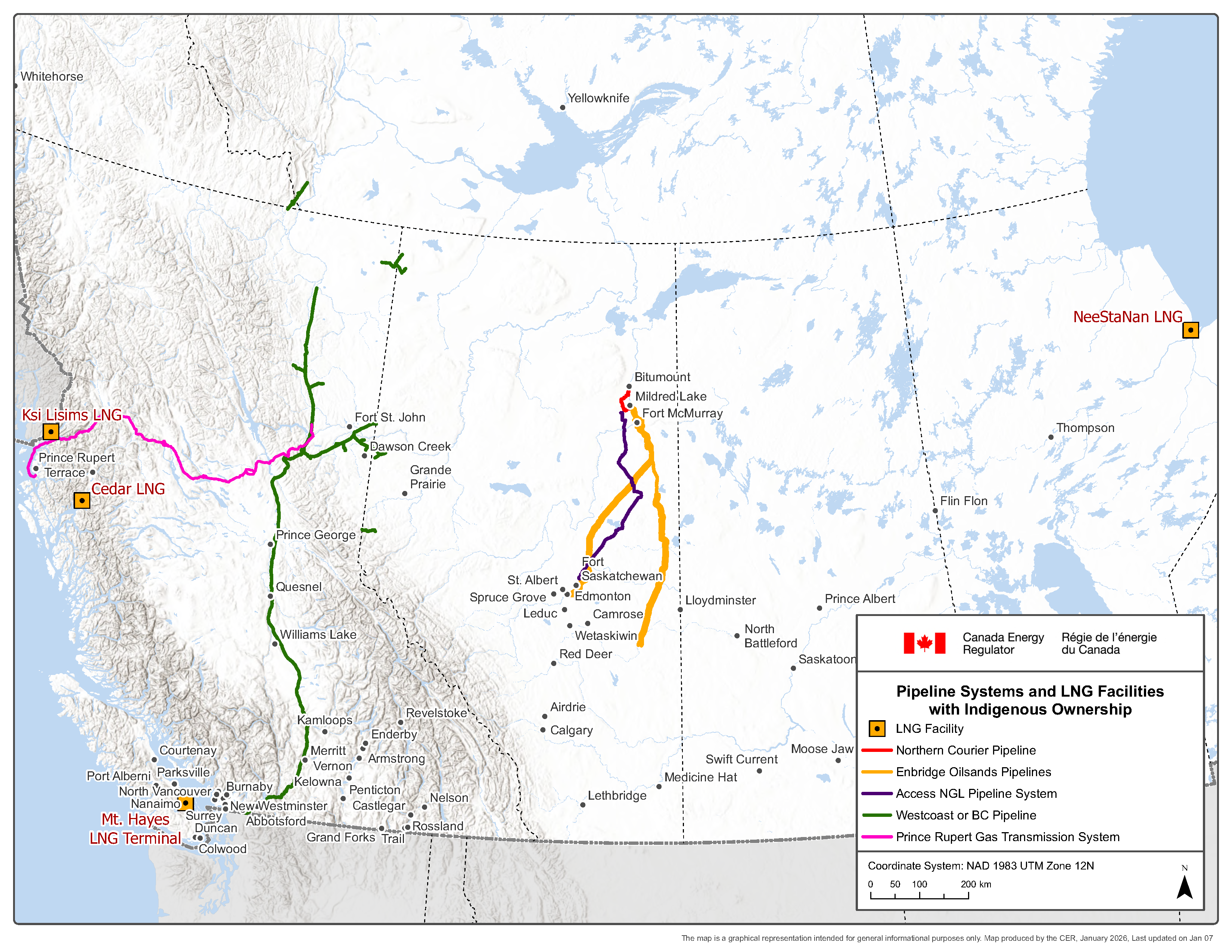
The map below illustrates current pipelines and LNG facilities with Indigenous equity ownership.
Figure 1: Map of pipeline systems and LNG facilities with Indigenous ownership
Source and Text Alternative
Source: CER
Text Alternative: This map of Canada shows the locations of pipelines and LNG facilities that have Indigenous equity ownership.
Table 1: Pipelines with Indigenous ownership
| Infrastructure | Length and capacity | Deal information | Indigenous financing support | Indigenous partnership or group | Operating status |
|---|---|---|---|---|---|
| Northern Courier PipelineFootnote 3 | 90 km 194 thousand barrels per day (Mb/d) | Acquired an 14.25% ownership stake in November 2021 in partnership with Suncor. | Alberta Indigenous Opportunities Corporation (AIOC) provided a $40 million loan guarantee. | Astisiy PartnershipFootnote 4 | In operation. |
|
Enbridge Oilsands PipelinesFootnote 5Footnote 6Footnote 7 Athabasca (Line 19) Athabasca Twin and Wood Buffalo Extension (Line 45) Norlite Diluent (Line 74) Waupisoo (Line 18) Wood Buffalo (Line 75) Woodland (Line 49) Woodland Extension (Line 70) |
Total: 2,456 km Total: 3,678 Mb/d Line 19: 546 km and 570 Mb/d Line 45: 454 km and 800 Mb/d Line 74: 447 km and 218 Mb/d Line 18: 380 km and 550 Mb/d Line 75: 100 km and 550 Mb/d Line 49: 142 km and 540 Mb/d Line 70: 387 km and 540 Mb/d |
Acquired an 11.57% ownership stake in September 2022 in partnership with Enbridge. | Alberta Indigenous Opportunities Corporation (AIOC) provided a $250 million loan guarantee. | Athabasca Indigenous InvestmentsFootnote 8 | In operation. |
| Access NGL Pipeline SystemFootnote 9Footnote 10 |
100 km Approximately 70 Mb/d |
Acquired 43% ownership stake in June 2023 in partnership with Wolf Midstream Canada. | Alberta Indigenous Opportunities Corporation (AIOC) provided a $103 million loan guarantee. | Northern Lakehead Indigenous AllianceFootnote 11 | In operation. |
| Westcoast Natural Gas PipelineFootnote 12Footnote 13 |
Over 2,900 km 3.6 billion cubic feet per day (Bcf/d) |
Acquired 12.5% ownership stake in July 2025 in partnership with Enbridge. | Canada Indigenous Loan Guarantee Corporation (CILGC) provided a $400 million loan guarantee. | Stonlasec8 Alliance Limited PartnershipFootnote 14 | In operation. |
| Prince Rupert Gas Transmission System | Over 750 km | Acquired an assumed 50% ownership stake in March 2024. | Not disclosed. | Nisga'a Nation | Proposed. |
| Clearwater Midstream AssetsFootnote 15 | Not disclosed. | Acquired 85% ownership stake in mid-stream infrastructure covering the Marten Hills and Nipisi areas of the Clearwater play in December 2023 in partnership with Tamarack Valley Energy. | Alberta Indigenous Opportunities Corporation (AIOC) provided a $150 million loan guarantee. | Wapiscanis Waseskwan Nipiy Holding Limited PartnershipFootnote 16 | In operation. |
Table 2: Liquified Natural Gas (LNG) Facilities with Indigenous Ownership
| Infrastructure | Total volume | Deal Information and Development process | Financing support | Indigenous partnership or group | Operating status |
|---|---|---|---|---|---|
| Cedar LNGFootnote 17 | Expected to export 3.3 million tonnes per year. | Under construction, with operations expected to commence in 2028. Positive Final Investment Decision in June 2024. Acquired a 50.1% ownership stake in June 2024 in partnership with Pembina Pipeline Corporation. |
Federal support of $200 million under the Strategic Innovation Fund; Commitment of capital from the First Nations Finance Authority; and B.C. provincial contribution agreement providing $200 million to support the electrification of Cedar LNG. | Haisla Nation | Under construction. |
| Ksi Lisims LNGFootnote 18 | Planned to export 12 million tonnes per year. | Operations are targeted to commence in 2029. Referred to the Major Projects Office. Awaiting final investment decision. In partnership with Rockies LNG Partners and Western LNG. |
Not disclosed. | Nisga’a Nation | Proposed. |
| NeeStaNan LNGFootnote 19 | Not available. | Feasibility study underway. The project is 100% Indigenous-owned and governed. |
Manitoba Government funding of ~$6.7 million over two years to study the feasibility of the project. | Fox Lake Cree Nation | Proposed. |
| Mt. Hayes LNG TerminalFootnote 20 | Stores up to 1.5 billion cubic feet. | Since 2011, supplements gas needed to meet peak local natural gas demand. In partnership with FortisBC. |
Not disclosed. | Stz’uminus (Chemainus) First Nation and Cowichan Tribes | In operation. |
Government financing mechanisms increasing Indigenous ownership
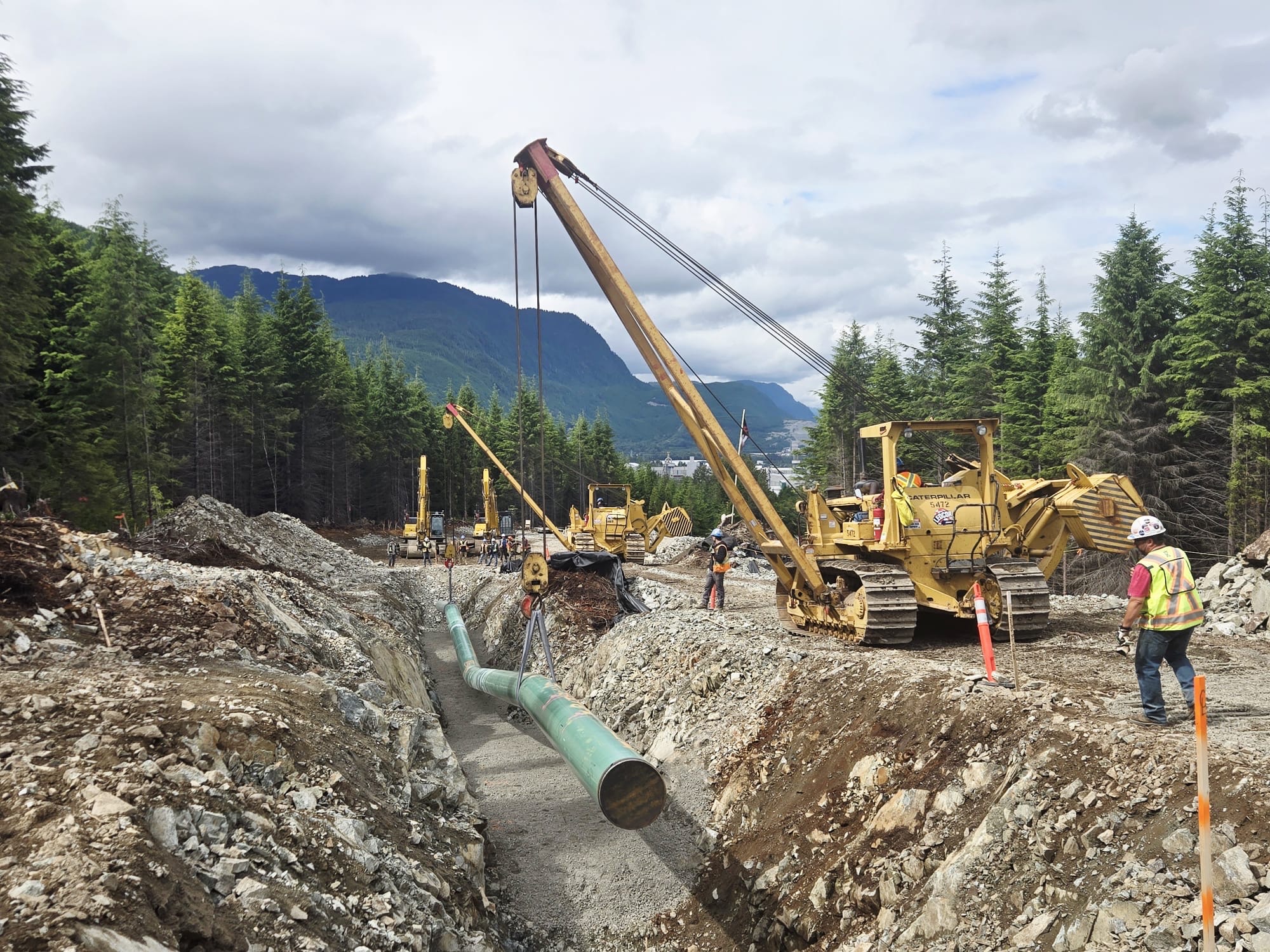
Photo credit: Cedar LNG Project, Haisla Nation and Pembina Pipeline Corporation
Indigenous ownership is commonly structured through a consortium or a limited partnership. A consortium brings together multiple First Nations, Metis, or Indigenous governments to jointly own a project. Whereas a limited partnership is used to clearly define how ownership, financial returns, and responsibilities are shared among participating Communities or Nations. These structures allow multiple Indigenous Communities or Nations to invest together, share risks and benefits, while still respecting each Nation’s independence and legal authority.
A growing number of federal and provincial programs support Indigenous ownership in operating energy infrastructure. One key tool is a loan guarantee, which means the government agrees to repay a loan if the owner is unable to do so. These programs reduce financial risk for lenders and help Indigenous Communities access larger amounts of capital on better terms, such as lower interest rates. As noted by the First Nations Major Projects Coalition, addressing barriers to capital access helps create the conditions for strong, collaborative partnerships with Indigenous nations.Footnote 21
At the federal level, Indigenous Loan Guarantee Program (ILGP), administered through the Canada Indigenous Loan Guarantee Corporation (CILGC), provides loan guarantees that improve access to capital. Several provinces such as Alberta, Ontario, Saskatchewan, British Columbia (B.C.), and Manitoba, have introduced similar programs. Some of these programs, such as the Alberta Indigenous Opportunities Corporation (AIOC), also provide capacity-building grants or supports to help Indigenous Nations access third-party legal, financial, and technical advice, supporting informed decision making.Footnote 22
Table 3: Canadian federal and provincial Indigenous Loan Guarantee Programs
| Region | Program | Program administrator | Description |
|---|---|---|---|
| Canada | Indigenous Loan Guarantee Program (ILGP) | Canada Indigenous Loan Guarantee Corporation (CILGC) – a subsidiary of Canada Development Investment Corporation (CDEV) | National program delivered via a subsidiary of Canada Development Investment Corporation (CDEV); supports Indigenous equity investments in major projects, including in the energy and natural resource sectors. Guarantees are available from ~$20 million to $1 billion. This program was initiated in 2024. |
| Alberta | Government of Alberta | Alberta Indigenous Opportunities Corporation (AIOC) | Provincial loan guarantee investment program supporting Indigenous equity participation in qualifying projects, including in the natural resource sector. Minimum per project guarantee ~$20 million, with typical deals cited between $20 million and $250 million. This program was initiated in 2019. |
| Ontario | Building Ontario Fund | Indigenous Opportunities Financing Program (IOFP) | Formerly the Aboriginal Loan Guarantee Program (ALGP). It was renamed and expanded to support Indigenous participation in Ontario-based projects, including in the energy and natural resource sectors. Minimum investment of at least $100 million, or $50 million for projects that advance community and economic wellbeing for Indigenous Communities. This program was initiated in 2025. |
| Saskatchewan | Government of Saskatchewan | Saskatchewan Indigenous Investment Finance Corporation (SIIFC) | Provides loan guarantees (minimum ~$5 million) to Indigenous Communities/entities to support equity ownership in natural resources and value-added agriculture projects. This program was initiated in 2022. |
| Manitoba | Government of Manitoba | Manitoba Indigenous Loan Guarantee Program (MILGP) | This program was developed to support First Nations and Metis participation in Manitoba Hydro’s Call for Wind Power. The MILGP will offer up to $300 million in guarantees. This program was initiated in 2025. |
| British Columbia | Government of British Columbia | First Nations Equity Financing Framework / Program | Announced in the B.C. 2024 budget; includes a special account and planned loan-guarantee program (up to ~$1 billion cumulative guarantee limit). This program is still being implemented. |
A recent example of this model is when 38 First Nations, through the Stonlasec8 Alliance Limited Partnership, invested in the Westcoast natural gas pipeline system. Together, these Indigenous Communities purchased a 12.5% ownership stake, supported by a $400 million loan guarantee from the federal Indigenous Loan Guarantee Program.
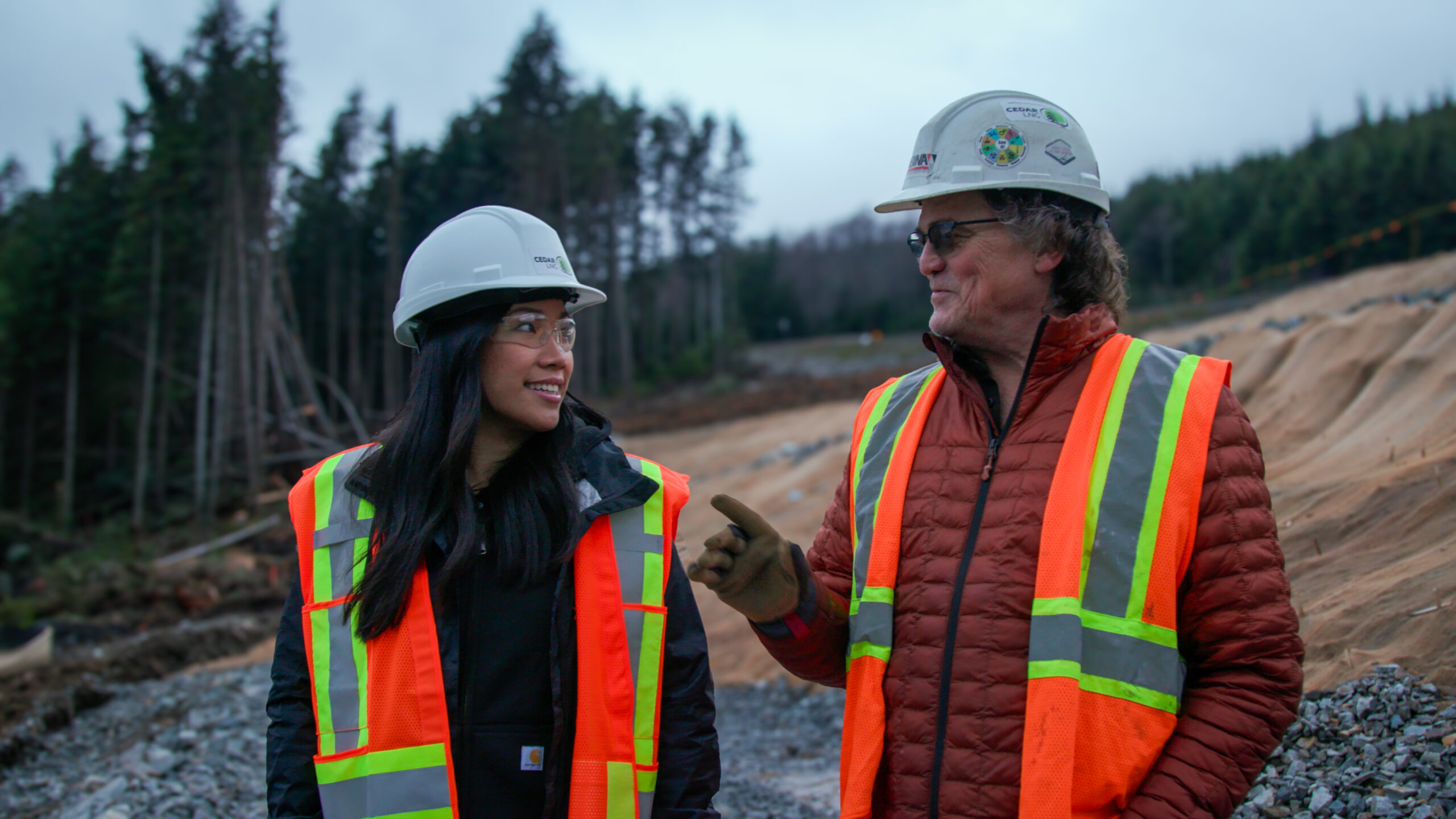
Photo credit: Cedar LNG Project, Haisla Nation and Pembina Pipeline Corporation
For these developing projects, government funding can support a wide range of activities, including feasibility studies, project planning, project finance, and construction. For example, Cedar LNG received $400 million in committed capital from the federal Strategic Innovation Fund and the First Nations Finance Authority (in the form of grants or contributions). The project is a partnership between the Haisla Nation and Pembina Pipeline Corporation, showing how Indigenous proponents work alongside industry partners to co-develop and advance large-scale energy infrastructure projects.
Overall, the growing role of Indigenous ownership in pipelines and LNG projects in Canada marks a significant shift in how major energy projects in the country are developed, financed, and managed.
- Date modified: