
Canada Energy Regulator 2026–27 Departmental Plan
Erratum
The target for “Number of opportunities that Canadians have to collaborate and provide feedback on energy information products” is “At least 120”, not “At least 85” as indicated I the document. Please see Core Responsibility 4: Energy Information, Table 11.
On this page
- At a glance
- Message from the Vice-Chairperson
- Message from the Chief Executive Officer
- Plans to deliver on core responsibilities and internal services
- Department-wide considerations
- Planned spending and human resources
- Supplementary information tables
- Federal tax expenditures
- Corporate information
- Definitions
Copyright information
©His Majesty the King in Right of Canada, as represented by the Canada Energy Regulator, 2026, ISSN: 2562-9735
At a glance
This departmental plan details Canada Energy Regulator’s priorities, plans, and associated costs for the upcoming three fiscal years.
These plans align with the priorities outlined in the Mandate Letter, as well as Canada Energy Regulator’s Vision, mission, raison d’être and operating context.
Key priorities
Canada Energy Regulator identified the following key priorities for 2026-27:
- Trust and Confidence: We foster the trust and confidence of Canadians by effectively delivering on our mission with safety at the forefront. We engage and empower our diverse workforce. We strengthen relationships that uphold the rights and interests of First Nations, Inuit and Métis, and we communicate transparently and engage meaningfully with all our stakeholders.
- Reconciliation and Implementation of the United Nations Declaration: We are implementing the United Nations (UN) Declaration on the Rights of Indigenous Peoples (UN Declaration) and delivering on the commitments made in the UN Declaration Act Action Plan. We do so based on the recognition of rights, respect, co-operation and partnership, by working together with First Nations, Inuit and Métis governments, communities, and organizations. We continue to build the cultural intelligence of the CER.
- Competitiveness and Regulatory Excellence: We enhance Canada’s global competitiveness through leadership in regulatory innovation and best practices, focusing on cost-effectiveness, transparency, predictability, timeliness and efficiency of regulatory processes.
- Preparing for the Energy Future: We inform the energy transition by offering expertise and insight as the energy system transitions to a net-zero economy across Canada. We focus on energy innovation, security, competitiveness, and safe and reliable energy transmission infrastructure that is resilient to the effects of climate change.
Comprehensive Expenditure Review
The government is committed to restraining the growth of day-to-day operational spending to make investments that will grow the economy and benefit Canadians.
Canada Energy Regulator does not have planned reductions under the Comprehensive Expenditure Review.
Canada Energy Regulator will, however, respect the spirit of the exercise by doing the following:
- Leveraging advanced digital technologies including Artificial Intelligence to attain operational efficiencies.
- Reducing its reliance/cost on professional services contractors across multiple programs.
- Engaging in regulatory activities by conducting meetings, training and hearings virtually, where possible.
This departmental plan reflects these measures.
Highlights for Canada Energy Regulator in 2026-27
The CER is focused on regulatory efficiency through a number of initiatives that support continuous improvements to lifecycle regulation of Canada’s federal energy infrastructure. In addition to supporting and enabling the efficient and effective regulatory review of project applications that are submitted to the CER for its adjudication, the CER will continually improve its regulatory framework and processes in the coming year. Regulatory optimization efforts include launching the external interface for the CER Portal to further enhance the timeliness of application processing and continued streamlining of assessments while maintaining robust adjudication processes. These ongoing efforts to improve decision-making speed and clarity support the CER’s commitment to ensuring its regulatory framework is effective and future-ready.
Updating the Onshore Pipeline Regulations (OPR) continues to be a CER priority in 2026-27. Analysis of input received during phase two engagement will inform a draft regulatory proposal and the approach to the final engagement phase to consult Indigenous Peoples, industry and stakeholders. This comprehensive update will deliver modern, clear and efficient improvements to the CER’s pipeline regulations while continuing to ensure the safety of people and the environment and protect Indigenous rights and interests.
In addition to continued work on the CER’s flagship energy information publication, the Canada’s Energy Future report, in 2026-27 the CER will publish timely, relevant, and fact-based Market Snapshots, Pipeline Profiles, Regulated Trade Statistics, Provincial and Territorial Profiles and an updated Canada’s Pipeline System report.
In 2026-27, total planned spending (including internal services) for Canada Energy Regulator is $119,372,758 and total planned full-time equivalent staff (including internal services) is 559.4.
Summary of planned results
The following provides a summary of the results the department plans to achieve in 2026-27 under its main areas of activity, called “core responsibilities.”
-
Core responsibility 1: Energy Adjudication
In 2026-27, the CER’s Energy Adjudication core responsibility will continue to ensure fair, transparent, efficient, and inclusive adjudication processes. The CER will evaluate its current adjudication processes, including its role as the Crown Consultation Coordinator, to identify potential improvements in efficiency and predictability, while maintaining comprehensive assessments and meaningful engagement with First Nations, Métis and Inuit and with stakeholders. The CER will also collaborate with other federal organizations to support and implement any new adjudication processes resulting from the Building Canada Act. Additionally, the CER will introduce digital solutions to modernize user experiences of CER adjudication processes through increased administrative efficiency, while also reducing timelines for proponents.
- Planned spending: $29,562,960
- Planned human resources: 122.7
More information about Energy Adjudication can be found in the full plan.
-
Core responsibility 2: Safety and Environment Oversight
In 2026–27, the CER’s regulatory oversight and compliance activities will continue to be planned and executed with a focus on ensuring the safety of people, property and the environment at the forefront. These efforts will include inspections, audits, and emergency preparedness exercises, underscoring the CER’s dedication to preventing harm. Continued collaboration between Indigenous monitors and CER inspectors will strive to ensure Indigenous knowledge and perspectives are integrated into regulatory practices and tools. As a lifecycle regulator, the CER will maintain oversight of regulated companies’ financial capacity to decommission infrastructure, and its management of orphaned pipelines. All of this work will be supported by continued enhancements to the compliance and enforcement framework that will help clarify the methods and instruments used to promote and enforce adherence to regulatory standards. The CER will further advance work updating the OPR, incorporating input received in the final engagement phase to develop a draft regulatory proposal. Promoting safety culture and human and organizational performance will remain a priority, advanced by a continued focus on the Safety Culture Learning Portal and industry workshops. Increasing emphasis on process safety management oversight also remains a priority. Regulatory cooperation with aligned provincial, territorial, federal and international entities will also be prioritized to enhance the CER’s regulatory oversight.
- Planned spending: $30,651,627
- Planned human resources: 144.9
More information about Safety and Environment Oversight can be found in the full plan.
-
Core responsibility 3: Engagement
The CER is committed to enhancing trust and confidence in its regulatory processes through transparent, coordinated, and collaborative engagement with Indigenous Peoples and stakeholders. The CER will conduct strategic engagement leveraging modern technology activities across the country to support its regulatory activities and energy information responsibilities. It will continue working closely with First Nations and Métis governments, organizations, and communities affected by CER-regulated facilities to strengthen Indigenous participation in oversight and decision-making. Engagement efforts will continue to meet the needs of diverse audiences at both national and regional levels. These initiatives will promote the integration of Indigenous knowledge, respect for Indigenous rights, and capacity-building, ensuring that Indigenous communities rights and interests are respected while ensuring they have a meaningful role in shaping the future of Canada’s energy systems.
- Planned spending: $10,999,449
- Planned human resources: 41.2
More information about Engagement can be found in the full plan.
-
Core responsibility 4: Energy Information
The CER provides Canadians with trusted energy information to support informed decisions about the country’s energy future. The 2026 iteration of Canada’s Energy Future, our long-term outlook on energy supply and demand, will address ongoing economic and market uncertainties, while exploring pathways to achieve net-zero emissions by 2050. It will also broaden its scope to include energy security, First Nations, Métis and Inuit perspectives, and investment requirements, supported by improved energy models and databases. The CER will also update the Canada’s Pipeline System Report, an interactive online resource that explains market trends for crude oil, natural gas, and natural gas liquids, along with the economic regulation of CER-regulated pipelines. This report is designed to make complex pipeline and energy market data accessible and easy to understand. In addition to publishing various updates to commodity statistics throughout the year, the CER will also refresh its 14 Provincial and Territorial Profiles, which provide detailed information on energy production, transportation, trade, consumption, and greenhouse gas emissions for each province and territory. The profiles are widely used for research and decision-making and serve as an important engagement tool for the CER. The CER will continue publishing Market Snapshots - many of which will focus on Canada’s energy trade with other countries, offering timely insights into evolving market dynamics.
- Planned spending: $5,285,390
- Planned human resources: 36.9
More information about Energy Information can be found in the full plan.
For complete information on Canada Energy Regulator’s total planned spending and human resources, read the Planned spending and human resources section of the full plan.
Message from the Vice-Chairperson

Melanie Debassige
Vice-Chairperson
On behalf of the Board of Directors of the Canada Energy Regulator (CER), I am honoured to present our 2026–27 Departmental Plan. This plan outlines the priorities and activities that will guide our work over the coming year as we deliver on the commitments set out in the CER’s Strategic Plan.
As the Board’s Vice-Chairperson, I am inspired by the path ahead. The CER regulates energy infrastructure to ensure the safe, reliable, and environmentally sustainable delivery of energy to Canada and the world. Canada has the energy information it needs to meet the generational challenge ahead and position itself as a leader in both clean and conventional energy sources.
Our Strategic Plan provides a road map of how we can help Canadians make informed decisions about their energy future. It reflects both the challenges and opportunities before us and exemplifies how the CER works to continue fulfilling its mandate with excellence.
In this work, we recognize and respect the inherent and constitutionally protected rights of First Nations, Inuit, and Métis. We are advancing Reconciliation by implementing the United Nations Declaration on the Rights of Indigenous Peoples.
Our priorities for 2026–27 are: to foster trust and confidence by effectively delivering on our mandate; to enhance Canada’s global competitiveness through leadership in regulatory innovation and best practices; to advance Reconciliation and implement the United Nations Declaration on the Rights of Indigenous Peoples; and to prepare for the energy future by offering energy expertise and insight as the energy system transitions to a net-zero economy across Canada.
The CER is well-positioned to meet these priorities. We have a clear strategic direction, a culture of continuous improvement and regulatory efficiency, and a dedicated workforce whose professionalism and commitment make this work possible.
On behalf of the Board of Directors, I extend my sincere appreciation to CER staff, partners, and collaborators for their contributions to this plan. I want to acknowledge the work and leadership of the CER’s Commission, which is a key part of the CER’s governance structure and organization, and also thank the members of the CER’s Indigenous Advisory Committee, who provide their support and advice to the Board and the organization on its work and strategy. There are many who are invested in the success of the CER, and their dedication, expertise and commitment is appreciated.
Melanie Debassige
Vice-Chairperson
Board of Directors of the Canada Energy Regulator
Message from the Chief Executive Officer

Tracy Sletto
Chief Executive Officer
I am privileged to deliver our 2026–27 Departmental Plan. This year’s plan sets out our priorities and is also a reflection of the work already happening across the organization.
Every day, CER staff are out in the field inspecting pipeline operations and construction activities, analyzing energy markets and engaging directly with Indigenous Nations, landowners, and stakeholders. We review applications for new infrastructure, respond to emergencies, publish energy information and listen to the people whose lives and lands are touched by what we regulate. Behind the scenes, our internal services teams provide critical support that keeps everything running smoothly. This is the day-to-day work that keeps energy moving safely and reliably across the country.
The future of energy is changing quickly, and we are changing with it. We will continue to work closely with the federal government’s Major Projects Office to help ensure there are clear and efficient approval processes for any CER-regulated infrastructure projects that are designated under the Building Canada Act. We will also continue to modernize our regulatory frameworks, streamlining our regulatory processes, strengthening our energy system modeling capabilities and engaging with Canadians from coast to coast to coast transparently, so Canadians can have confidence in the work we do.
Central to everything we do is our commitment to preventing harm—to people, to the environment, and to communities. This commitment extends to how we build relationships. Through our work to implement the United Nations Declaration on the Rights of Indigenous Peoples Act Action Plan, we are working together with First Nations, Métis and Inuit partners to create more space for Indigenous voices in CER decisions and advance Reconciliation in concrete and lasting ways.
We have a dedicated team. Our employees are deeply committed to safety, transparency and service to Canadians.
I am proud of what we have accomplished, appreciative of the support and commitment of all those who make what we do possible, and I am excited about what lies ahead.
Tracy Sletto
Chief Executive Officer
Canada Energy Regulator
Plans to deliver on core responsibilities and internal services
Core responsibilities and internal services:
- Core responsibility 1: Energy Adjudication
- Core responsibility 2: Safety and Environment Oversight
- Core responsibility 3: Engagement
- Core responsibility 4: Energy Information
- Internal Services
Core responsibility 1: Energy Adjudication
In this section
Description
Making decisions or recommendations to the Governor in Council on applications that pertain to pipelines and related facilities, international power lines, offshore renewable energy, tolls and tariffs, compensation disputes, energy exports, and oil and gas exploration and drilling in certain northern and offshore areas of Canada. Decisions and recommendations use processes that are fair, inclusive, transparent and efficient.
Quality of life impacts
This core responsibility contributes to:
- the “Environment” domain of the Quality of Life Framework for Canada and, more specifically, “climate change adaptationFootnote 1,” and “greenhouse gas emissions” through the assessment activities mentioned in the core responsibility description;
- the “Society” domain of the Quality of Life Framework for Canada and, more specifically, “shared values” through the decision-making process mentioned in the core responsibility description in alignment with the mandate reflected in the PreambleFootnote 2 of the Canadian Energy Regulator Act (CER Act);
- the “Prosperity” domain of the Quality of Life Framework for Canada and, more specifically, “productivity” through efficient processes mentioned in the core responsibility description; and
- the “Good governance” domain of the Quality of Life Framework for Canada and, more specifically, “Indigenous self-determination” through fair, transparent and inclusive processes mentioned in the core responsibility description.
Indicators, results and targets
This section presents details on the department’s indicators, the actual results from the three most recently reported fiscal years, the targets and target dates for Energy Adjudication. Details are presented by departmental result.
Table 1: Energy adjudication processes are fair and transparent.
Departmental Results Indicators |
Actual Results |
2026–27 Target |
Date to achieve target |
|---|---|---|---|
Percentage of adjudication decisions overturned on judicial appeal related to procedural fairness. |
2022-23: 0% 2023-24: 0% 2024-25: 0% |
Exactly 0% |
March 2027 |
Table 2: Energy adjudication processes are efficient.
Departmental Results Indicators |
Actual ResultsTable Note a |
2026–27 Target |
Date to achieve target |
|---|---|---|---|
Percentage of adjudication decisions and recommendations that are made within legislated time limits. |
2022-23: 100% 2023-24: 100% 2024-25: 100% |
Exactly 100% |
March 2027 |
Table 3: Energy adjudication processes are inclusive.
Departmental Results Indicators |
Actual Results |
2026–27 Target |
Date to achieve target |
|---|---|---|---|
Percentage of surveyed participant funding recipients who agree that participant funding enabled their participation in an adjudication process. |
2022-23: 94% 2023-24: 95% 2024-25: 100% |
At least 90% |
March 2027 |
Additional information on the detailed results and performance information for Canada Energy Regulator’s program inventory is available on GC InfoBase.
Plans to achieve results
The following section describes the planned results for Energy Adjudication in 2026-27.
Energy adjudication processes are fair and transparent.
Results we plan to achieve
-
Filing Manual
The CER intends to issue draft revisions to sections A.2 and A.4 (Environmental and Socio-economic Assessment and Lands) of its Filing Manual. These forthcoming updates will be informed by comprehensive consultations with Indigenous Peoples and stakeholders and will offer greater clarity and transparency regarding application information requirements.
-
Crown Consultation
The CER will undertake a review of the Crown Consultation Coordinator role within CER adjudication processes, with a goal to providing external clarity for proponents, Indigenous Peoples, and stakeholders.
-
CER Portal
The CER Portal is a secure, user-centric, digital platform that modernizes regulatory activities across the entire energy lifecycle—from pre-application to abandonment. In 2026-27, the CER will externally launch further components of the CER Portal, enhancing user experience within CER adjudication processes through increased administrative efficiency and reduced burden, while simultaneously decreasing application timelines for proponents.
Energy adjudication processes are efficient.
Results we plan to achieve
-
Responding to New Legislation
The CER will work with other federal organizations to support, design and implement any new adjudication processes as a result of the Building Canada Act to ensure readiness should a federally regulated pipeline or powerline be designated as a Project of National Interest.
-
Adjudication Efficiency
The CER plans to examine its adjudication processes to find ways to enhance efficiency and predictability, with particular attention to the initial steps of the application assessment.
-
Streamlining Assessments of Negligible-Risk Applications
The CER will continue to implement and refine a risk-based approach to streamline the assessment of negligible-risk applications while maintaining quality and thoroughness of reviews. This strategy was informed by engagement with Indigenous Peoples and stakeholders and will provide more predictable, efficient and timely regulatory decision-making processes for lower risk projects.
-
Leveraging Technology
The CER will continue to explore opportunities to leverage advancements in technology, such as Artificial Intelligence, to support efficient and predictable regulatory decisions.
Energy adjudication processes are inclusive.
Results we plan to achieve
-
Early Engagement
Early engagement is a cornerstone of the CER’s approach to facilitating inclusive participation in its regulatory processes. In 2026-27, the CER plans to enhance its early engagement process and requirements for proponents based on the findings and recommendations of its internal evaluation on early engagement. Improvements to the CER’s early engagement process will allow for greater involvement of impacted stakeholders early in an application process.
-
Participation of Indigenous Peoples
The CER is reviewing its internal processes around the early identification of potentially impacted Indigenous Peoples and the establishment of Crown Lists for CER-regulated projects. The objectives of this review are to enhance transparency and ensure that Indigenous communities are appropriately engaged by proponents and consulted by the CER early and throughout CER adjudication processes.
The CER will continue to offer Participant Funding to facilitate the participation of the public, and in particular, Indigenous Peoples, in CER adjudicative processes.
Gender-based Analysis Plus
- The CER receives general Gender-based Analysis (GBA) Plus information related to energy adjudication through its regulatory processes, including company applications, participant comments and evidence. While embedded in its adjudication processes, the CER does not currently collect data in such a manner that allows for reporting of impacts by various GBA Plus factors.
- In its assessment, the CER considers the health, social and economic effects of a project, including with respect to the intersection of sex and gender with other identity factors. By examining GBA Plus evidence provided in project applications, the CER can better understand the possible disproportionate effects of a project on distinct groups of people, including on vulnerable populations. The consideration of this data is evident in the Commission’s decisions and recommendation reports. All this information is publicly available and can be found on a project-specific basis through the CER’s regulatory database, REGDOCS.
- Greater public participation and access to adjudicative proceedings tied to energy reviews are supported through a number of ongoing initiatives. For project design, the CER expects project proponents to take a GBA Plus lens when developing early engagement activities. As described in the CER’s Early Engagement Guide, companies should conduct early engagement activities in a manner that facilitates the involvement of all relevant identifiable groups of people.
- Further, the CER expects proponents to apply a GBA Plus lens in the design phase, and throughout the lifecycle of a project. The CER is continuing a comprehensive review of sections of the Filing Manual pertaining to environment and socio-economic assessment and land matters to reflect changing requirements, conditions, regulations, and industry practices. As part of this work, over the next year, the CER plans to continue to engage with Indigenous Peoples, regulated industry, landowners, and other stakeholders on potential updates.
Planned resources to achieve results
Table 4: Planned resources to achieve results for Energy Adjudication
Resource |
Planned |
|---|---|
| Spending | $29,562,960 |
Full-time equivalents |
122.7 |
Complete financial and human resources information for the Canada Energy Regulator’s program inventory is available on GC InfoBase.
Program inventory
Energy Adjudication is supported by the following programs:
- Infrastructure, Tolls, and Export Applications
Additional information related to the program inventory for Energy Adjudication is available on the Results page on GC InfoBase.
Summary of changes to reporting framework since last year
- The Energy Adjudication Core Responsibility description has been updated for 2026-27 to make it easier to understand and align more closely to the CER Act.
-
Departmental Results wording has been modified:
- The word “transparent” has been added to “Energy adjudication processes are fair and transparent” as transparency is an aspect of fairness and the Departmental Result “Energy adjudication processes are transparent” has been removed.
- The word “timely” has been replaced by “efficient” as it better captures the concept of both timeliness and streamlined, effective processes that reduce regulatory burden.
- The word “accessible” has been replaced by “inclusive” to better reflect the language in the CER Act.
-
Departmental Results Indicator wording has been modified:
- “Service standards” has been removed to focus the indicator on Time Limits which are set out in legislation. Service standards will now be tracked with a new measure by the supporting Program, where the service standards are more directly aligned to process performance.
- The Departmental Result Indicator “Percentage of surveyed participants who indicate that adjudication processes are transparent” has been removed and included in the amended indicator “Energy adjudication processes are fair and transparent”, to reduce redundancy and reflect that transparency is an aspect of procedural fairness.
Core responsibility 2: Safety and Environment Oversight
In this section
Description
Setting and enforcing regulatory expectations for regulated companies over the full lifecycle - construction, operation, and abandonment - of energy-related activities. These activities pertain to pipelines and related facilities, international power lines, offshore renewable energy, tolls and tariffs, energy exports and imports, and oil and gas exploration and drilling in certain northern and offshore areas of Canada.
Quality of life impacts
This core responsibility contributes to:
- the “Environment” domain of the Quality of Life Framework for Canada and, more specifically, “conserved areas,” “the Canadian species index,” “water quality in Canadian rivers”, and “marine and coastal ecosystems” through all of the activities mentioned in the core responsibility description;
- the “Society” domain of the Quality of Life Framework for Canada and, more specifically, “sense of pride in Canada” through enhancing Indigenous participation in our safety and environment oversight activities and in alignment with the mandate reflected in the PreambleFootnote 3 of the CER Act; and
- the “Good governance” domain of the Quality of Life Framework for Canada and, more specifically, “Indigenous self-determination” through setting and enforcing regulatory expectations for regulated companies and by including Indigenous perspectives in the CER’s safety and environment oversight programs, including the regulatory framework.
Indicators, results and targets
This section presents details on the department’s indicators, the actual results from the three most recently reported fiscal years, the targets and target dates for Safety and Environment Oversight. Details are presented by departmental result.
Table 5: Harm to people or the environment, throughout the lifecycle of energy-related activities, is prevented.
Departmental Result Indicators |
Actual Results |
2026–27 Target |
Date to achieve target |
|---|---|---|---|
|
Number of serious injuries and fatalities related to regulated infrastructure. |
2022-23: 21Table Note a 2023-24: 9Table Note b 2024-25: 5 |
Exactly 0 |
March 2027 |
|
Number of incidents related to regulated infrastructure that harm the environment. |
2022-23: 28Table Note a 2023-24: 26Table Note b 2024-25: 6 |
Exactly 0 |
March 2027 |
|
Percentage of unauthorized activities on regulated infrastructure that involve repeat violators. |
2022-23: 16%Table Note a 2023-24: 11% 2024-25: 15% |
At most 15% |
March 2027 |
Additional information on the detailed results and performance information for the Canada Energy Regulator’s program inventory is available on GC InfoBase.
Plans to achieve results
The following section describes the planned results for Safety and Environment Oversight in 2026-27.
Harm to people or the environment, throughout the lifecycle of energy-related activities, is prevented.
Results we plan to achieve
-
Compliance Verification Activities
In 2026-27, the CER will remain focused on monitoring compliance with regulatory requirements at every phase of the facility’s lifecycle, including ensuring the safety and security of people, protection of property and the environment, and financial requirements. Using a risk informed approach, the CER will prioritize inspecting operations or companies with higher risk for compliance violations or incidents and locations where there are more hazards due to population or sensitive environments. The CER’s oversight will include monitoring new construction projects, incident follow-up, oversight promoting integrity of existing infrastructure and reclamation and post-construction work of recently completed major projects. Compliance verification will include activities such as inspections, audits, and evaluation of company emergency response exercises. Where non-compliance occurs, the CER will take necessary compliance and enforcement action to bring companies back into compliance and deter future non-compliance.
-
Indigenous Monitoring
Collaboration with Indigenous Peoples during construction and operation oversight will remain paramount to the CER’s Reconciliation efforts. The organization will continue to support and enable Indigenous monitors to bring Indigenous perspectives into the CER’s work and enhance its compliance verification. The CER’s compliance planning processes will continue to evolve to better reflect Indigenous Peoples' priorities and address socio-economic issues specific to pipeline facility construction.
-
Abandonment Funding Program
In 2026-27, the Abandonment Funding Program will continue efforts to improve the annual compliance process, review updated Statements of Investment Policies and Procedures, improve the transparency of the Abandonment Cost Estimate calculation, and update the CER’s website on abandonment.
-
Orphan Pipelines
To maintain and improve upon the ongoing protection of the public and environment, the CER will continue to develop and implement a set of processes and procedures for the identification, designation, abandonment and ongoing monitoring of orphan pipelines under the CER Act.
-
Emergency Management
The CER will continue to lead and participate in strategic initiatives that improve Emergency Management Systems and promote continual improvement of emergency preparedness and response among regulated companies, first responders, Indigenous Peoples, and communities that could potentially be involved in a response or impacted by an emergency. This will be accomplished through various working groups and relationships across the country and through comprehensive and targeted compliance verification activities that focus on reducing risk and preventing harm. The CER will continue to enhance Indigenous involvement in the CER’s emergency management oversight of companies through compliance verification activities and considering the Industry Best Practices for Involvement of Indigenous Nations and Communities in Emergency Management.
-
Compliance and Enforcement Framework
The CER will update its compliance and enforcement framework to clarify the approaches and tools used to promote, verify and enforce compliance with regulatory requirements. The update will enhance the transparency and predictability of the CER’s compliance and enforcement activities.
-
Safety, Safety Culture and Security
The CER will promote Safety Culture advancement by continuing to lead industry workshops and engagement with other North American regulators to share knowledge and best practices for the purposes of process safety excellence and major accident prevention. The CER will facilitate industry-wide Safety Culture and Human and Organizational Factors learning via The Learning Portal. The CER will also continue to refine its regulatory oversight in the domains of damage prevention and occupational health and safety. Emphasis will be placed on enhancing oversight related to process safety management and cybersecurity.
-
Industry Performance Improvements
In 2026-27, the CER will continue to engage regulated companies, regulators, Indigenous Peoples and stakeholders through CER-hosted workshops and other activities to share information, promote ongoing dialogue, and identify common issues, gaps and opportunities. This includes areas such as environmental protection, safety culture, safety and damage prevention, and pipeline integrity. CER oversight data and trends, as well as data from incidents, unauthorized activities and company reports will continually be assessed to inform the CER’s work identifying areas where industry performance can be improved.
To further promote and improve safety and environmental outcomes, the CER will also identify technical research projects to encourage innovative and improved methods to strengthen pipeline integrity and enhance compliance oversight planning and processes to better address socio-economic impacts.
-
Emerging Areas of Regulatory Oversight
The CER will focus on supporting innovation and preparing to regulate potential new energy projects, including those involving the transportation of emerging fuels (such as hydrogen) and electricity.
-
Infrastructure Resiliency
The CER will enhance its regulatory oversight tools to ensure industry continues to improve the resiliency of regulated infrastructure against extreme weather hazards. The CER will engage with regulated companies, academia and other stakeholders to ensure that it is meeting the changing needs of the energy sector and adapting its requirements, guidance and capacity to monitor, assess and respond effectively to energy sector changes.
-
Regulatory Framework Program
In 2026-27, the CER will advance the work outlined in its Forward Regulatory Plan. This plan sets out the regulations, regulatory documents, and guidance that the organization plans to develop or amend over a three-year period.
In 2026-27, the OPR project will develop a draft regulatory proposal for comment in phase 3 engagement. The CER’s objective for the OPR Review is to deliver a regulation that supports the highest level of safety, security and environmental protection; advances Reconciliation with Indigenous Peoples; addresses transparency and inclusive participation; provides for predictable and timely oversight; and encourages innovation. In the next year, the CER will continue its multi-year initiative to update the OPR in a manner that incorporates specific localized knowledge held by Indigenous Peoples, as well as Indigenous laws, policies, practices, and protocols.
Gender-based Analysis Plus
-
The CER expects regulated companies to apply a GBA Plus lens throughout the lifecycle of a project. Oversight activities are not expected to negatively impact Canadians from identifiable groups. Specific conditions placed on an applicant relating to GBA Plus matters in the application assessment process (through the Energy Adjudication core responsibility) will be assessed as part of condition filings that will be followed up on through company oversight activities if issues are identified. Otherwise, the CER does not collect specific GBA Plus data in this area. Regulatory infrastructure compliance programs, indicators and associated data are not currently structured in a way that benefits are clearly disaggregated by identity factors. The CER’s Departmental Results Framework measures for safety and environment oversight serve as a proxy indication as to how safely infrastructure is being operated.
-
The Regulatory Framework program collaborates with the Energy Adjudication and Engagement programs to develop regulatory strategies for project lifecycle oversight, ensuring that socio-economic effects including impacts to GBA Plus factors are monitored and managed by companies effectively. The CER will continue to build tools and processes that will help it gather, collate, report and measure GBA Plus impacts as they relate to the development and management of the CER’s Regulatory Framework and regulatory initiatives. This program advances GBA Plus, using inclusive engagement measures, to support the participation of Indigenous Peoples and other diverse groups, such as tailoring engagement efforts to address the specific needs of diverse groups. The program will continue to enhance engagement activities to deepen understanding of the needs of Indigenous Peoples and all underrepresented groups. The CER will continue to apply a GBA Plus lens through the OPR and Filing Manual Review, and other upcoming regulatory development projects to ensure that diverse groups and views are engaged.
Planned resources to achieve results
Table 6: Planned resources to achieve results for Safety and Environment Oversight
Resource |
Planned |
|---|---|
| Spending | $30,651,627 |
Full-time equivalents |
144.9 |
Complete financial and human resources information for the Canada Energy Regulator’s program inventory is available on GC InfoBase.
Program inventory
Safety and Environment Oversight is supported by the following programs:
- Company Performance
- Industry Performance
- Regulatory Framework
Additional information related to the program inventory for Safety and Environment Oversight is available on the Results page on GC InfoBase.
Summary of changes to reporting framework since last year
- The CER is moving from four to three programs for this Core Responsibility. Emergency Management is no longer a standalone program as its activities are a subset of the Company Performance and Industry Performance Programs. “Management System” has been removed from the title of Industry Performance as it is a component of both the Company Performance and Industry Performance Programs.
Core responsibility 3: Engagement
In this section
Description
Engaging with Indigenous Peoples, using a distinctions-based approach, and with stakeholders nationally and regionally, through open and responsive dialogue.
Quality of life impacts
This core responsibility contributes to:
- the “Good governance” domain of the Quality of Life Framework for Canada and, more specifically, “Indigenous self-determination” through all of the activities mentioned in the core responsibility description; and
- the “Society” domain of the Quality of Life Framework for Canada and, more specifically, “sense of pride in Canada” through engagement activities that enable decision-making and actions related to the CER’s mandate.
Indicators, results and targets
This section presents details on the department’s indicators, the actual results from the three most recently reported fiscal years, the targets and target dates for Engagement. Details are presented by departmental result.
Table 7: Indigenous Peoples and stakeholders shape the Canada Energy Regulator’s work.
Departmental Result Indicators |
Actual ResultsTable Note a |
2026–27 Target |
Date to achieve target |
|---|---|---|---|
|
Evidence that Indigenous Peoples and stakeholders shape the Canada Energy Regulator’s work. |
2022-23: Refer to results narrative in 2022-23 Departmental Results Report. 2023-24: Refer to results narrative in 2023-24 Departmental Results Report. 2024-25: Refer to results narrative in 2024-25 Departmental Results Report. |
Narrative |
March 2027 |
Table 8: Canada Energy Regulator engagement with Indigenous Peoples and stakeholders is meaningful.
Departmental Result Indicators |
Actual ResultsTable Note a |
2026–27 Target |
Date to achieve target |
|---|---|---|---|
Feedback that CER engagement with Indigenous People and stakeholders is meaningful. |
2022-23: 92% 2023-24: 91% 2024-25: 86% |
At least 75% |
March 2027 |
Additional information on the detailed results and performance information for the Canada Energy Regulator’s program inventory is available on GC InfoBase.
Plans to achieve results
The following section describes the planned results for Engagement in 2026-27.
Indigenous Peoples and stakeholders shape the Canada Energy Regulator’s work.
Results we plan to achieve
-
Inclusive Engagement for Transparent Regulatory Decision-Making
The CER continues to expand its impact by actively engaging leaders from key sectors—including Indigenous Peoples, landowners, municipal governments, industry, and lands professionals—who represent the interests of their respective communities and stakeholder groups. Through a collaborative approach, the CER will continue to facilitate open dialogue and the exchange of diverse viewpoints, including Indigenous knowledge and perspectives. This process supports the development of targeted deliverables and informed recommendations that contribute to transparent, inclusive, and culturally respectful regulatory decision-making.
Canada Energy Regulator engagement with Indigenous Peoples and stakeholders is meaningful.
Results we plan to achieve
-
Engaging on Regulatory Framework
The CER will continue to build trust and confidence by engaging with Indigenous Peoples and stakeholders in a coordinated, transparent and collaborative manner on regulatory framework initiatives, such as the OPR Review and updates to the Filing Manuals.
-
Building Confidence
Efforts will also focus on ensuring that Canadians and Indigenous Peoples have confidence in the CER’s role in enabling safe, reliable, competitive and environmentally sustainable energy transmission. Engagement activities are tailored to meet the needs of diverse audiences and communities at the national and regional levels, with regional offices in Montreal, Vancouver, and Yellowknife, guided by engagement plans that prioritize building sustainable relationships. The CER’s Land Matters Group plays a key role in this work by supporting respectful and transparent interactions with landowners and land users, addressing land-related concerns, and helping to ensure that land matters are considered throughout the lifecycle of energy infrastructure projects.
-
Stewardship of Historical Indigenous Evidence
The CER will build on previous meaningful engagements and collaborate with Nations who have expressed interest in shaping their involvement in the Stewardship of Indigenous Evidence initiative. By respecting Indigenous oral governance and cultural protocols, the project returns sacred materials to communities that the CER received in past regulatory proceedings. This fosters trust and supports Indigenous data sovereignty, supporting communities to have better access and use of their knowledge. The initiative combines Indigenous protocols with regulatory practices, reinforcing confidence in the CER’s respect of Indigenous rights and perspectives.
-
Systemic Model - Indigenous Involvement in Oversight
The CER and Indigenous partners are advancing a shared commitment through the United Nations Declaration Act Action Plan Measure 34 (Shared Priorities).
To advance this work, the CER will continue to work in collaboration with Indigenous Peoples to develop a systemic approach to Indigenous involvement in compliance and oversight over the lifecycle of CER-regulated infrastructure. This work will build upon experience and knowledge gained from the existing Indigenous Advisory and Monitoring Committees (IAMCs) and the Indigenous Oversight Forum (IOF) for the NGTL System. The CER will engage Indigenous Peoples, the existing IAMCs and communities involved in the NGTL IOF, regulated industry and other stakeholders to develop the approach.
-
Cultural Intelligence
The CER will continue efforts to build its Indigenous cultural intelligence and integrity across the organization, to better enable all staff to understand and respect Indigenous laws and better weave Indigenous knowledge into their work.
Gender-based Analysis Plus
-
The CER continues to use feedback from stakeholders and Indigenous Peoples to ensure engagement activities are inclusive and consider GBA Plus factors. This includes measuring how input received from Indigenous Peoples shapes the work of the CER. The organization will use distinction-based approaches and tailor its engagement to reflect First Nations, Inuit and Métis distinct governance structures and models when developing engagement plans with Indigenous communities.
-
Engagement measures enable the CER to monitor how effectively it engages a diversity of views to shape its work. The CER is gathering data to build a more comprehensive understanding of the impact and effectiveness of its engagement efforts. This includes measuring the percentage of participants in engagement activities who provide feedback that engagement was meaningful.
-
The CER will continue leveraging modern technologies to enhance engagement and collaboration with a broader, more diverse, and geographically dispersed audience. It will also explore inclusive methods of sharing information to ensure accessibility for individuals and communities with limited connectivity.
Planned resources to achieve results
Table 9: Planned resources to achieve results for Engagement
Resource |
Planned |
|---|---|
| Spending | $10,999,449 |
Full-time equivalents |
41.2 |
Complete financial and human resources information for the Canada Energy Regulator’s program inventory is available on GC InfoBase.
Program inventory
Engagement is supported by the following programs:
- Stakeholder Engagement
- Indigenous Engagement
Additional information related to the program inventory for Engagement is available on the Results page on GC InfoBase.
Summary of changes to reporting framework since last year
- The Engagement Core Responsibility description has been updated for 2026-27 to reflect the importance of distinctions-based engagement approaches and to increase clarity.
- Departmental Results have been modified to clarify wording. The term "shape" emphasizes the significant and lasting impact of Indigenous Peoples and stakeholders on the CER’s work that can be achieved through engagement.
- Departmental Results Indicators have been modified to reflect the changes in the Departmental Results.
Core responsibility 4: Energy Information
In this section
Description
Collecting, monitoring, analyzing, and publishing information on energy markets and supply, sources of energy, and the safety and security of pipelines and international power lines.
Quality of life impacts
This core responsibility contributes to:
- the “Prosperity” domain of the Quality of Life Framework for Canada and, more specifically, “Gross Domestic Product (GDP) per capita” through collecting, monitoring, analyzing and publishing information on energy markets and supply;
- the “Environment” domain of the Quality of Life Framework for Canada and, more specifically, “greenhouse gas emissions” through delivering relevant and timely information for Canadians – including on topics related to GHGs; and
- the “Good governance” domain of the Quality of Life Framework for Canada and, more specifically, “Indigenous self-determination” through seeking ways to fill gaps in the energy information landscape in Canada, including the particular energy information needs of Indigenous audiences.
Indicators, results and targets
This section presents details on the department’s indicators, the actual results from the three most recently reported fiscal years, the targets and target dates for Energy Information. Details are presented by departmental result.
Table 10: Canadians access and use energy information for knowledge, research, or decision-making.
Departmental Result Indicators |
Actual Results |
2026–27 Target |
Date to achieve target |
|---|---|---|---|
|
Evidence that Canadians access and use CER energy information products and specialized expertise, including community-specific information, for knowledge, research, or decision-making. |
2022-23: Refer to results narrative in 2022-23 Departmental Results Report. 2023-24: Refer to results narrative in 2023-24 Departmental Results Report. 2024-25: Refer to results narrative in 2024-25 Departmental Results Report. |
Narrative evidence |
March 2027 |
Table 11: Canadians have opportunities to collaborate and provide feedback on Canada Energy Regulator information products.
Departmental Result Indicators |
Actual Results |
2026–27 Target |
Date to achieve target |
|---|---|---|---|
|
Number of opportunities that Canadians have to collaborate and provide feedback on energy information products. |
2022-23: 166 2023-24: 231 2024-25: 142 |
At least 85 |
March 2027 |
Additional information on the detailed results and performance information for the Canada Energy Regulator’s program inventory is available on GC InfoBase.
Plans to achieve results
The following section describes the planned results for Energy Information in 2026-27.
Canadians access and use energy information for knowledge, research, or decision-making.
Results we plan to achieve
-
Canada’s Energy Future Series
Energy information helps Canadians to make informed decisions about their energy future. Canada’s Energy Future is the CER’s long-term energy supply and demand outlook. The 2026 iteration of the report recalibrates its focus to explore ongoing economic and energy market uncertainties, while also exploring the pathways to net-zero emissions by 2050. Its expanded scope covers energy security, Indigenous insights, and investment requirements — with improvements to energy models and databases. Following the publication of Canada’s Energy Future 2026, the CER will prioritize post-release engagement. The organization also expects to begin planning and preliminary analysis for the next iteration of the Canada’s Energy Future report.
-
Market Snapshots
Market Snapshots are bi-weekly articles that provide timely, impartial energy information and analysis. These publications support Canada’s public dialogue on energy issues and inform decision-making by Canadians, governments, industry, and other interested parties. While Snapshots cover a wide variety of topics related to energy in Canada, many of the Snapshots will focus on energy trade between Canada and other countries.
-
Energy Commodity Statistics
The CER will continue to publish various Energy Commodity Statistics updates throughout the year, including monthly Canadian Crude Oil and Equivalent and Marketable Natural Gas production by province and territory; exports of natural gas and liquefied natural gas; exports of natural gas liquids; exports of crude oil and refined petroleum products; and imports and exports of electricity.
-
Canada’s Pipeline System Report
The CER will update the Canada’s Pipeline System Report, a web-based, interactive publication that provides commentary and data on the market trends of crude oil, natural gas, and natural gas liquids in Canada, as well as a description of the economic regulation of the CER’s regulated pipelines. The report seeks to make complex pipeline and energy market data user-friendly and accessible.
-
Provincial and Territorial Profiles
The CER will update its Provincial and Territorial (PT) Profiles, which consist of 14 profiles that provide a detailed breakdown of energy production, transportation, trade, consumption, and greenhouse gas emissions in each Canadian province and territory. The PT Profiles provide Canadians with access to energy information for knowledge, research, and decision-making. They also serve as a key engagement point for the CER, spurring dozens of energy information requests from readers.
Canadians have opportunities to collaborate and provide feedback on Canada Energy Regulator information products
Results we plan to achieve
-
Canadian Centre for Energy Information
The Canadian Centre for Energy Information (CCEI) is a one stop-shop for energy information in Canada. In 2026-27, the CER will continue to support the CCEI workplan, including through collaboration on content for the CCEI website.
Gender-based Analysis Plus
-
The CER will continue improving digital content to accommodate the diverse needs of Canadians, ensuring that all audiences can access and use our energy information products equitably. The CER applies the principles of GBA Plus by integrating accessibility, inclusivity, and intersectional considerations into communication and design, consistent with the Canada.ca Content Style Guide and the Government of Canada’s Accessibility Strategy.
-
While this program does not yet collect sufficient disaggregated data to monitor program impacts by gender and diversity, the CER will explore opportunities to strengthen data collection and analysis methods in alignment with the Canadian Gender Budgeting Act, the Quality of Life Framework for Canada, and the Gender Results Framework.
Planned resources to achieve results
Table 12: Planned resources to achieve results for Energy Information
Resource |
Planned |
|---|---|
| Spending | $5,285,390 |
Full-time equivalents |
36.9 |
Complete financial and human resources information for the Canada Energy Regulator’s program inventory is available on GC InfoBase.
Program inventory
Energy Information is supported by the following programs:
- Energy and Pipeline Information
Additional information related to the program inventory for Energy Information is available on the Results page on GC InfoBase.
Summary of changes to reporting framework since last year
- The CER is combining its two programs under Energy Information into one to optimize resource use, achieve process efficiencies and streamline its results framework.
Internal Services
In this section
Description
Internal services are the services that are provided within a department so that it can meet its corporate obligations and deliver its programs. There are 10 categories of internal services:
- acquisition management services
- communications services
- financial management services
- human resources management services
- information management services
- information technology services
- legal services
- material management services
- management and oversight services
- real property management services
Plans to achieve results
This section presents details the department’s plans to achieve results and meet targets for internal services.
- Facilitate implementation of management action plans in response to Risk and Compliance Process and mitigate corporate risks.
- Implement the Procurement Management Framework and further improve effective and efficient acquisition management for the organization.
- Improve the planning processes to further align resources to support the delivery of programs.
- Continue to implement the People Strategy.
- Provide enhanced training for leaders and staff on topics related to psychological safety, respectful behaviours and belonging.
- Implement an enhanced approach to accountability setting for all employees’ protection of data and information assets and continuous delivery of regulatory activities in support of the CER’s mandate.
- Create a transparent and trusting workplace by keeping employees informed, encouraging participation and feedback, while promoting a sense of belonging and connection to enhance a healthy workplace culture.
- Educate and inform the public about the CER's role in overseeing and regulating energy in Canada while building trust through strategic communication that promotes active listening, participation, and content engagement with our audiences.
- Monitor and analyze online dialogue to gain insights into public perception of the CER.
- Advance organizational priorities by implementing the CER’s Digital and Data Strategies, enabling modern digital systems that align with Government of Canada policies and drive innovation, efficiency, and informed decision-making across the organization.
- Enhance the CER’s cyber security posture by advancing the implementation of the Cyber Security Strategy, ensuring the resilience, reliability, and integrity of all digital systems and information assets. This approach will proactively address emerging threats, safeguard critical systems, and support the secure delivery of regulatory activities.
- Strengthen organizational efficiency and uphold rigorous compliance with the Privacy Act, Access to Information Act, Policy on Government Security, and all associated directives, guidelines, and standards to support effective governance and risk mitigation.
Planned resources to achieve results
Table 13: Planned resources to achieve results for internal services this year
Resource |
Planned |
|---|---|
| Spending | $42,873,332 |
Full-time equivalents |
213.7 |
Complete financial and human resources information for the Canada Energy Regulator’s program inventory is available on GC InfoBase.
Planning for contracts awarded to Indigenous businesses
The CER has implemented an Indigenous Procurement Strategy with an objective to purchase goods and/or services from Indigenous vendors so that they tangibly benefit from CER procurements through sales and business development. The CER will annually surpass the Procurement Strategy for Indigenous Business minimum performance target (it is a floor, not a ceiling), build relationships with communities and companies, increase Indigenous cultural competence as it applies to procurement, change procurement processes and the behaviour of Buyers and Project Authorities, reduce and/or eliminate cultural barriers and unconscious biases in procurement processes and transactions, and diversify the types of purchases made.
Table 14: Percentage of contracts planned and awarded to Indigenous businesses
5% Reporting Field |
2024–25 Actual Result |
2025–26 Forecasted Result |
2026–27 Planned Result |
|---|---|---|---|
Total percentage of contracts with Indigenous businesses |
10.3% |
10.29% |
6.04%Table Note a |
Department-wide considerations
In this section
Related government priorities
United Nations 2030 Agenda for Sustainable Development and the UN Sustainable Development Goals
More information on Canada Energy Regulator’s contributions to Canada’s Federal Implementation Plan on the 2030 Agenda and the Federal Sustainable Development Strategy can be found in our Departmental Sustainable Development Strategy.
Planned spending and human resources
This section provides an overview of Canada Energy Regulator’s planned spending and human resources for the next three fiscal years and of planned spending for 2026-27 with actual spending from previous years.
Spending
This section presents an overview of the department's planned expenditures from 2023-24 to 2028-29.
Graph 1 Planned spending by core responsibility in 2026-27
Graph 1 presents the department’s planned spending in 2026-27 by core responsibility and for internal services.
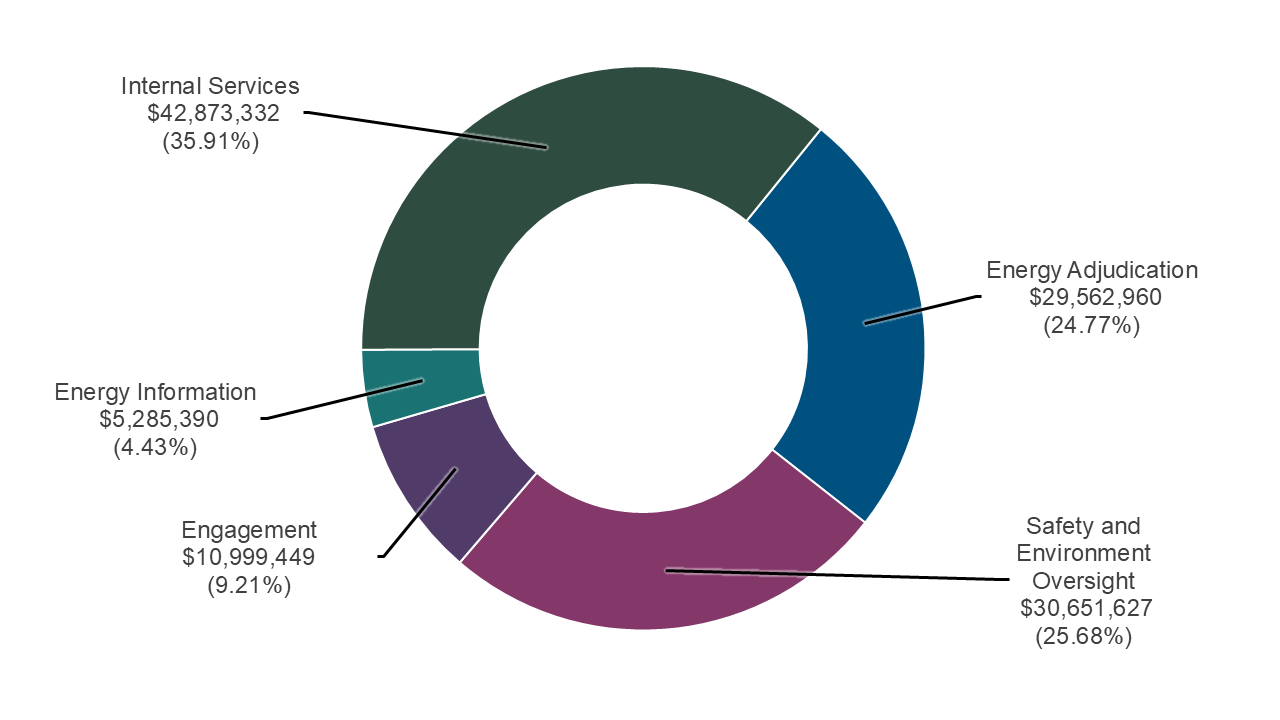
Text description of Graph 1
Core responsibilities and internal services |
2026-27 planned spending |
|---|---|
Energy Adjudication |
$29,562,960 |
Safety and Environment Oversight |
$30,651,627 |
Energy Information |
$5,285,390 |
Engagement |
$10,999,449 |
Internal Services |
$42,873,332 |
Analysis of planned spending by core responsibility
This graph shows 2026-27 spending by core responsibility and internal services.
- Energy Adjudication: $29,562,960 (24.77%)
- Safety and Environment Oversight: $30,651,627 (25.68%)
- Energy Information: $5,285,390 (4.43%)
- Engagement: $10,999,449 (9.21%)
- Internal services: $42,873,332 (35.91%)
Budgetary performance summary
Table 15: Three-year spending summary for core responsibilities and internal services (dollars)
Core responsibilities and internal services |
2023–24 Actual Expenditures |
2024–25 Actual Expenditures |
2025–26 Forecast Spending |
|---|---|---|---|
Energy Adjudication |
24,241,323 |
28,840,434 |
30,654,582 |
Safety and Environment Oversight |
26,092,375 |
32,187,203 |
29,526,505 |
Energy Information |
7,428,212 |
9,097,121 |
7,829,281 |
Engagement |
9,555,679 |
9,829,606 |
9,661,885 |
Subtotal |
67,317,589 |
79,954,364 |
77,672,253 |
Internal Services |
46,350,676 |
51,008,469 |
47,408,243 |
Total |
113,668,265 |
130,962,833 |
125,080,496 |
Analysis of the past three years of spending
Variance between 2023-24 actual expenditures and 2024-25 actual expenditures
The 2024-25 actual spending is $17.29 million higher than the 2023-24 actual spending, and the variance is primarily due to:
- an increase of $7.05 million primarily related to Collective Agreement renewal and other compensation adjustments including changes to terms and conditions of service or employment in the federal public administration.
- an increase of $5.61 million mainly related to changes to support evolving organizational priorities and requirements.
- an increase of $4.27 million related to Grants and Contributions.
- an increase of $1.80 million related to 2024-25 employee benefit plan costs.
- an increase of $1.49 million related to Budget 2024 funding for Indigenous Advisory and Monitoring Committees.
- a decrease of $2.93 million related to Budget 2022 funding for regulatory renewal activities as well as funding to implement the Impact Assessment Act.
Variance between 2024-25 actual expenditures and 2025-26 forecast spending
The 2025-26 forecast spending is $5.88 million lower than the 2024-25 actual spending, and the variance is primarily due to:
- an increase of $7.49 million related to Budget 2025 funding for innovative data and information management, as well as funding for net-zero energy modeling.
- an increase of $0.87 million mainly related to operational budget carry forward to support organizational priorities and requirements.
- an increase of $0.09 million related to employee benefit plan costs.
- a decrease of $7.05 million primarily related to Collective Agreement renewal and other compensation adjustments including changes to terms and conditions of service or employment in the federal public administration.
- a decrease of $6.62 million related to Budget 2022 funding for regulatory renewal activities as well as funding to implement the Impact Assessment Act.
- a decrease of $0.66 million related to Grants and Contributions.
More financial information from previous years is available on the Finances section of GC Infobase.
Table 16: Planned three-year spending on core responsibilities and internal services (dollars)
Core responsibilities and internal services |
2026-27 Planned Spending |
2027-28 Planned Spending |
2028-29 Planned Spending |
|---|---|---|---|
Energy Adjudication |
29,562,960 |
26,808,652 |
19,670,325 |
Safety and Environment Oversight |
30,651,627 |
29,456,903 |
24,964,926 |
Energy Information |
5,285,390 |
5,195,994 |
5,163,215 |
Engagement |
10,999,449 |
9,669,987 |
5,214,965 |
Subtotal |
76,499,426 |
71,131,536 |
55,013,431 |
Internal Services |
42,873,332 |
42,214,569 |
39,546,531 |
Total |
119,372,758 |
113,346,105 |
94,559,962 |
Analysis of the next three years of spending
Variance between 2026-27 planned spending and 2027-28 planned spending
The 2027-28 planned spending is $6.03 million lower than the 2026-27 planned spending primarily related to:
- a decrease of $4.20 million related to Grants and Contributions.
- a decrease of $1.57 million primarily related to Collective Agreement renewal and other compensation adjustments including changes to terms and conditions of service or employment in the federal public administration.
- a decrease of $0.26 million related to employee benefits plan costs.
Variance between 2027-28 planned spending and 2028-29 planned spending
The 2028-29 planned spending is $18.79 million lower than the 2027-28 planned spending primarily related to:
- a decrease of $11.80 million related to Budget 2022 funding for regulatory renewal activities, as well as funding to implement the Impact Assessment Act.
- a decrease of $5.34 million related to Grants and Contributions.
- a decrease of $1.65 million mainly related to employee benefits plan costs.
More detailed financial information on planned spending is available on the Finances section of GC Infobase.
Funding
This section provides an overview of the department's voted and statutory funding for its core responsibilities and for internal services. For further information on funding authorities, consult the Government of Canada budgets and expenditures.
Graph 2 summarizes the department's approved voted and statutory funding from 2023-24 to 2028-29.
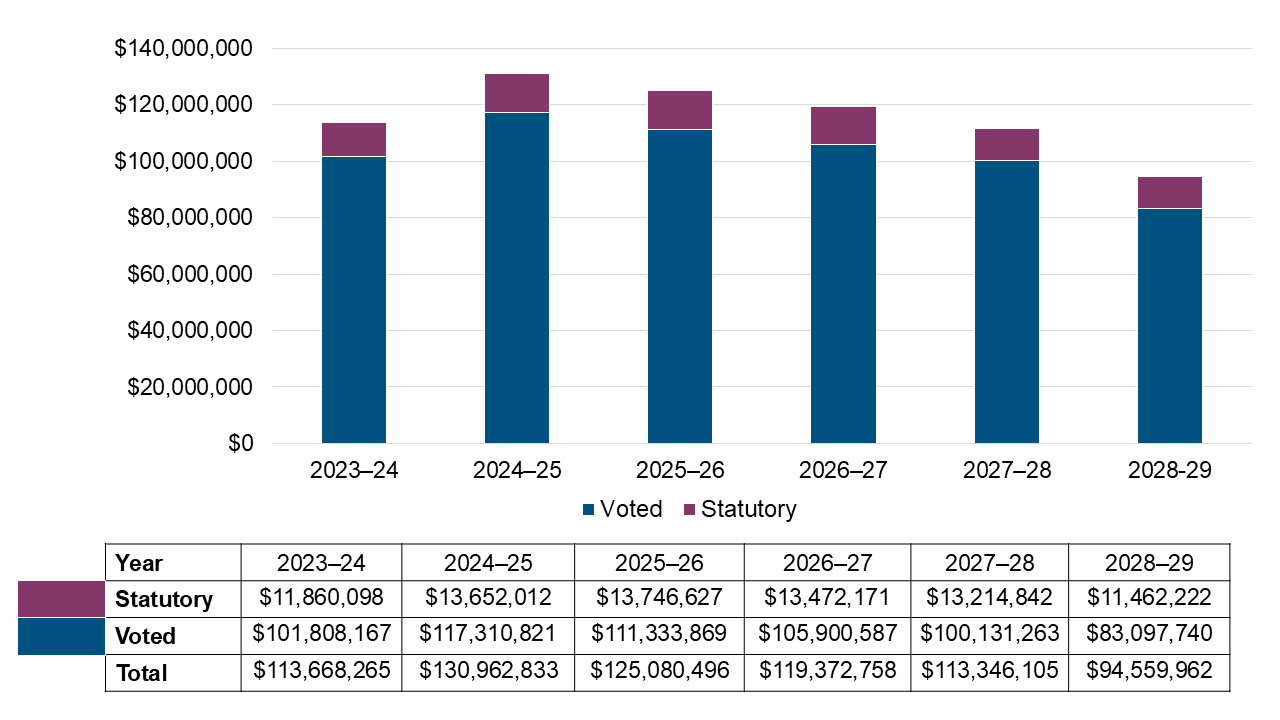
Text description of Graph 2
Fiscal year |
Total |
Voted |
Statutory |
|---|---|---|---|
2023-24 |
$113,668,265 |
$101,808,167 |
$11,860,098 |
2024-25 |
$130,962,833 |
$117,310,821 |
$13,652,012 |
2025-26 |
$125,080,496 |
$111,333,869 |
$13,746,627 |
2026-27 |
$119,372,758 |
$105,900,587 |
$13,472,171 |
2027-28 |
$113,346,105 |
$100,131,263 |
$13,214,842 |
2028-29 |
$94,559,962 |
$83,097,740 |
$11,462,222 |
Analysis of statutory and voted funding over a six-year period
This bar graph shows the CER’s six-year spending trend. It includes actual spending for the fiscal years 2023-24 and 2024-25, forecast spending for the year 2025-26 and planned spending for the years 2026-27 to 2028-29. Amounts are depicted by Voted and Statutory amounts. An explanation of spending variances is provided in Table 15: Three-year spending summary for core responsibilities and internal services and Table 16: Planned three-year spending on core responsibilities and internal services.
For further information on Canada Energy Regulator’s departmental appropriations, consult the 2026-27 Main Estimates.
Future-oriented condensed statement of operations
The future-oriented condensed statement of operations provides an overview of Canada Energy Regulator’s operations for 2025-26 to 2026-27.
Table 17: Future-oriented condensed statement of operations for the year ended March 31, 2027 (dollars)
Financial information |
2025–26 Forecast results |
2026–27 Planned results |
Difference (Planned results minus forecasted) |
|---|---|---|---|
Total expenses |
140,344,374 |
134,636,636 |
(5,707,738) |
Total revenues |
– |
– |
– |
Net cost of operations before government funding and transfers |
140,344,374 |
134,636,636 |
(5,707,738) |
Analysis of forecasted and planned results
Variance between 2025-26 forecast results and 2026-27 planned results
The 2026-27 planned results are $5.71 million lower than the 2025-26 forecast results mainly due to:
- an increase of $4.12 million related to Grants and Contributions.
- an increase of $1.50 million related to Budget 2022 funding for regulatory renewal activities as well as funding to implement the Impact Assessment Act.
- a decrease of $7.76 million related to Budget 2025 funding for innovative data and information management, as well as funding for net-zero energy modeling.
- a decrease of $1.61 million mainly related to operational budget carry forward.
- a decrease of $1.47 million related to Budget 2024 funding for Indigenous Advisory and Monitoring Committees.
- a decrease of $0.49 million related to employee benefit plan costs.
A more detailed Future-Oriented Statement of Operations and associated Notes for 2026-27, including a reconciliation of the net cost of operations with the requested authorities, is available on Canada Energy Regulator’s website.
Human resources
This section presents an overview of the department’s actual and planned human resources from 2023-24 to 2028-29.
Table 18: Actual human resources for core responsibilities and internal services
Core responsibilities and Internal services |
2023–24 Actual full-time equivalents |
2024–25 Actual full-time equivalents |
2025–26 Forecasted full-time equivalents |
|---|---|---|---|
Energy Adjudication |
120.1 |
117.6 |
123.6 |
Safety and Environment Oversight |
138.6 |
140.3 |
143.0 |
Energy Information |
40.6 |
44.5 |
41.0 |
Engagement |
46.2 |
47.3 |
44.6 |
Subtotal |
345.5 |
349.7 |
352.2 |
Internal Services |
225.4 |
230.5 |
229.3 |
Total |
570.9 |
580.2 |
581.5 |
Analysis of human resources over the last three years
Variance between 2023-24 actual full-time equivalents and 2024-25 actual full-time equivalents
The increase of 9.3 full-time equivalents from 2023-24 to 2024-25 is primarily due to:
- an increase of 23.0 full-time equivalents due to changes across the organization to meet operational requirements.
- an increase of 9.6 full-time equivalents related to Budget 2024 funding for Indigenous Advisory and Monitoring Committees.
- a decrease of 23.3 full-time equivalents related to Budget 2022 funding for regulatory renewal activities, as well as funding to implement the Impact Assessment Act.
Variance between 2024-25 actual full-time equivalents and 2025-26 forecast full-time equivalents
The increase of 1.3 full-time equivalents from 2024-25 to 2025-26 is primarily due to:
- an increase of 39.1 full-time equivalents related to Budget 2025 funding for innovative data and information management, as well as funding for net-zero energy modeling.
- a decrease of 37.1 full-time equivalents related to Budget 2022 funding for regulatory renewal activities, as well as funding to implement the Impact Assessment Act.
- a decrease of 0.7 full-time equivalents due to changes across the organization to meet operational requirements.
Table 19: Human resources planning summary for core responsibilities and internal services
Core responsibilities and internal services |
2026–27 Planned full-time equivalents |
2027–28 Planned full-time equivalents |
2028–29 Planned full-time equivalents |
|---|---|---|---|
Energy Adjudication |
122.7 |
117.7 |
97.8 |
Safety and Environment Oversight |
144.9 |
142.2 |
128.2 |
Energy Information |
36.9 |
37.3 |
37.3 |
Engagement |
41.2 |
33.1 |
22.2 |
Subtotal |
345.7 |
330.3 |
285.5 |
Internal Services |
213.7 |
205.1 |
193.9 |
Total |
559.4 |
535.4 |
479.4 |
Analysis of human resources over the last three years
Variance between 2026-27 planned full-time equivalents and 2027-28 planned full-time equivalents
The decrease of 23.95 full-time equivalents from 2026-27 to 2027-28 is primarily due to:
- a decrease of 10.53 full-time equivalents due to changes across the organization to meet operational requirements.
- a decrease of 13.42 full-time equivalents related to Budget 2022 funding for regulatory renewal activities, as well as funding to implement the Impact Assessment Act.
Variance between 2027-28 planned full-time equivalents and 2028-29 planned full-time equivalents
The decrease of 56.0 full-time equivalents from 2027-28 to 2028-29 is primarily due to:
- a decrease of 50.92 full-time equivalents related to the loss of funding from Budget 2022 for regulatory renewal activities, as well as to implement the Impact Assessment Act.
- a decrease of 5.08 full-time equivalents due to changes across the organization to meet operational requirements.
Supplementary information tables
The following supplementary information tables are available on Canada Energy Regulator’s website:
Information on Canada Energy Regulator’s departmental sustainable development strategy can be found on Canada Energy Regulator’s website.
Federal tax expenditures
Canada Energy Regulator’s Departmental Plan does not include information on tax expenditures.
The tax system can be used to achieve public policy objectives through the application of special measures such as low tax rates, exemptions, deductions, deferrals and credits. The Department of Finance Canada publishes cost estimates and projections for these measures each year in the Report on Federal Tax Expenditures.
This report also provides detailed background information on tax expenditures, including descriptions, objectives, historical information and references to related federal spending programs as well as evaluations and GBA Plus of tax expenditures.
Corporate information
Departmental profile
Appropriate minister(s): The Honourable Tim Hodgson, P.C., M.P.
Institutional head: Tracy Sletto
Ministerial portfolio: Energy and Natural Resources
Enabling instrument(s): Canadian Energy Regulator Act
Year of incorporation / commencement: 2019
Other: The CER Act came into force on 28 August 2019.
Departmental contact information
Headquarters – Calgary
Mailing address:
210-517 10 Ave SW
Calgary AB T2R 0A8
Telephone:
Office: 403-292-4800
Toll free: 1-800-899-1265
Fax: 403-292-5503
Toll free fax: 1-877-288-8803
Email: info@cer-rec.gc.ca
Definitions
List of terms
appropriation (crédit)
Any authority of Parliament to pay money out of the Consolidated Revenue Fund.
budgetary expenditures (dépenses budgétaires)
Operating and capital expenditures; transfer payments to other levels of government, departments or individuals; and payments to Crown corporations.
core responsibility (responsabilité essentielle)
An enduring function or role performed by a department. The intentions of the department with respect to a core responsibility are reflected in one or more related departmental results that the department seeks to contribute to or influence.
Departmental Plan (plan ministériel)
A report on the plans and expected performance of an appropriated department over a 3 year period. Departmental Plans are usually tabled in Parliament each spring.
departmental result (résultat ministériel)
A consequence or outcome that a department seeks to achieve. A departmental result is often outside departments’ immediate control, but it should be influenced by program-level outcomes.
departmental result indicator (indicateur de résultat ministériel)
A quantitative measure of progress on a departmental result.
departmental results framework (cadre ministériel des résultats)
A framework that connects the department’s core responsibilities to its departmental results and departmental result indicators.
Departmental Results Report (rapport sur les résultats ministériels)
A report on a department’s actual accomplishments against the plans, priorities and expected results set out in the corresponding Departmental Plan.
full-time equivalent (équivalent temps plein)
A measure of the extent to which an employee represents a full person-year charge against a departmental budget. For a particular position, the full-time equivalent figure is the ratio of number of hours the person actually works divided by the standard number of hours set out in the person’s collective agreement.
gender-based analysis plus (GBA Plus) (analyse comparative entre les sexes plus [ACS Plus])
Is an analytical tool used to support the development of responsive and inclusive policies, programs, and other initiatives. GBA Plus is a process for understanding who is impacted by the issue or opportunity being addressed by the initiative; identifying how the initiative could be tailored to meet diverse needs of the people most impacted; and anticipating and mitigating any barriers to accessing or benefitting from the initiative. GBA Plus is an intersectional analysis that goes beyond biological (sex) and socio-cultural (gender) differences to consider other factors, such as age, disability, education, ethnicity, economic status, geography (including rurality), language, race, religion, and sexual orientation.
Using GBA Plus involves taking a gender- and diversity-sensitive approach to our work. Considering all intersecting identity factors as part of GBA Plus, not only sex and gender, is a Government of Canada commitment.
government priorities (priorités gouvernementales)
For the purpose of the 2026-27 Departmental Plan, government priorities are the high-level themes outlining the government’s agenda in the 2025 Speech from the Throne.
horizontal initiative (initiative horizontale)
An initiative where two or more federal departments are given funding to pursue a shared outcome, often linked to a government priority.
Indigenous business (entreprise autochtones)
Requirements for verifying Indigenous businesses for the purposes of the departmental result report are available through the Indigenous Services Canada Mandatory minimum 5% Indigenous procurement target website.
non‑budgetary expenditures (dépenses non budgétaires)
Non-budgetary authorities that comprise assets and liabilities transactions for loans, investments and advances, or specified purpose accounts, that have been established under specific statutes or under non-statutory authorities in the Estimates and elsewhere. Non-budgetary transactions are those expenditures and receipts related to the government's financial claims on, and obligations to, outside parties. These consist of transactions in loans, investments and advances; in cash and accounts receivable; in public money received or collected for specified purposes; and in all other assets and liabilities. Other assets and liabilities, not specifically defined in G to P authority codes are to be recorded to an R authority code, which is the residual authority code for all other assets and liabilities.
performance (rendement)
What a department did with its resources to achieve its results, how well those results compare to what the department intended to achieve, and how well lessons learned have been identified.
performance indicator (indicateur de rendement)
A qualitative or quantitative means of measuring an output or outcome, with the intention of gauging the performance of a department, program, policy or initiative respecting expected results.
plan (plan)
The articulation of strategic choices, which provides information on how a department intends to achieve its priorities and associated results. Generally, a plan will explain the logic behind the strategies chosen and tend to focus on actions that lead to the expected result.
planned spending (dépenses prévues)
For Departmental Plans and Departmental Results Reports, planned spending refers to those amounts presented in Main Estimates.
A department is expected to be aware of the authorities that it has sought and received. The determination of planned spending is a departmental responsibility, and departments must be able to defend the expenditure and accrual numbers presented in their Departmental Plans and Departmental Results Reports.
program (programme)
Individual or groups of services, activities or combinations thereof that are managed together within the department and focus on a specific set of outputs, outcomes or service levels.
program inventory (répertoire des programmes)
Identifies all the department’s programs and describes how resources are organized to contribute to the department’s core responsibilities and results.
result (résultat)
A consequence attributed, in part, to a department, policy, program or initiative. Results are not within the control of a single department, policy, program or initiative; instead they are within the area of the department’s influence.
statutory expenditures (dépenses législatives)
Expenditures that Parliament has approved through legislation other than appropriation acts. The legislation sets out the purpose of the expenditures and the terms and conditions under which they may be made.
target (cible)
A measurable performance or success level that a department, program or initiative plans to achieve within a specified time period. Targets can be either quantitative or qualitative.
voted expenditures (dépenses votées)
Expenditures that Parliament approves annually through an appropriation act. The vote wording becomes the governing conditions under which these expenditures may be made.
- Date modified: