
Canada Energy Regulator 2024–25 Departmental Results Report
On this page
- At a glance
- Message from the Chairperson
- Message from the CEO
- Results – what we achieved
- Core responsibility 1: Energy Adjudication
- Core responsibility 2: Safety and Environment Oversight
- Core responsibility 3: Engagement
- Core responsibility 4: Energy Information
- Internal services
- Spending and human resources
- Supplementary information tables
- Federal tax expenditures
- Corporate information
- Definitions
Copyright/Permission to Reproduce
ISSN 2563-3244
At a glance
This departmental results report details the Canada Energy Regulator’s (CER) actual accomplishments against the plans, priorities and expected results outlined in its 2024-25 Departmental Plan.
Key priorities
The CER identified the following key priorities for 2024-25 as part of its 2024-27 Strategic Plan:
- Trust and Confidence: We foster the trust and confidence of Canadians by effectively delivering on our mission with safety at the forefront. We engage and empower our diverse workforce. We strengthen relationships that uphold the rights and interests of First Nations, Inuit and Métis, and we communicate transparently and engage meaningfully with all our stakeholders.
- Reconciliation and Implementing the UN Declaration: We are implementing the United Nations (UN) Declaration on the Rights of Indigenous Peoples (UN Declaration) and delivering on the commitments made in the UN Declaration Act Action Plan. We do so based on the recognition of rights, respect, co-operation and partnership, by working together with First Nations, Inuit and Métis governments, communities, and organizations. We continue to build the cultural intelligence of the CER.
- Competitiveness and Regulatory Excellence: We enhance Canada’s global competitiveness through leadership in regulatory innovation and best practices, focusing on cost-effectiveness, transparency, predictability, timeliness and efficiency of regulatory processes.
- Preparing for the Energy Future: We inform the energy transition by offering expertise and insight as the energy system transitions to a net zero economy across Canada. We focus on energy innovation, security, competitiveness, and safe and reliable energy transmission infrastructure that is resilient to the effects of climate change.
Highlights for the CER in 2024-25
- Total actual spending (including internal services): $130,962,833
- Total full-time equivalent staff (including internal services): 580.2
For complete information on the CER’s total spending and human resources, read the Spending and human resources section of its full departmental results report.
Summary of results
The following provides a summary of the results the department achieved in 2024-25 under its main areas of activity, called “core responsibilities.”
-
Core responsibility 1: Energy Adjudication
- Actual spending: $28,840,434
- Actual human resources: 117.6
This year, the Commission released 606 decisions on applications related to infrastructure, tolls and tariffs, export licences and orders, frontier exploration and production, leave to open orders and other matters that spanned the energy infrastructure lifecycle. The CER continued to explore ways to improve the predictability, transparency, and efficiency of application assessments through this core responsibility. We engaged with Indigenous Peoples, regulated industry, landowners, and other stakeholders as we update the Environmental and Socio-economic Assessment and Lands Sections of the Filing Manual. To enhance transparency in the adjudicative process, the CER Portal will combine and expand existing tools and provide a user-friendly interface for timely access to regulatory documents and support efficiency for all participants. Phase 1 of the project launched in 2024-25 to improve internal workflows for routine facility applications under section 214 of the Canadian Energy Regulator Act (CER Act). We completed early engagement and conducted supplemental Crown consultation activities with 70 Indigenous communities on Westcoast Energy Inc.’s application for the Sunrise Expansion Program and with 36 Indigenous communities on Pouce Coupé’s Pipe Line Ltd.’s Taylor to Gordondale Project. This engagement supports meaningful involvement in the CER’s regulatory processes, to build enduring relationships based on a recognition of rights and resolve issues early and outside of the hearing process, where possible.
For information on the CER’s Energy Adjudication core responsibility, read the “Results – what we achieved” section of its Departmental Results Report.
-
Core responsibility 2: Safety and Environment Oversight
- Actual spending: $32,187,203
- Actual human resources: 140.3
Preventing harm is the foundation of how the CER keeps people safe and protects the environment, and we will continue to enforce strict safety and environmental standards through this core responsibility. The CER continued to carry out its current three-year safety culture strategy and workplan, focusing on system-wide influence and company performance, and promoted learning via its Learning Portal. The CER continued to support and enable Indigenous monitors to bring Indigenous perspectives into our work and enhance our oversight tools. In 2024-25, the CER conducted 249 compliance verification activities, of which 38 involved Indigenous Monitors. Improving the application of enforcement tools and related processes will support us in promoting compliance and improving safety and environmental outcomes. This year we began a three-year project to review and clarify the tools and interventions used by the CER to promote, verify, and enforce compliance with regulatory requirements. We continued our review of the Onshore Pipeline Regulations (OPR), providing grants and contributions funding to 46 Indigenous-led organizations to enable engagement on the project. CER staff created clear processes for managing orphan pipelines regulated by the CER through its Orphan Pipeline Initiative. Work is underway to establish a long-term funding solution for abandonment activities associated with orphan pipelines.
For information on the CER’s Safety and Environment Oversight core responsibility, read the “Results – what we achieved” section of its Departmental Results Report.
-
Core responsibility 3: Engagement
- Actual spending: $9,829,606
- Actual human resources: 47.3
The CER’s Indigenous Cultural Intelligence Framework guided the CER in navigating the internal transformation needed to implement the UN Declaration Act and advance Reconciliation. Through the implementation of the Framework, the CER is building its competency to create systemic changes by advancing the cultural intelligence of its staff. Based on advice from our Indigenous Advisory Committee (IAC), we also completed the National Indigenous Engagement Blueprint, which outlines best practices and tools for CER staff to engage with Indigenous communities in a meaningful way. The CER carried out significant engagement activities across the country in support of our regulatory change projects such as the OPR and Filing Manual review and updating the Rules of Practice and Procedure Regulations. In 2024-25, the CER administered $7.6 million in grant and contribution funding to Indigenous Nations participating in adjudication processes, Crown consultations, engagement with ongoing CER policy work, and to develop capacity to enable involvement in lifecycle oversight and related Indigenous monitoring committees. The CER led the establishment of a UN Declaration Act Action Plan Measure 34 (Shared Priorities) (UN Declaration Act APM SP34) Leadership Group in 2024-25, to lead the implementation by encouraging collaboration and offering strategic guidance. The CER continues to work toward a more consistent and structured way of involving Indigenous Peoples in the oversight of CER regulated energy infrastructure.
For information on the CER’s Engagement core responsibility, read the “Results – what we achieved” section of its Departmental Results Report.
-
Core responsibility 4: Energy Information
- Actual spending: $9,097,121
- Actual human resources: 44.5
This year marked the 10-year anniversary of the CER’s Market Snapshots series, with 26 published during the year, covering a wide range of topics like crude oil and natural gas production, renewable energy, electricity and energy trade. The CER launched the Content Management System for the CER’s Pipeline Profiles, allowing for a more streamlined way of generating, reviewing, and publishing profile content and updates. This launch included the publication of the final 11 interactive pipeline maps, data and visual updates, and new sections of pipeline. The CER also updated the Provincial and Territorial Energy Profiles to reflect the latest data and market events shaping each jurisdiction, including trade and greenhouse gas emissions data. The CER deferred the release of the next Canada's Energy Future report, to ensure the next report would continue to be timely, relevant and neutral, and reflective of the significant shifts in North American energy markets and policy context that characterized the first months of 2025. We continued to publish various statistics updates including exports of natural gas and liquefied natural gas, exports of natural gas liquids, exports of crude oil and refined petroleum products and imports and exports of electricity.
For information on the CER’s Energy Information core responsibility, read the “Results – what we achieved” section of its Departmental Results Report.
Message from the Chairperson
As the Chairperson of the CER Board of Directors, I am pleased to present the CER’s Departmental Results Report for 2024-25. As we navigate an increasingly dynamic and evolving energy landscape, the Board remains dedicated to providing strong advice and direction and supporting the organization to fulfill its mandate with excellence.
In 2024, the CER celebrated its fifth anniversary. This is an important milestone in the ongoing evolution of the organization as a modern regulator. The launch of the CER Act in August 2019 established the CER as Canada’s energy regulator with new authorities and responsibilities.
Over the past five years, the Board has seen the organization develop, strengthen its relationships with diverse communities and embrace new and innovative ways in how its work is undertaken.
Building on the last five years, the Board set the strategic priorities of the organization at the start of the 2024-25 fiscal year as: Trust and Confidence, Reconciliation and implementing the UN Declaration, Competitiveness and Regulatory Excellence, and Preparing for the Energy Future. The organization moved these priorities forward with clear and tangible success as you will read in the report that follows. This includes, for example, our OPR and Filing Manual Review, our collaborative work with the IAC on UN Declaration Act APM SP34, and the energy information that we provide to Canadians.
This year’s achievements reflect the organization’s ability to adapt, lead, and build on its strengths. I commend the team on their focus on enhancing efficiency and streamlining decision-making. The CER Portal is a great example of their efforts that are already helping to reduce timelines and improve regulatory effectiveness. The commitment and dedication of our staff and leadership have been instrumental in advancing these priorities and positioning the organization for long-term success.
In 2024-25, the Board of Directors welcomed three new members: Peter Fraser, Matthew Foss, and Annette Bergeron. Each brings extensive experience and expertise to the CER and to the Board. We also recognize and thank Karim Mahmud, Cassie Doyle, and Ellen Barry, whose terms concluded in 2024-25, for their outstanding contributions.
I have had the privilege of spending nearly the last six years as a part of the CER’s Board of Directors. In summer 2025, I announced to the CER that I would be resigning from the Board. As the first Vice-Chair and over the last two years as Chair of the Board, I have had the great pleasure to interact with many individuals in the organization. On behalf of the Board of Directors, I extend my heartfelt appreciation to the CER’s staff for their unwavering dedication and professionalism.
George Vegh
Chairperson
Board of Directors of the Canada Energy Regulator

George Vegh
Chairperson
Message from the CEO
As the Chief Executive Officer of the CER, I am incredibly proud of what we have achieved over the past year.
As Canada’s primary safety and economic energy regulator, the CER regulates pipelines, energy development and trade in the Canadian public interest. We ensure energy projects are built, operated, and abandoned safely. Safety and environmental protection are at the core of what we do.
We continue to innovate in how we meet our mandate, finding new ways to be fast, flexible, efficient and transparent. A key part of our success has been our ongoing commitment to streamline and improve how we work. This ensures that we stay competitive and adapt to change – while still maintaining rigorous safety and environmental standards. Our readiness is evident across several areas from emergency response readiness to the review of the OPR and Filing Manual, to significant improvements in streamlining our hearing and decision-making processes and the launch of the CER Portal.
The CER builds lasting relationships with Indigenous Peoples, municipal and provincial/territorial governments and stakeholders to create the trust and confidence necessary for permitted projects to be built. We are committed to Reconciliation and implementation of the UN Declaration. We are weaving Indigenous perspectives throughout our processes. This includes our work to advance UN Declaration Act APM SP34 where the CER has a leadership role around enhancing Indigenous participation in our oversight and decision-making processes. Our goal is to build more inclusive and meaningful relationships.
As an Agent of the Crown, we are committed to continuing to explore new ways to ensure Indigenous Peoples are meaningfully consulted and engaged. By bringing Indigenous Peoples into discussions earlier and working collaboratively on solutions, we are improving both the process and its outcomes.
We remain deeply committed to regulatory excellence, ensuring that Canada’s energy sector has a clear and predictable framework for decision-making that can adapt to changes in our regulated industry as well as broader society. We are also proud to support the federal government’s initiatives to improve regulatory effectiveness and efficiency. We have made strategic investments in automation and streamlining decision-making to reduce timelines and improve regulatory effectiveness. Since 2019, the CER has assessed 4,216 infrastructure, tolls and tariffs, northern, export and other applications and met its legislated time limits for infrastructure project reviews 99 per cent of the time.
Preparing for the future of energy is a key part of our strategy. We publish timely, factual and unbiased energy information products that inform and educate policymakers, industry and everyday Canadians about the energy conversation. We regularly provide Market Snapshots that highlight emerging trends in different segments of the energy market and our Pipeline Profiles that showcase key data and information for pipelines that are regulated by the CER. We are building our ability to support energy security, resilience and innovation.
Looking ahead, we know that change is constant, and we remain focused on how shifts in the energy sector will affect everyone in the country. While we cannot predict what changes might come, we are committed to adapting to the evolving energy landscape and ensuring we are prepared to meet the needs of Canadians, Indigenous Peoples and industry. Our responsibility remains the same: ensuring safety, protecting communities and the environment and building a regulatory system that is future-ready.
I am filled with optimism and confidence in the progress we have made and the direction we are headed. Lastly, I would like to thank George Vegh, the CER’s outgoing Chairperson, for his leadership of our Board of Directors and for all of his support and guidance throughout his tenure with the Board.
With my thanks and appreciation,
Tracy Sletto
Chief Executive Officer
Canada Energy Regulator

Tracy Sletto
Chief Executive Officer
Results – what we achieved
Core responsibilities and internal services
Core responsibility 1: Energy Adjudication
In this section
Description
Making decisions or recommendations to the Governor in Council on applications, which include impact assessments, using processes that are fair, transparent, timely and accessible. These applications pertain to pipelines and related facilities, international power lines, offshore renewable energy, tolls and tariffs, compensation disputes resolution, energy exports and imports, and oil and gas exploration and drilling in certain northern and offshore areas of Canada.
Quality of Life impacts
This core responsibility contributes to:
- the “Environment” domain of the Quality of Life Framework for Canada and, more specifically, “climate change adaptationFootnote 1,” and “greenhouse gas emissions” through the assessment activities mentioned in the core responsibility description;
- the “Society” domain of the Quality of Life Framework for Canada and, more specifically, “shared valuesFootnote 2 ” through the decision-making process mentioned in the core responsibility description in alignment with the mandate reflected in the PreambleFootnote 3 of the CER Act;
- the “Prosperity” domain of the Quality of Life Framework for Canada and, more specifically, “productivity” through timely processes mentioned in the core responsibility description; and
- the “Good governance” domain of the Quality of Life Framework for Canada and, more specifically, “Indigenous self-determination” through fair, transparent and accessible processes mentioned in the core responsibility description.
Additional details on how the core responsibility contributes to the Quality of Life Framework can be found in the CER’s 2025-26 Departmental PlanFootnote 4.
Progress on results
This section details the department’s performance against its targets for each departmental result under Core responsibility 1: Energy Adjudication.
Table 1: Energy adjudication processes are fair
Table 1 shows the target, the date to achieve the target and the actual results for each indicator under Energy adjudication processes are fair in the last three fiscal years.
Departmental Result Indicator |
Target |
Date to achieve target |
Actual Results |
|---|---|---|---|
Percentage of adjudication decisions overturned on judicial appeal related to procedural fairness. |
Exactly 0% |
March 2025 |
2022–23: 0% |
Table 2: Energy adjudication processes are timely
Table 2 shows the target, the date to achieve the target and the actual results for each indicator under Energy adjudication processes are timely in the last three fiscal years.
Departmental Result Indicator |
Target |
Date to achieve target |
Actual Results |
|---|---|---|---|
Percentage of adjudication decisions and recommendations that are made within legislated time limits and service standards. |
Exactly 100% |
March 2025 |
2022–23: 100% |
Table 3: Energy adjudication processes are transparent
Table 3 shows the target, the date to achieve the target and the actual results for each indicator under Energy adjudication processes are transparent in the last three fiscal years.
Departmental Result Indicator |
Target |
Date to achieve target |
Actual Results |
|---|---|---|---|
Percentage of surveyed participants who indicate that adjudication processes are transparent. |
At least 75% |
March 2025 |
2022–23: 83% |
|
(a) The result is based on two surveys with a total of three survey respondents, of which two indicated the process was transparent (67%). |
|||
Table 4: Energy adjudication processes are accessible
Table 4 shows the target, the date to achieve the target and the actual results for each indicator under Energy adjudication processes are accessible in the last three fiscal years.
Departmental Result Indicator |
Target |
Date to achieve target |
Actual Results |
|---|---|---|---|
Percentage of surveyed participant funding recipients who agree that participant funding enabled their participation in an adjudication process. |
At least 90% |
March 2025 |
2022–23: 94% |
The Results section of the Infographic for the CER on the GC Infobase page provides additional information on results and performance related to its program inventory.
Details on results
The following section describes the results for Energy Adjudication in 2024-25 compared with the planned results set out in the CER’s departmental plan for the year.
Energy adjudication processes are fair.
Results achieved
-
Procedural Fairness
Court decisions on appeals of CER decisions or recommendations based on procedural fairness are a measure of the fairness of a process. The CER continued its strong performance in this area with no decisions overturned on judicial appeal due to procedural fairness.
-
Dispute Resolution
Dispute resolution plays a vital role in how the CER fulfills its mandate to help balance the interests of all Canadians in the stewardship of pipelines and energy development in Canada. Through various processes and methods, such as alternative dispute resolution services, the CER helps to resolve disputes between companies and rights holders, owners and users of lands, Indigenous Peoples, other orders of government, and nongovernmental organizations. Disputes relate to CER regulated facilities and activities, such as pipeline maintenance and pipeline application hearings. Disputes received this year related to agriculture, air quality, compensation, construction, damage prevention, Indigenous matters, and noise, notification. In 2024-25, the CER received 45 disputes and facilitated the resolution of 42 disputes.
Energy adjudication processes are timely.
Results achieved
-
Commission Decisions and Proceedings
During 2024-25, the Commission released 606 decisions on applications related to infrastructure, tolls and tariffs, export licences and orders, frontier exploration and production, leave to open orders and other matters that spanned the energy infrastructure lifecycle.
The Commission strives to continually improve how it works. In 2024-25, the Commission reduced the time to decision for CER Act section 214 applications through such initiatives as refining the notification process and reducing the amount of time required to determine the completeness of applications. This initiative substantially reduced the number of days from application receipt to completeness, from 78 days in 2022-23 to 35 days in 2023-24, and a further reduction to 30 days during this reporting period. Additionally, the average completion time for section 214 applications has been reduced to 111 days in 2024-25, down from 128 days in 2023-24. This significant efficiency was accomplished while still maintaining rigorous and transparent assessments.
For a summary of Commission decisions and recommendations, please see the 2024-25 Annual Report of the Commission of the Canada Energy Regulator on the CER website.
Energy adjudication processes are transparent.
Results achieved
-
Crown ConsultationFootnote 5
The CER primarily conducts Crown consultation through the Commission’s adjudication processes, where Indigenous Peoples are encouraged to participate. For certain projects, primarily those where the GIC makes the final decision, the CER, in its capacity as Crown Consultation Coordinator (CCC), conducts supplemental consultations.
In 2024-25, the CER, in its CCC role, conducted supplemental Crown consultation activities with 70 Indigenous communities on Westcoast Energy Inc.’s application for the Sunrise Expansion Program and with 36 Indigenous communities on Pouce Coupé’s Pipe Line Ltd.’s Taylor to Gordondale Project. Undertaken during the early engagement and assessment phases of these projects, the CCC met directly with Indigenous communities and filed submissions on the Commission’s hearing records. These submissions were designed to help inform the Commission’s assessment of the projects, including the projects’ impacts to rights and any accommodation measures, such as conditions. In addition, the CCC facilitated information sessions with Indigenous communities on the project applications and established federal review teams to support a holistic and comprehensive response to consultations.
Another key area of focus for the CCC in 2024-25 was to engage proponents earlyFootnote 6 and regularly to support a shared understanding of the CER’s approach to Crown consultation and the proponents’ role in the process.
-
Filing Manual Review
The CER’s Filing Manual explains what companies should include in an application for a potential project. In 2024-25, the CER continued to update its filing requirements and guidance in support of a transparent and efficient process for applicants. Proposed updates to Guide R - Transfer of Ownership, Lease, or Amalgamation were posted for public comment in late 2024. Feedback on the proposed changes is being analyzed and an updated Guide R is expected to be published in 2025.
In conjunction with the OPR ReviewFootnote 7, an extensive public engagement period was launched to review the Environment and Socio-economic Assessment (Guide A.2) and Lands (Guide A.4) sections of the Filing Manual. Updates will be informed by written comments received on 13 topic-specific discussion papers, information sessions, and workshops with industry, Indigenous communities and other interested parties. Feedback is being analyzed, and updated draft sections are expected to be available in late 2025. The Filing Manual review is a deliverable under the Competitiveness and Regulatory Excellence Strategic Priority in the CER’s Strategic Plan.
-
Cooperative Agreements
We established a Memorandum of Understanding with Environment and Climate Change Canada (ECCC) to jointly facilitate and enhance cooperation and coordination between the CER and ECCC. Work this year focused on continuing to develop the operational annexes that detail specific areas of collaboration in regulatory activities, mandates, and the sharing of resources.
Work with the Environmental Assessment Office of British Columbia to update our existing agreement was paused in 2024-25. The intent is to pursue updates that reflect greater alignment in our work as resourcing allows.
Energy adjudication processes are accessible.
-
CER Portal
The CER Portal is an online platform where regulated companies, participants and Indigenous Peoples can share information with the regulator. The CER is working on a multi-phase project to deliver enhanced user experience through an accessible, bilingual, and integrated platform that modernizes regulatory activities across the entire energy lifecycle. Phase 1 of the project launched in 2024-25 to improve internal workflows for routine facility applications under section 214 of the CER Act. The CER Portal is a deliverable under the Competitiveness and Regulatory Excellence Strategic Priority in the CER’s Strategic Plan.
-
Early Engagement Activities
In 2024-25, the CER completed early engagement activities with the public related to Pouce Coupé Pipe Line Ltd.’s Taylor to Gordondale Project and Westcoast Energy Inc.’s Sunrise Expansion Program. The CER’s early engagement activities focus on educating the public on the CER’s role as a regulator and providing information on proposed projects and how to participate in upcoming hearings, including participant funding.
Resources required to achieve results
Table 5: Snapshot of resources required for Energy Adjudication
Table 5 provides a summary of the planned and actual spending and full-time equivalents required to achieve results.
Resource |
Planned |
Actual |
|---|---|---|
Spending |
$28,730,875 |
$28,840,434 |
Full-time equivalents |
122.5 |
117.6 |
The Finances section of the Infographic for the CER on the GC Infobase page and the People section of the Infographic for the CER on the GC Infobase page provide complete financial and human resources information related to its program inventory.
Related government-wide priorities
This section highlights government priorities that are being addressed through this core responsibility.
Gender-based analysis plus
- Sections 183.2 (c), 262.2 (c) and 298.3 (c) of the CER Act outlines GBA Plus factors that must be considered in Commission recommendations to the Minister, such as health, social and economic effects, including with respect to the intersection of sex and gender with other identity factors. The CER has issued filing guidance on assessing GBA Plus requirements in applications, and staff are trained in GBA Plus to assess applications using this guidance. Updates to the guidance will be informed by engagement on the Filing Manual and OPR.
- The CER’s Technical Specialists, Technical Leaders, Hearing Managers, Process Advisors, and Socio-Economic Specialists help ensure that the CER’s early engagement activities, Dispute Resolution services, and Commission’s adjudicative processes (including Indigenous knowledge sessions) are accessible to diverse groups, including women, men, gender-diverse, and underrepresented people.
United Nations 2030 Agenda for Sustainable Development and the UN Sustainable Development Goals
More information on the CER’s contributions to Canada’s Federal Implementation Plan on the 2030 Agenda and the Federal Sustainable Development Strategy can be found in our Departmental Sustainable Development Strategy.
Program inventory
Energy Adjudication is supported by the following program:
- Infrastructure, Tolls, and Export Applications
Additional information related to the program inventory for Energy Adjudication is available on the Results page on GC InfoBase.
Core responsibility 2: Safety and Environment Oversight
In this section
Description
Setting and enforcing regulatory expectations for regulated companies over the full lifecycle - construction, operation, and abandonment - of energy-related activities. These activities pertain to pipelines and related facilities, international power lines, offshore renewable energy, tolls and tariffs, energy exports and imports, and oil and gas exploration and drilling in certain northern and offshore areas of Canada.
Quality of life impacts
This core responsibility contributes to:
- the “Environment” domain of the Quality of Life Framework for Canada and, more specifically, “ecological integrity and environmental stewardshipFootnote 8” through all of the activities mentioned in the core responsibility description;
- the “Society” domain of the Quality of Life Framework for Canada and, more specifically, “sense of pride in CanadaFootnote 9” through enhancing Indigenous participation in our safety and environment oversight activities and in alignment with the mandate reflected in the PreambleFootnote 10 of the CER Act; and
- the “Good governance” domain of the Quality of Life Framework for Canada and, more specifically, “Indigenous self-determination” through setting and enforcing regulatory expectations for regulated companies and by including Indigenous perspectives in the CER’s safety and environment oversight programs, including the regulatory framework.
Additional details on how the core responsibility contributes to the Quality of Life Framework can be found in the CER’s 2025-26 Departmental Plan.
Progress on results
This section details the department’s performance against its targets for each departmental result under Core responsibility 2: Safety and Environment Oversight.
Table 1: Harm to people or the environment, throughout the lifecycle of energy-related activities, is prevented
Table 1 shows the target, the date to achieve the target and the actual results for each indicator under Harm to people or the environment, throughout the lifecycle of energy-related activities, is prevented in the last three fiscal years.
Departmental Result Indicator |
Target |
Date to achieve target |
Actual Results |
|---|---|---|---|
| Number of serious injuries and fatalities related to regulated infrastructure. | Exactly 0 | March 2025 | 2022–23: 21(a) 2023–24: 9(b) 2024–25: 5(c) |
| Number of incidents related to regulated infrastructure that harm the environment. | Exactly 0 | March 2025 | 2022–23: 28(a) 2023–24: 26(a) 2024–25: 6(c) |
| Percentage of unauthorized activities on regulated infrastructure that involve repeat violators. | At most 15% | March 2025 | 2022–23: 16%(a) 2023–24: 11% 2024–25: 15% |
|
(a) Please consult the 2022-23 Departmental Results Report for details on previous missed target results. (b) Please consult the 2023-24 Departmental Results Report for details on previous missed target results. (c) In 2024-25, there were no fatalities related to regulated infrastructure. The number of serious injury incidents decreased by 44 per cent compared to the previous fiscal year, and the number of incidents that harmed the environment decreased by 77 per cent compared to the previous fiscal year. These decreases align with a corresponding decrease in pipeline construction activity. |
|||
The Results section of the Infographic for the CER on the GC Infobase page provides additional information on results and performance related to its program inventory.
Details on results
The following section describes the results for Safety and Environment Oversight in 2024-25 compared with the planned results set out in the CER’s departmental plan for the year.
Harm to people or the environment, throughout the lifecycle of energy-related activities, is prevented.
Results achieved
-
Compliance Verification Activities
The CER’s aim is zero incidents, meaning there is no harm to people, property or the environment resulting from the energy infrastructure it regulates. The CER uses a risk-based approach in planning and conducting Compliance Verification Activities (CVAs). CVAs are a check at one point in time that a company is meeting requirements in acts, regulations, and conditions of a project’s approval, certificate, order, or permit. When the activities of regulated companies have the potential to pose greater harm to people or the environment, the CER increases oversight through engagement, inspections, investigations, audits, and enforcement.
In 2024-25, the CER conducted 249 CVAs, including:
- 106 inspections
- 22 emergency response exercises
- six management system audits
- 111 compliance meetings
- four manual reviews
In addition to CVAs, the CER provides oversight in other ways, such as:
- Analyses of the root causes of incidents and responses to emergencies when they happen.
- Examination of conditions of authorizations (e.g., orders and certificates).
- Reviews of Operations and Maintenance notifications.
- Reviews of contaminated sites documentation.
-
Indigenous Monitoring
The CER’s Indigenous monitoring program strengthens safety and environmental oversight to more holistically prevent harm, help protect Indigenous rights and interests and build relationships with Indigenous communities. The CER completed a total of 38 CVAs with Indigenous Monitors in 2024-25. There were 32 CVAs completed on the Trans Mountain Expansion Project, one on Enbridge Line 3, and five on the Nova Gas Transmission Ltd. system. Inspection Officers and Indigenous Monitors completed 30 field inspections and five meetings on Environmental Protection, Safety, and Socio-Economic disciplines. Indigenous Monitors also participated in three emergency response exercises.
-
Remediation Oversight
When contamination that could harm the environment or human health is identified, the CER ensures that the right steps are taken for its remediation. Remediation oversight activities in 2024-25 included the oversight of 478 active contaminated sites under CER jurisdiction. Staff conducted 12 CVAs, reviewed 460 contaminated sites Annual Updates, completed reviews of 10 Remedial Action Plans and Risk Management Plans, and closed 25 contaminated site files.
Improvements to the CER’s Remediation Process in 2024-25 included enhancing the CER’s Online Event Reporting System to improve contaminated site data and the risk-based approach to oversight.
-
Safety and Information Advisories
The CER works to improve safety outcomes by sharing important information with industry about identified safety or environmental concerns with the goal of preventing similar incidents from occurring. Safety Advisories are issued periodically to highlight specific CER requirements and emphasize the CER’s expectation that regulated companies take appropriate actions to mitigate any potential impacts to people or the environment. Information advisories are issued to share learnings from CER’s compliance oversight.
In 2024-25, the CER issued one Safety Advisories regarding nonconforming components in Pipelines and Materials Quality Assurance. In addition, the CER issued one Information Advisory, which shared common findings from 2024-25 management system audits.
-
Security
The CER’s Security team conducted 17 CVAs in 2024-25, five of which focused on cyber security. Cyber security CVAs have continued to focus on security measures that regulated companies have implemented on operational technology. The CER continued to work on maturing its cyber and physical security CVA processes through formalized cyber security training for our staff and collaborating with regulatory and security agencies in Canada and the United States.
-
Emergency Management
The CER expects the companies it regulates to do everything they can to keep their regulated infrastructure safe, which includes being ready in case of an emergency. In an emergency, the CER makes sure that companies respond to protect people, property, and the environment. In 2024-25, the Emergency Management Program conducted 45 CVAs, which included 26 exercise evaluations, seven inspections, three compliance meetings, six emergency procedures manual reviews, and supported three audits. In June 2024, the CER issued Industry Best Practices for Involvement of Indigenous Nations and Communities in Emergency Management. These best practices advance Reconciliation with Indigenous Peoples and provide a further opportunity for the CER, regulated companies, and First Nations, Inuit and Métis communities to foster stronger relationships through emergency management.
Through its incident line, and supported by its Emergency Operations Centre (EOC), the CER maintains 24-hour capacity to respond to emergencies or monitor activities that could evolve and require deployment of CER staff. In April 2024, the EOC was activated and a field response team was deployed to an incident on the Nova Gas Transmission Ltd. Grand Prairie Mainline. During the year, the EOC was also activated as a precaution to monitor line fill activities following the completion of construction of the Trans Mountain Expansion Project and certain flooding and wildfires with potential to impact regulated infrastructure.
-
Safety Culture
The CER is working to improve safety culture (SC) across the pipeline industry. In 2024-25, the CER continued to carry out its current three-year SC strategy and workplan, focusing on two goals:
- System-wide influence - The CER will take a system-wide approach to influencing a positive SC across industry that supports effective management of threats to people and the environment.
- Company performance - The CER will enhance company understanding and detection of underlying human and organizational factors (HOF) to support improved risk management and SC maturity.
CER staff continue to build their skills in this area by taking part in workshops and community sessions on SC and HOF. The CER also improved its industry-focused Learning Portal by adding interactive e-learning modules on SC and supported learning across the industry through its annual technical workshop with regulated companies.
-
Regulatory Framework
The CER is dedicated to having a Regulatory Framework that is robust, clear, transparent, coherent and consistent. To achieve this goal, the CER works with many different stakeholders to improve regulatory tools¬¬ – ensuring regulations that are in force remain appropriate and that regulatory documents, policies and guidance achieve their intended purpose.
Improvements in 2024-25 included publishing the CER’s 2024 Revised Event Reporting Guidelines, publishing draft regulations related to the Export and Import Regulatory Framework, and advancing work on Predictable and Efficient Processing and Assessment of Negligible Risk and Low-Risk Projects (renamed this year to the Rapid Review Process). The CER also started its review of the Rules of Practice and Procedure through engagement activities.
Information about the CER’s annual planned initiatives to improve the Regulatory Framework can be found on the CER’s website under Regulatory Framework Plan.
-
Onshore Pipeline Regulations (OPR) Review
The OPR are the main regulations the CER uses to oversee pipelines in Canada. The CER is undertaking a comprehensive review of the OPR, along with its Filing Manual. Both the OPR and Filing Manual review are deliverables under the Competitiveness and Regulatory Excellence Strategic Priority in the CER’s Strategic Plan. Phase 2 of the OPR review began in June 2024 with the release of 13 technical topic papers. A total of $2.6 million was provided through grants and contributions to 46 Indigenous-led organizations to hold engagement sessions for the project. Engagement activities for Phase 2 were designed to gather feedback on new requirements and commitments introduced through the UN Declaration Act and UN Declaration Act APM SP34 respectively.
From June 2024 to March 2025, the CER led workshops and information sessions with industry and heritage resource protection experts. The engagement period closed 31 March 2025. Submissions from Indigenous-led organizations, industry, and interested stakeholders will inform potential improvements to the OPR, the Filing Manual and other related guidance and internal processes. Feedback submitted will be posted publicly on the CER’s website in 2025-26.
-
Review and Clarification of Compliance Framework
In 2024-25, the CER initiated a three-year project to review and clarify the tools and interventions used by the CER to promote, verify, and enforce compliance with regulatory requirements. This will lead to an updated internal compliance and enforcement framework and policy. The framework review is a deliverable under the Competitiveness and Regulatory Excellence Strategic Priority in the CER’s Strategic Plan.
-
Audits and Enforcement
- Management System Audits
Audits evaluate how a company manages its activities. The CER expects regulated companies to have effective management systems and protection programs. Companies that manage their activities well can better anticipate, prevent, and mitigate issues that can affect safety, security, and the environment.
After the CER completes an audit, it makes the report public. The audited company must then submit a Corrective and Preventative Action Plan and the CER will verify how the plan has been implemented. The CER expects all companies to consider and review the findings in these reports (which are summarized annually and issued as an Information Advisory) and use these learnings to improve their own management systems.
In 2024-25, the CER conducted six management system audits. These audits assessed compliance with management system requirements related to emergency management, annual reporting and environmental protection programs, with a focus on lifecycle transition from construction to operations.
- Inspection Officer Orders
An Inspection Officer Order is issued when a situation requires immediate action to maintain safety and protect the environment. The Order will require a company to complete certain actions by a set date.
In 2024-25, the CER issued seven Inspection Officer Orders. All Inspection Officer Orders (current and historical) and their status are available on the CER website.
- Warning Letters and Administrative Monetary Penalties
The CER, on occasion, determines that it is important that an accountable officer in a company is aware of the seriousness of an issue and will use a warning letter to do this. A warning letter is typically issued after other tools have been used such as a notice of non-compliance and/or Inspection Officer Order when an Inspection Officer thinks that seriousness of an offense warrants referral to an enforcement investigation. It is also used in areas such as export permits where Inspection Officer Orders are not used or for repeat non-compliances by third parties that are not typically the focus of compliance oversight.
In 2024-25, the CER issued 18 Warning Letters, which is higher than usual due to the number of Warning Letters issued this year to address compliance with the Export and Import Regulations filing requirements. In addition, three Warning Letters were issued for violations of Damage Prevention regulations.
Administrative Monetary Penalties (AMPs) provide the CER with a flexible enforcement tool to promote compliance with legislation, regulations, decisions, permits, orders, licenses or certificate conditions. Both companies and individuals can be issued monetary penalties for actions that are unsafe.
In 2024-25, the CER did not issue any AMPs.
- Management System Audits
-
Orphan Pipeline Initiative
During 2024-25, CER staff created clear processes for managing orphan pipelines regulated by the CER. Pipelines are designated as orphan or orphan abandoned pipelines when the company's directors or officers cannot be located, or the company is insolvent, bankrupt, or cannot be located. Additionally, work is underway to establish a long-term funding solution for abandonment activities associated with orphan pipelines. The CER has started pre-abandonment work on the DR Four Beat Energy Corp.’s Knappen Border Gas orphan pipeline. Appointed designated officers have decision-making authority over any action or measure in respect of designated orphan pipelines. To date, three CER-regulated pipelines have been designated as orphan, and two others are under assessment.
-
Abandonment Cost Estimates and Set-Aside and Collection Mechanisms
The Commission conducts periodic reviews to consider the amount of funds companies must set aside to pay for the future abandonment of their regulated pipeline systems, known as abandonment cost estimates. These reviews are typically done every five years. In the most recent review, the Commission issued updated estimates calculated with a new GIS-based methodology and directed companies that use a letter of credit or surety bond for its set-aside mechanism, to amend or replace its financial instruments using the new estimates by 31 May 2024. On 22 July 2024, the Commission issued non-compliance orders to 16 companies that did not meet those filing requirements. Companies using trusts were required to file updated information on how funds would be set aside over time. The Commission issued its decisions on those filings on 24 May and 30 August 2024.
Resources required to achieve results
Table 2: Snapshot of resources required for Safety and Environment Oversight
Table 2 provides a summary of the planned and actual spending and full-time equivalents required to achieve results.
Resource |
Planned |
Actual |
|---|---|---|
Spending |
$22,962,958 |
$32,187,203 |
Full-time equivalents |
128.8 |
140.3 |
The Finances section of the Infographic for the CER on the GC Infobase page and the People section of the Infographic for the CER on the GC Infobase page provide complete financial and human resources information related to its program inventory.
Related government-wide priorities
This section highlights government priorities that are being addressed through this core responsibility.
Gender-based analysis plus
- The CER continued to work to ensure that safety and oversight activities do not negatively impact Canadians from identifiable groups. The CER enforces specific conditions placed on an applicant relating to GBA Plus matters in the application assessment process in subsequent oversight activity.
- The CER conducts a GBA Plus analysis pursuant to the Cabinet Directive on Regulation for its regulation development projects. The CER continued strengthening its regulatory framework by assessing the impact that proposed regulatory framework changes could have on Canadians from identifiable groups, and applied a GBA Plus lens during the second phase of engagement on the review of the OPR.
- Communications with regulated industry will continue to use gender-neutral terms and promote gender-neutral terminology.
United Nations 2030 Agenda for Sustainable Development and the UN Sustainable Development Goals
More information on the CER’s contributions to Canada’s Federal Implementation Plan on the 2030 Agenda and the Federal Sustainable Development Strategy can be found in our Departmental Sustainable Development Strategy.
Program inventory
Safety and Environment Oversight is supported by the following programs:
- Company Performance
- Emergency Management
- Management System and Industry Performance
- Regulatory Framework
Additional information related to the program inventory for Safety and Environment Oversight is available on the Results page on GC InfoBase.
Core responsibility 3: Engagement
In this section
Description
Engaging nationally and regionally with Indigenous Peoples and stakeholders through open dialogue, asking questions, sharing perspectives, and collaboration. These activities pertain to all decisions and actions related to the Canada Energy Regulator’s legislated mandate.
Quality of life impacts
This core responsibility contributes to:
- the “Good governance” domain of the Quality of Life Framework for Canada and, more specifically, “Indigenous self-determination” through all of the activities mentioned in the core responsibility description; and
- the “Society” domain of the Quality of Life Framework for Canada and, more specifically, “sense of pride in CanadaFootnote 11” through engagement activities that enable decision-making and actions related to the CER’s mandate.
Additional details on how the core responsibility contributes to the Quality of Life Framework can be found in the CER’s 2025-26 Departmental Plan.
Progress on results
This section details the department’s performance against its targets for each departmental result under Core responsibility 3: Engagement.
Table 1: Input provided by Indigenous Peoples and stakeholders influences the Canada Energy Regulator’s decisions and work
Table 1 shows the target, the date to achieve the target and the actual results for each indicator under Input provided by Indigenous Peoples and stakeholders influences the Canada Energy Regulator’s decisions and work in the last three fiscal years.
Departmental Result Indicator |
Target |
Date to achieve target |
Actual Results |
|---|---|---|---|
Evidence that input from Indigenous Peoples and stakeholders influences the Canada Energy Regulator’s decisions and work. |
Narrative |
March 2025 |
2022-23: Refer to results narrative in 2022-23 Departmental Results Report. 2023–24: Refer to results narrative in 2023-24 Departmental Results Report 2024–25: Refer to narrative in the Details on results section. |
Table 2: Indigenous Peoples and stakeholders provide feedback that engagement with the Canada Energy Regulator is meaningful
Table 2 shows the target, the date to achieve the target and the actual results for each indicator under Indigenous Peoples and stakeholders provide feedback that engagement with the Canada Energy Regulator is meaningful in the last three fiscal years.
Departmental Result Indicator |
Target |
Date to achieve target |
Actual Results |
|---|---|---|---|
Percentage of participants in engagement activities who indicate that the engagement was meaningful. |
At least 75% |
March 2025 |
2022-23: 92% |
The Results section of the Infographic for the CER on the GC Infobase page provides additional information on results and performance related to its program inventory.
Details on results
The following section describes the results for Engagement in 2024-25 compared with the planned results set out in the CER’s departmental plan for the year.
Input provided by Indigenous Peoples and stakeholders influences the Canada Energy Regulator’s decisions and work.
Results achieved
-
CER Indigenous Cultural Intelligence
The CER’s Indigenous Cultural Intelligence Framework guides the CER in navigating the internal transformation needed to implement the UN Declaration Act and advance Reconciliation and is a deliverable under the related Strategic Priority in the CER’s Strategic Plan. The Framework was finalized in September 2024 and is the result of organization-wide collaboration, including with the CER’s IAC and Indigenous Employee Circle. Through the implementation of the Framework, the CER is building its competency to create systemic changes by advancing the cultural intelligence of its staff. This allows CER staff to apply intercultural skills and knowledge in their work, fostering behavioural changes, setting expectations and accountabilities and recognizing the different values, belief systems and rights of Indigenous Peoples.
In 2024-25, the Framework supported several key achievements: a new blueprintFootnote 12 was developed to help staff engage with Indigenous Peoples in a culturally appropriate way; the CER awarded 10.3 per cent of its contracts to Indigenous-owned businesses - well above the federal target of five per cent; and, 62 per cent of employees took part in cultural intelligence training, which included land-based learning, two-eyed seeing, and trauma- and equity-informed practices.
-
Indigenous Involvement in Oversight
The CER is actively advancing the UN Declaration Act through UN Declaration Act APM SP34, co-developed with Natural Resources Canada (NRCan) and the TMX Indigenous Advisory and Monitoring Committee (TMX-IAMC). UN Declaration Act APM SP34 aims to enhance Indigenous Peoples' participation and enable them to exercise federal regulatory authority over CER-regulated projects.
In 2024-25, a UN Declaration Act APM SP34 Leadership Group was formed with representatives from the CER, NRCan, and Indigenous Caucuses of the IAMCs for TMX and Line 3. This group is leading the implementation of UN Declaration Act APM SP34 by encouraging collaboration and offering strategic guidance. The CER is working toward a more consistent and structured way of involving Indigenous Peoples in the oversight of CER regulated energy infrastructure. This approach builds on existing partnerships and guidance of the Leadership Group.
Through the TMX-IAMC and Line 3-IAMC, the CER continued to have important conversations to make sure that Indigenous perspectives, needs and realities in relation to federally-regulated energy infrastructure are addressed. These discussions provided valuable insights for strengthening Indigenous involvement in oversight.
The CER has committed to developing a collaborative oversight mechanism for the Nova Gas Transmission Ltd. System. This effort supports Reconciliation and aligns with the UN Declaration Act and UN Declaration Act APM SP34. In June 2024, a co-writing committee of 17 First Nation and Métis participants and CER staff was formed to advance conceptual work on the mechanism. Over the year, they co-developed a draft Summary Report of technical workshops held in early 2024. This report outlines Indigenous perspectives of what could form a collaborative mechanism that braids Western and Indigenous knowledges in regulatory oversight and integrates Indigenous voices in decision-making and the stewardship of their lands.
-
Implementation Plan for UN Declaration Act APM SP34
As part of setting out a multi-year implementation plan for collaboration on the implementation of UN Declaration Act APM SP34, the CER created the internal Collaborative Executive Roundtable and an external UN Declaration Act APM SP34 roundtable with Indigenous Advisory Monitoring Committee Co-Chairs and Natural Resources Canada. These collaborative tables will help guide the work of APM SP34, which spans across multiple projects, units, and the organization, on a unified path forward. The implementation plan is a deliverable under the Reconciliation and Implementing the UN Declaration Act Strategic Priority in the CER’s Strategic Plan.
-
Grants and Contributions
The CER uses grants and contributions to enhance public participation in CER activities. In 2024-25, the CER administered $7.6 million in grant and contribution funding to Indigenous Nations participating in adjudication processes, Crown consultations, engagement with ongoing CER policy work, and to develop capacity to enable involvementFootnote 13 in lifecycle oversight and related Indigenous monitoring committees. The CER also provided a $15,000 grant to the Canadian Standards Association to advance research in matters related to our oversight. Details on grants and contributions awarded by the CER are available through the Open Government portal.
Indigenous Peoples and stakeholders provide feedback that engagement with the Canada Energy Regulator is meaningful.
-
National Indigenous Engagement Blueprint
The CER completed the National Indigenous Engagement Blueprint (the Blueprint), developed based on advice from the IAC, and part of the National Engagement Strategy and Framework. The Blueprint outlines best practices and tools for CER staff to engage with Indigenous communities in a meaningful way. The Blueprint:
- Guides CER employees how to follow the National Engagement Strategy and Framework when working with Indigenous Peoples.
- Supports relationship building by helping the CER to understand how to better strengthen and renew its relationships with Indigenous communities.
- Supports planning and delivering engagement activities with Indigenous Peoples in a manner that meets the obligations under the UN Declaration, in particular, the requirement to assess an initiative against the intersections of the UN Declaration Act.
- Assists the development of specific engagement plans for various initiatives.
-
Stakeholder Engagement
The CER undertook several regulatory change projects in 2024-25, which required significant engagement across the country to collect feedback from Indigenous Peoples and stakeholders. Focused engagement support resulted in more inclusive and effective written submissions to initiatives such as the OPR and Filing Manual review, updating the Rules of Practice and Procedure Regulations, and the Rapid Review Process. The CER's efforts to assess intersections of the UN Declaration and enhance regional engagement ensured that Indigenous concerns, such as environmental protection and safety in relation to traditional land use, are properly reflected. This inclusion not only leads to better policies but also strengthens relationships.
The CER also developed engagement plans for the Pacific, Eastern and Prairie regions for implementation in 2025-26, and started development of the next iteration of the National Engagement Plan. These engagement plans are deliverables under the Trust and Confidence Strategic Priority in the CER’s Strategic Plan.
-
Land Matters Advisory Committee
In 2024-25, the members of the Land Matters Advisory Committee (LMAC) embarked on a new path, with the creation of a new Terms of Reference, a three-year Roadmap, and an action plan. The year was marked with the addition of representation from the local government sector that will complement the views and interests shared by landowner representatives. Over a two-day workshop, LMAC members provided feedback on several topics, including damage prevention and the issues revolving around Indigenous matters and how these could potentially impact all stakeholder groups. The action plan for 2025-26 will reflect some of the priorities identified during the meeting, including the collaborative development of guidelines for land agents and the publication of an information booklet for landowners.
Resources required to achieve results
Table 3: Snapshot of resources required for Engagement
Table 3 provides a summary of the planned and actual spending and full-time equivalents required to achieve results.
Resource |
Planned |
Actual |
|---|---|---|
Spending |
$9,187,376 |
$9,829,606 |
Full-time equivalents |
47.3 |
47.3 |
The Finances section of the Infographic for the CER on the GC Infobase page and the People section of the Infographic for the CER on the GC Infobase page provide complete financial and human resources information related to its program inventory.
Related government-wide priorities
This section highlights government priorities that are being addressed through this core responsibility.
Gender-based analysis plus
- The CER continues to use feedback from stakeholders and Indigenous Peoples to ensure engagement activities are inclusive and consider GBA Plus factors. The organization will use distinction-based approaches and tailor its engagement to reflect First Nations, Inuit and Métis distinct governance structures and models when developing engagement plans with Indigenous communities.
- Engagement measures enable the CER to monitor how effectively it engages a diversity of views to inform its decisions and work. The CER is continuing to improve its performance measures to collect information that is relevant to providing a more comprehensive picture of the impact of its engagement efforts.
- The CER is continuing to explore modern approaches to find ways to engage and collaborate with a more diverse and geographically dispersed audience. It will consider different approaches to sharing information with individuals and communities who do not have regular access to high-speed internet connections.
United Nations 2030 Agenda for Sustainable Development and the UN Sustainable Development Goals
More information on the CER’s contributions to Canada’s Federal Implementation Plan on the 2030 Agenda and the Federal Sustainable Development Strategy can be found in our Departmental Sustainable Development Strategy.
Program inventory
Engagement is supported by the following programs:
- Stakeholder Engagement
- Indigenous Engagement
Additional information related to the program inventory for Engagement is available on the Results page on GC InfoBase.
Core responsibility 4: Energy Information
In this section
Description
Collecting, monitoring, analyzing, and publishing information on energy markets and supply, sources of energy, and the safety and security of pipelines and international power lines.
Quality of life impacts
This core responsibility contributes to:
- the “Prosperity” domain of the Quality of Life Framework for Canada and, more specifically, “Gross Domestic Product (GDP) per capita” through collecting, monitoring, analyzing and publishing information on energy markets and supply;
- the “Environment” domain of the Quality of Life Framework for Canada and, more specifically, “greenhouse gas emissions” through delivering relevant and timely information for Canadians – including on topics related to GHGs.
- the “Good governance” domain of the Quality of Life Framework for Canada and, more specifically, “Indigenous self-determination” through seeking ways to fill gaps in the energy information landscape in Canada, including the particular energy information needs of Indigenous audiences.
Additional details on how the core responsibility contributes to the Quality of Life Framework can be found in the CER’s 2025-26 Departmental Plan.
Progress on results
This section details the department’s performance against its targets for each departmental result under Core responsibility 4: Energy Information.
Table 1: Canadians access and use energy information for knowledge, research, or decision-making
Table 1 shows the target, the date to achieve the target and the actual results for each indicator under Canadians access and use energy information for knowledge, research, or decision-making in the last three fiscal years.
Departmental Result Indicator |
Target |
Date to achieve target |
Actual Results |
|---|---|---|---|
Evidence that Canadians access and use CER energy information products and specialized expertise, including community-specific information, for knowledge, research, or decision-making. |
Narrative evidence |
March 2025 |
2022-23: Refer to results narrative in 2022-23 Departmental Results Report. 2023-24: Refer to results narrative in the 2023-24 Departmental Results Report. 2024-25: Refer to narrative in the Details on results section. |
Table 2: Canadians have opportunities to collaborate and provide feedback on Canada Energy Regulator information products
Table 2 shows the target, the date to achieve the target and the actual results for each indicator under Canadians have opportunities to collaborate and provide feedback on Canada Energy Regulator information products in the last three fiscal years.
Departmental Result Indicator |
Target |
Date to achieve target |
Actual Results |
|---|---|---|---|
Number of opportunities that Canadians have to collaborate and provide feedback on energy information products. |
At least 85 |
March 2025 |
2022-23: 166 |
The Results section of the Infographic for the CER on the GC Infobase page provides additional information on results and performance related to its program inventory.
Details on results
The following section describes the results for Energy Information in 2024-25 compared with the planned results set out in the CER’s departmental plan for the year.
Canadians access and use energy information for knowledge, research, or decision-making.
Results achieved:
- Canada’s Energy Future
The Canada’s Energy Future series explores how possible energy futures might unfold for Canadians over the long term, using economic and energy models. The Energy Future series is a deliverable under the Preparing for the Energy Future Strategic Priority in the CER’s Strategic Plan. In 2024-25, the CER engaged with the publicFootnote 14 to gather feedback to improve the Energy Future series relevance and accessibility and published the EF2025 What we heard report that summarizes responses received to the Energy Futures 2025 Discussion Paper. With the significant shifts in North American energy markets and policy context in early 2025, the CER decided to defer the release of the next Canada's Energy Future report to update its supporting analysis, while continuing to provide energy analysis and information through other publications.
The CER strives to provide meaningful insights into the evolving energy landscape and took an important step forward in 2024-25 – bringing Indigenous perspectives into the Canada’s Energy Future work. The CER contracted Mokwateh, a consulting firm specializing in Indigenous engagement, to seek diverse perspectives from Indigenous Peoples regarding Canada’s energy transition. This outreach was not just about gathering opinions; it was a thoughtful process aimed at understanding the aspirations, concerns, and perspectives of Indigenous individuals and communities regarding the future of energy in Canada. The result is a wealth of meaningful insights that will inform future iterations of the Canada’s Energy Future report.
- Market Snapshots
The Market Snapshot series aims to further the CER’s goal of providing Canadians with a neutral source of timely and relevant energy information and analysis. The focus of the Market Snapshots series is broad, and includes topics ranging from energy production and trade, to decarbonization and emerging energy markets.
2024-25 marked the 10-year anniversary of Market Snapshots and saw the publishing of the CER’s 400th article in October 2024. In all, the CER published 26 during the year, covering a wide range of topics like crude oil and natural gas production, renewable energy and electricity. Of note, the CER also produced eight snapshots on energy trade and will continue that trend into the next year. Market Snapshots continue to be a significant source of web traffic for the CER with an over 58 per cent increase in web traffic when compared to last year.
- Pipeline Profiles
Pipeline Profiles is a flagship energy information product and continues to be a useful source of pipeline information. Pipeline Profiles is a comprehensive collection of information from various sources about pipelines the CER regulates. Profiles are accessible, easy to use, and cover 90 per cent of the pipelines the CER regulates. In November 2024, the Content Management System for the Profiles was launched – allowing for a more streamlined way of generating, reviewing, and publishing profile content and updates. This launch also included the publication of the final 11 interactive pipeline maps, data and visual updates, and new sections of pipeline. One of the pipeline profiles’ accompanying datasets (throughput and capacity) continues to be in the top 100 most downloaded datasets among the tens of thousands of datasets on the Open Government website each month.
- Energy Commodity Statistics
The CER continued to publish various statistics updates throughout the year, including exports of natural gas and liquefied natural gas, exports of natural gas liquids, exports of crude oil and refined petroleum products and imports and exports of electricity.
In 2024-25, the CER’s Energy Supply and Data team partnered with the Audit, Enforcement, and Investigation teamFootnote 15 to leverage enforcement tools to improve regulated companies’ compliance in meeting reporting requirements for export instruments.
Canadians have opportunities to collaborate and provide feedback on Canada Energy Regulator information products.
Results achieved:
- Provincial and Territorial Energy Profiles
The Provincial and Territorial Energy Profiles remained an important source of energy information for Canadians at the provincial and territorial levels. In 2024-25, the CER updated the profiles to reflect the latest data and market events shaping each jurisdiction, including trade and greenhouse gas emissions data. As part of this update, a User Research Study was conductedFootnote 16 to better understand the needs of readers. The update featured a data appendix (a recommendation from the study), which improved transparency and access to timely data. The Provincial and Territorial Energy Profiles is one of the top five most popular CER digital products, with just over 400,000 pageviews in 2024-25.
Resources required to achieve results
Table 3: Snapshot of resources required for Energy Information
Table 3 provides a summary of the planned and actual spending and full-time equivalents required to achieve results.
Resource |
Planned |
Actual |
|---|---|---|
Spending |
$6,780,584 |
$9,097,121 |
Full-time equivalents |
42.5 |
44.5 |
The Finances section of the Infographic for the CER on the GC Infobase page and the People section of the Infographic for the CER on the GC Infobase page provide complete financial and human resources information related to its program inventory.
Related government-wide priorities
This section highlights government priorities that are being addressed through this core responsibility.
Gender-based analysis plus
- The CER continued improving digital content, accommodating the diverse needs of Canadians, so that it is equally accessible to all audiences. We continued to assess our programs with a GBA Plus lens by referring to the Canada.ca Style Guide, and in our support of Priority Area Three: Information and Communication Technologies for the CER’s Accessibility Plan.
United Nations 2030 Agenda for Sustainable Development and the UN Sustainable Development Goals
More information on the CER’s contributions to Canada’s Federal Implementation Plan on the 2030 Agenda and the Federal Sustainable Development Strategy can be found in our Departmental Sustainable Development Strategy.
Program inventory
Energy Information is supported by the following programs:
- Energy System Information
- Pipeline Information
Additional information related to the program inventory for Energy Information is available on the Results page on GC InfoBase.
Internal services
In this section
Description
Internal services refer to the activities and resources that support a department in its work to meet its corporate obligations and deliver its programs. The 10 categories of internal services are:
- Management and Oversight Services
- Communications Services
- Legal Services
- Human Resources Management
- Financial Management
- Information Management
- Information Technology
- Real Property
- Materiel
- Acquisitions
Progress on results
This section presents details on how the department performed to achieve results and meet targets for internal services.
The CER’s internal services played an integral role in supporting the delivery of the CER’s mandate, providing employees with the tools they needed to deliver high-quality work in the Canadian public interest. Internal services continued to support the implementation of actions within our Core Responsibilities and Strategic Priorities: Trust and Confidence; Reconciliation and Implementing the UN Declaration; Competitiveness and Regulatory Excellence; and Preparing for the Energy Future.
- People Strategy and CER Culture Statement
Efforts continued in 2024-25 towards finalizing the People StrategyFootnote 17, to document how the CER will focus efforts related to developing its workforce. Relatedly, progress was made towards the development of a CER Culture Statement, a People Strategy deliverable. The CER finalized its organizational culture assessment and conducted workshops with senior management and leadership on advancing and promoting organizational culture – defining the workplace environment we want to create. The People Strategy and development of a CER Culture Statement are deliverables under the Trust and Confidence Strategic Priority in the CER’s Strategic Plan.
- Indigenous Recruitment, Retention, and Advancement Strategy
In 2024-25, the CER established a comprehensive strategy to become an employer of choice for Indigenous Peoples and advance Reconciliation. This year the CER increased Indigenous workforce representation by 26 per cent and improved its retention rate from 80 per cent to 94 per cent. The Indigenous Recruitment, Retention, and Advancement Strategy (IRRAS) was approved in 2024-25, and is designed to support the CER in its work to advance Reconciliation. The IRRAS is a deliverable under the Reconciliation and Implementing the UN Declaration Act Strategic Priority in the CER’s Strategic Plan. As part of the Indigenous Cultural Intelligence Framework, the IRRAS will help guide our actions to prepare the CER for the future and enhance current regulatory work in the energy sector. The strategy adopts the strategic objectives from the Government of Canada’s Many Voices One Mind Strategy: A Pathway to Reconciliation and is designed to encourage and support Indigenous Peoples to join the government, and to address bias, racism, discrimination, and harassment, training, development and career advancement concerns.
- Diversity and Belonging
The CER continued to support activities related to diversity, belonging and inclusion through engagements with employees, equity-deserving groups, and the CER’s Leadership Community of Practice, aiming to deliver a culture of belonging and well-being for all employees. In 2024-25, the CER operationalized its Diversity and Belonging Roadmap-related recommendations, such as formalizing diverse hiring panels and clarifying processes and tools for reporting and responding to misconduct occurrences.
- Career Services Program
In 2024-25, the CER added a Career Services program to its learning and development supports. As part of the CER’s commitment to support advancement – one of the key priorities identified in the Diversity and Belonging Roadmap – Career Services was launched, offering comprehensive guidance and serving as a central resource for all career development and professional growth inquiries. As part of the CER’s Career Services, the CER also announced the availability of Indigenous Career Navigators to provide Indigenous employees with guidance to navigate their career from a recruitment, professional development and advancement perspective.
The suite of services offered to employees through Career Services will also be expanded to coaching supports next year. This investment in innovative and employee-focused programs sets the organization apart from other employers, as acknowledged by the CER being recognized as one of Canada’s Top 100 Employers for 2025 for the 16th year in a row.
- Data and Digital improvements and tools
In 2024-25, the CER made significant IT infrastructure investments to support its operations. This included updating the audio-visual conferencing technology in its hearing room and boardrooms, ensuring the seamless integration of new and existing technology to improve efficiencies and enhance the hybrid meeting experience. Additionally, the organization refreshed monitors, laptops, and cell phones, and undertook significant work to decommission and donate old equipment. These efforts ensure the CER’s workforce has the necessary tools to perform effectively and maintain high standards of service.
The CER is committed to exploring the potential of artificial intelligence (AI) to help accelerate regulatory design and delivery – while at the same time striking the right balance between data privacy and security and unlocking the power of AI. Guidance has been provided to CER employees to ensure adherence to related Government of Canada AI policies.
The CER’s Cyber Security Strategy was updated to ensure ongoing protection of CER systems, applications, computing devices and data. The Cyber Security Strategy is a deliverable under the Trust and Confidence Strategic Priority in the CER’s Strategic Plan.
Internal Services also played a key role in the internal CER Portal launch and adding functionalities to our Operations Regulatory Compliance Application system.
Resources required to achieve results
Table 1: Resources required to achieve results for internal services this year
Table 1 provides a summary of the planned and actual spending and full-time equivalents required to achieve results.
Resource |
Planned |
Actual |
|---|---|---|
Spending |
$43,731,861 |
$51,008,469 |
Full-time equivalents |
196.9 |
230.5 |
The Finances section of the Infographic for the CER on the GC Infobase page and the People section of the Infographic for the CER on the GC Infobase page provide complete financial and human resources information related to its program inventory.
Contracts awarded to Indigenous businesses
Government of Canada departments are required to award at least 5% of the total value of contracts to Indigenous businesses every year.
CER results for 2024-25:
Table 2: Total value of contracts awarded to Indigenous businesses1
As shown in Table 2, the CER awarded 10.3% of the total value of all contracts to Indigenous businesses for the fiscal year.
Contracting performance indicators |
2024-25 Results |
|---|---|
Total value of contracts awarded to Indigenous businesses2 (A) |
$1,150,797.69 |
Total value of contracts awarded to Indigenous and non-Indigenous businesses (B) |
$11,174,914.62 |
Value of exceptions approved by deputy head (C) |
$0.0 |
Proportion of contracts awarded to Indigenous businesses [A / (B−C) × 100] |
10.3% |
|
The CER awarded 13 contracts to Indigenous businesses equating to 10.3% of the total value of all contracts this fiscal year. The CER Indigenous Procurement Planning target was 10.75%. This is 0.45% below target as the CER was unable to count two contracts towards our total as the contractor is not listed on the Indigenous Business Directory. If included, CER would have achieved 12.31% of its contracts being awarded to Indigenous Businesses. To achieve its target, the CER utilized preexisting tools issued by Public Services and Procurement Canada to Indigenous suppliers and set aside to procurements under the Procurement Strategy for Indigenous Business. The CER also developed and delivered internal training with a module focusing on Indigenous procurement considerations, including steps taken to implement a voluntary set-aside when permitted under contracting regulations and trade agreements. The CER committed to continually monitoring the Standing Offers and Supply Arrangements application, as well as the Indigenous Business Directory, to align spending with Indigenous business capacity.
|
|
In its 2025-26 Departmental Plan, the CER estimated that it would award at least 5% of the total value of its contracts to Indigenous businesses by the end of 2024-25.
Spending and human resources
In this section
Spending
This section presents an overview of the department's actual and planned expenditures from 2022-23 to 2027-28.
Graph 1 presents how much the department spent in 2024-25 to carry out core responsibilities and internal services.
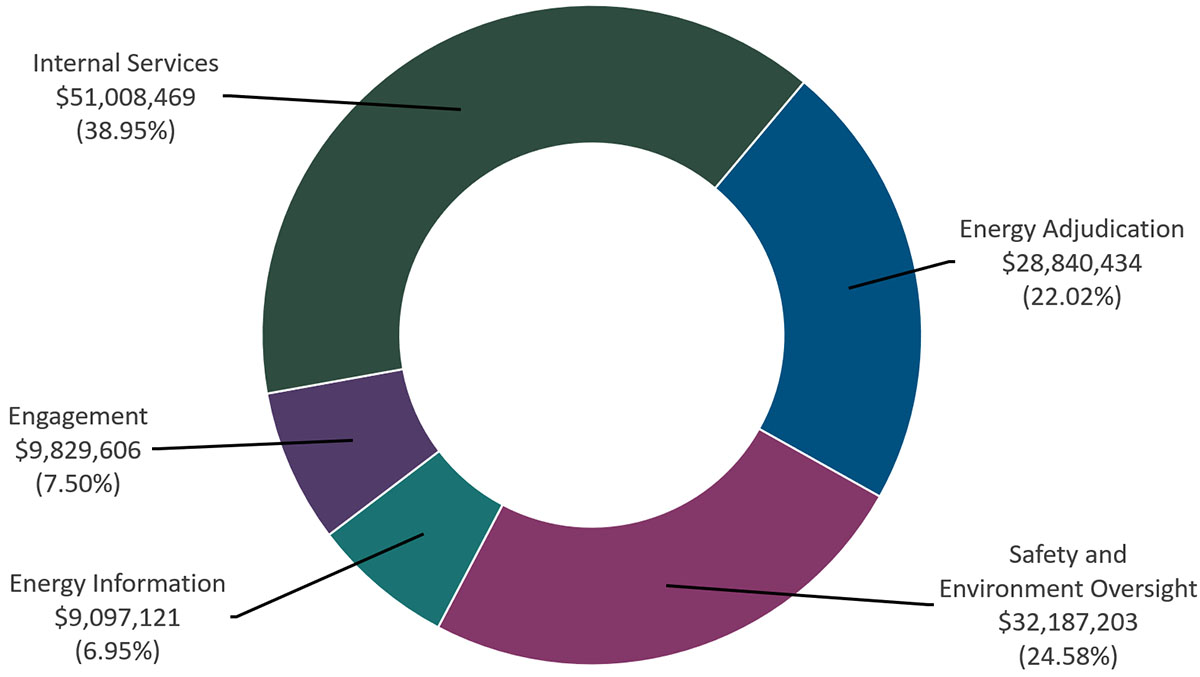
Text version of graph 1
This chart shows 2024-25 spending by core responsibility and internal services.
| Core responsibilities and internal services | 2024-25 actual spending |
|---|---|
| 1. Energy Adjudication | $28,840,434 (22.02%) |
| 2. Safety and Environment Oversight | $32,187,203 (24.58%) |
| 3. Engagement | $9,829,606 (7.50%) |
| 4. Energy Information | $9,097,121 (6.95%) |
| Internal services | $51,008,469 (38.95%) |
Analysis of actual spending by core responsibility
This chart shows 2024-25 spending by core responsibility and internal services
- Energy Adjudication: $28,840,434 (22.02%)
- Safety and Environment Oversight: $32,187,203 (24.58%)
- Engagement: $9,829,606 (7.50%)
- Energy Information: $9,097,121 (6.95%)
- Internal services: $51,008,469 (38.95%)
Refocusing Government Spending
In Budget 2023, the government committed to reducing spending by $14.1 billion over five years, starting in 2023-24, and by $4.1 billion annually after that.
As part of meeting this commitment, the CER identified the following spending reductions.
- 2024-25: $2,859,000
- 2025-26: $3,763,000
- 2026-27 and after: $5,000,000
During 2024-25, the CER worked to realize these reductionsFootnote 18 through the following measures:
- Operations and Maintenance (O&M) Reductions: The savings in O&M primarily came from travel and professional services. Within the professional services category, the reductions came from more limited use of contractors across multiple programs, including Core Responsibility programs in Energy Adjudication, Safety and Environment Oversight, Energy Information, and Engagement, and Internal Service programs including Information Technology, Information Management, People and Workforce and Finance and Acquisition Management. The reductions from travel focused on discretionary domestic and international travel for training, conferences and meetings. There was also reduced funding available for travel for engagement activities. Opportunities for virtual meetings, training and hearings were used where possible.
- Salary Reductions: A modest salary reduction was realized through attrition.
- Grants and Contributions (G&Cs) Reductions: Spending reductions in G&Cs came from non-hearing funding streams (policy dialogues, research and Indigenous Capacity Support Program). All hearing-related participant funding remained a priority. For non-hearing G&C spending, the CER reduced amounts across various initiatives to minimize negative impacts and maintain responsiveness to funding demands.
Budgetary performance summary
Table 1: Actual three-year spending on core responsibilities and internal services (dollars)
Table 1 presents how much money the CER spent over the past three years to carry out its core responsibilities and for internal services.
Core responsibilities and internal services |
2024-25 Main Estimates |
2024-25 total authorities available for use |
Actual spending over three years (authorities used) |
|---|---|---|---|
Energy Adjudication |
28,730,875 |
34,109,335 |
|
Safety and Environment Oversight |
22,962,958 |
29,574,464 |
|
Engagement |
9,187,376 |
11,674,580 |
|
Energy Information |
6,780,584 |
8,466,082 |
|
Subtotal |
67,661,793 |
83,824,461 |
|
Internal services |
43,731,861 |
52,123,935 |
|
Total |
111,393,654 |
135,948,396 |
|
Analysis of the next three years of spending
Variance between 2022-23 actual spending and 2023-24 actual spending
The 2023-24 actual spending is $1.25 million higher than the 2022-23 actual spending, and the variance is primarily due to:
- an increase of $13.71 million related to a Budget 2022 funding for regulatory renewal activities including Indigenous engagement and net-zero modelling; as well as funding to implement the Impact Assessment Act;
- an increase of $1.58 million related to Grants and Contributions;
- an increase of $0.24 million related to 2023-24 employee benefit plan costs;
- a decrease of $6.93 million related to a Budget 2018 initiative to transition to new impact assessment and regulatory processes;
- a decrease of $3.72 million related to other compensation adjustments including changes to terms and conditions of service or employment in the federal public administration; and
- a decrease of $3.63 million mainly related to funding to improve the CER’s ability to interpret and make data available digitally to Canadians.
Variance between 2023-24 actual spending and 2024-25 actual spending
The 2024-25 actual spending is $17.29 million higher than the 2023-24 actual spending, and the variance is primarily due to:
- an increase of $7.05 million primarily related to Collective Agreement renewal and other compensation adjustments including changes to terms and conditions of service or employment in the federal public administration;
- an increase of $5.61 million mainly related to changes to support evolving organizational priorities and requirements;
- an increase of $4.27 million related to Grants and Contributions;
- an increase of $1.80 million related to 2024-25 employee benefit plan costs;
- an increase of $1.49 million related to Budget 2024 funding for Indigenous Advisory and Monitoring Committees; and
- a decrease of $2.93 million related to Budget 2022 funding for regulatory renewal activities as well as funding to implement the Impact Assessment Act.
Variance between 2024-25 actual spending and 2024-25 planned spending
The 2024-25 actual spending is $19.57 million higher than the 2024-25 planned spending, and the variance is primarily due to:
- an increase of $10.76 million mainly related to changes to support evolving organizational priorities and requirements including operational budget carry forward;
- an increase of $7.05 million related to Collective Agreement renewal and other compensation adjustments including changes to terms and conditions of service or employment in the federal public administration;
- an increase of $3.40 million related to 2024-25 employee benefit plan costs;
- an increase of $1.49 million related to Budget 2024 funding for Indigenous Advisory and Monitoring Committees;
- a decrease of $1.87 million related to Grants and Contributions; and
- a decrease of $1.26 million related to Budget 2022 funding for regulatory renewal activities as well as funding to implement the Impact Assessment Act.
Variance between 2024-25 actual spending and 2024-25 total authorities available
The 2024-25 actual spending is $4.99 million lower than the 2024-25 total authority available, and the variance is primarily due to:
- a decrease of $4.06 million related to Budget 2022 funding for regulatory renewal activities as well as funding to implement the Impact Assessment Act;
- a decrease of $1.87 million related to Grants and Contributions;
- a decrease of $0.24 million related to Budget 2024 funding for Indigenous Advisory and Monitoring Committees; and
- an increase of $1.18 million related to Collective Agreement renewal and other compensation adjustments including changes to terms and conditions of service or employment in the federal public administration.
The Finances section of the Infographic for the CER on GC Infobase offers more financial information from previous years.
Table 2: Planned three-year spending on core responsibilities and internal services (dollars)
Table 2 shows the CER’s planned spending for each of the next three years on its core responsibilities and on internal services.
Core responsibilities and internal services |
2025-26 Planned Spending |
2026-27 planned spending |
2027-28 planned spending |
|---|---|---|---|
Energy Adjudication |
27,148,413 |
26,728,696 |
26,410,933 |
Safety and Environment Oversight |
30,012,096 |
30,321,478 |
29,817,680 |
Engagement |
11,628,160 |
9,566,026 |
9,318,152 |
Energy Information |
7,179,750 |
7,307,876 |
7,184,074 |
Subtotal |
75,968,419 |
73,924,076 |
72,730,839 |
Internal services |
41,003,427 |
39,964,465 |
39,348,309 |
Total |
116,971,846 |
113,888,541 |
112,079,148 |
Analysis of the next three years of spending
Variance between 2025-26 planned spending and 2026-27 planned spending
The 2026-27 planned spending is $3.08 million lower than the 2025-26 planned spending primarily related to:
- a decrease of $1.87 million related to Budget 2024 funding for Indigenous Advisory and Monitoring Committees;
- a decrease of $1.18 million related to Budget 2022 funding for regulatory renewal activities, as well as funding to implement the Impact Assessment Act;
- a decrease of $0.23 million related to employee benefits plan costs;
- a decrease of $0.08 million related to Grants and Contributions; and
- an increase of $0.28 million related to compensation adjustments including changes to terms and conditions of service or employment in the federal public administration.
Variance between 2026-27 planned spending and 2027-28 planned spending
The 2027-28 planned spending is $1.81 million lower than the 2026-27 planned spending primarily related to:
- a decrease of $1.41 million related to compensation adjustments including changes to terms and conditions of service or employment in the federal public administration;
- a decrease of $0.24 million related to employee benefits plan costs; and
- a decrease of $0.16 million related to Budget 2022 funding for regulatory renewal activities, as well as funding to implement the Impact Assessment Act.
The Finances section of the Infographic for the CER on GC Infobase offers more financial information from previous years.
Funding
This section provides an overview of the department's voted and statutory funding for its core responsibilities and for internal services. Consult the Government of Canada budgets and expenditures for further information on funding authorities.
Graph 2 summarizes the department's approved voted and statutory funding from 2022-23 to 2027-28.
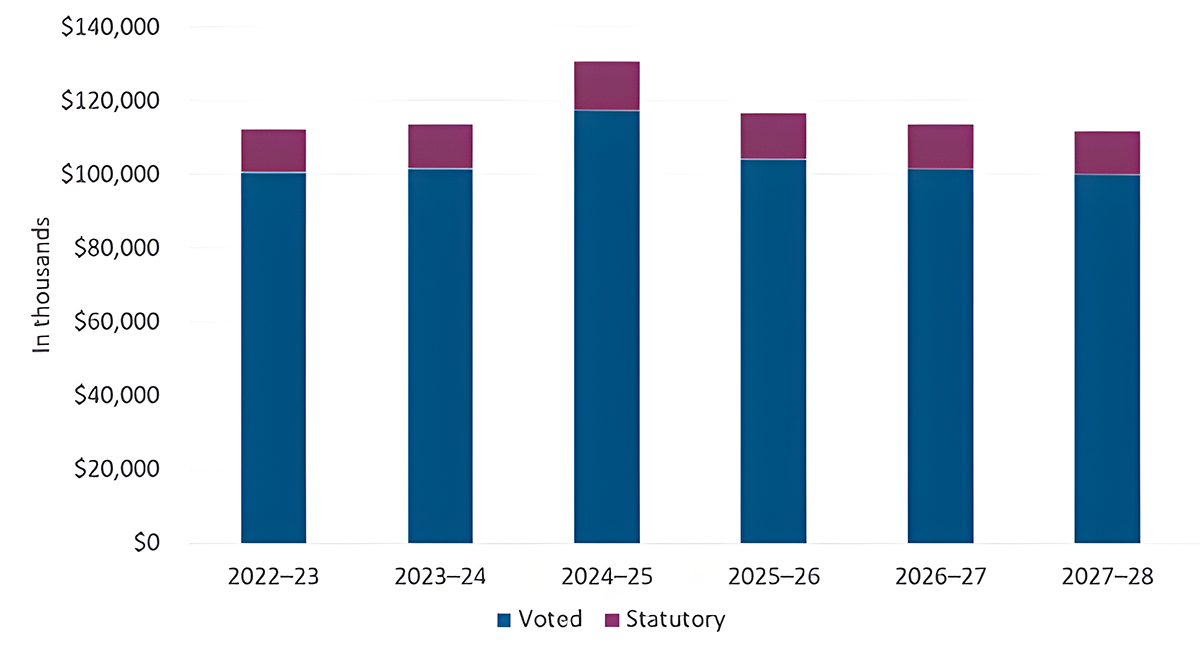
Text version of Graph 2
Graph 2 includes the following information in a bar graph:
| Fiscal year | Statutory | Voted | Total |
|---|---|---|---|
| 2022-23 | $11,614 | $100,803 | $11,003 |
| 2023-24 | $11,860 | $101,808 | $113,668 |
| 2024-25 | $13,652 | $117,311 | $130,963 |
| 2025-26 | $12,579 | $104,393 | $116,972 |
| 2026-27 | $12,353 | $101,536 | $113,889 |
| 2027-28 | $12,113 | $99,966 | $112,079 |
Analysis of statutory and voted funding over a six-year period
This bar chart shows the CER’s six-year spending trend. It includes actual spending for the fiscal years 2022-23 through 2024-25 and planned spending for the years 2025-26 to 2027-28. Amounts are depicted by Voted and Statutory amounts. An explanation of spending variances is provided below Table 1: Actual three-year spending on core responsibilities and internal services and Table 2: Planned three-year spending on core responsibilities and internal services.
The CER is funded through Parliamentary appropriations. The Government of Canada currently recovers a large majority of the appropriation from the industry the CER regulates. All collections from cost recovery invoices are deposited to the account of the Receiver General for Canada and credited to the Consolidated Revenue Fund.
Pipeline and power line companies that hold authorizations under the CER Act are subject to cost recovery. Applications before the CER for new facilities are not subject to cost recovery until the facility is placed into service, unless the company does not have any prior facilities regulated by the CER in which case a one-time levy is assessed following the authorization of construction.
Cost recovery is carried out on a calendar year basis.
Consult the Public Accounts of Canada for further information on the CER’s departmental voted and statutory expenditures.
Financial statement highlights
CER’s Financial Statements (audited) for the Year Ended March 31, 2025
Table 3: Condensed Statement of Operations (audited) for the year ended March 31, 2025 (dollars)
Table 3 summarizes the expenses and revenues for 2024-25 which net to the cost of operations before government funding and transfers.
| Financial information | 2024-25 actual results | 2024-25 planned results | Difference (actual results minus planned) |
|---|---|---|---|
| Total expenses | 137,743,243 | 128,083,583 | 9,659,660 |
| Total revenues | - | - | - |
| Net cost of operations before government funding and transfers | 137,743,243 | 128,083,583 | 9,659,660 |
Analysis of expenses and revenues for 2024-25
The 2024-25 planned results information is provided in the CER’s Future-Oriented Statement of Operations and Notes 2024-25.
The actual net cost of operations before government funding and transfers in 2024-25 was $9.66 million higher than the planned results for the same fiscal year. The net increase is primarily due to:
- an increase of $10.76 million mainly related to changes to support evolving organizational priorities and requirements including operational budget carry forward;
- an increase of $3.40 million related to 2024-25 employee benefit plan costs;
- an increase of $1.10 million related to retroactive payment for the salary increase as a result of collective agreement renewal;
- an increase of $1.49 million related to Budget 2024 funding for Indigenous Advisory and Monitoring Committees;
- a decrease of $3.96 million related to reduced lease costs, prepaid expenses and capital assets expenses;
- a decrease of $1.87 million related to Grants and Contributions; and
- a decrease of $1.26 million related to Budget 2022 funding for regulatory renewal activities as well as funding to implement the Impact Assessment Act.
Table 4: Condensed Statement of Operations (audited) for 2023-24 and 2024-25 (dollars)
Table 4 summarizes actual expenses and revenues which net to the cost of operations before government funding and transfers.
| Financial information | 2024-25 actual results | 2023-24 actual results | Difference (2024-25 minus 2023-24) |
|---|---|---|---|
| Total expenses | 137,743,243 | 133,790,839 | 3,952,404 |
| Total revenues | - | - | - |
| Net cost of operations before government funding and transfers | 137,743,243 | 133,790,839 | 3,952,404 |
Analysis of differences in expenses and revenues between 2023-24 and 2024-25
The actual net cost of operations before government funding and transfers in 2024-25 was $3.95 million higher than the actual results for the previous fiscal year, primarily due to:
- an increase of $5.61 million mainly related to changes to support evolving organizational priorities and requirements;
- an increase of $4.27 million related to Grants and Contributions;
- an increase of $1.80 million related to 2024-25 employee benefit plan costs;
- an increase of $1.78 million related to 2024-25 employee future benefits and vacation payout;
- an increase of $1.49 million related to Budget 2024 funding for Indigenous Advisory and Monitoring Committees;
- a decrease of $4.85 million primarily related to retroactive salary payment accrual in 2023-24;
- a decrease of $3.22 million related to reduced lease expenses, prepaid expenses and capitalization of IT software development expenses; and
- a decrease of $2.93 million related to Budget 2022 funding for regulatory renewal activities as well as funding to implement the Impact Assessment Act.
Table 5: Condensed Statement of Financial Position (audited) as at March 31, 2025 (dollars)
Table 5 provides a brief snapshot of the amounts the department owes or must spend (liabilities) and its available resources (assets), which helps to indicate its ability to carry out programs and services.
| Financial information | Actual fiscal year (2024-25) |
Previous fiscal year (2023-24) | Difference (2024-25 minus 2023-24) |
|---|---|---|---|
| Total net liabilities | 33,980,654 | 33,474,084 | 506,570 |
| Total net financial assets | 20,451,316 | 21,227,691 | (776,375) |
| Departmental net debt | 13,529,338 | 12,246,393 | 1,282,945 |
| Total non-financial assets | 11,357,916 | 8,911,870 | 2,446,046 |
| Departmental net financial position | (2,171,422) | (3,334,523) | 1,163,101 |
Analysis of department’s liabilities and assets since last fiscal year
Departmental net debt increased by $1.28 million, in comparison to 2023-24. The increase is mainly attributed to increased employee future benefits, vacation and compensatory leave accruals.
Departmental net financial position increased by $1.16 million, in comparison to 2023-24. The increase is mainly due to increased capital assets and prepaid expenses, offset by increased employee future benefits and vacation accruals.
Human resources
This section presents an overview of the department’s actual and planned human resources from 2022-23 to 2027-28.
Table 6: Actual human resources for core responsibilities and internal services
Table 6 shows a summary shows a summary in full-time equivalents of human resources for the CER’s core responsibilities and for its internal services for the previous three fiscal years.
| Core responsibilities and internal services | 2022-23 actual full-time equivalents | 2023-24 actual full-time equivalents | 2024-25 actual full-time equivalents |
|---|---|---|---|
| Energy Adjudication | 121.4 | 120.1 | 117.6 |
| Safety and Environment Oversight | 137.7 | 138.6 | 140.3 |
| Engagement | 44.8 | 46.2 | 47.3 |
| Energy Information | 41.6 | 40.6 | 44.5 |
| Subtotal | 345.5 | 345.5 | 349.7 |
| Internal services | 225.7 | 225.4 | 230.5 |
| Total | 571.2 | 570.9 | 580.2 |
Analysis of human resources over the last three years
Variance between 2022-23 actual full-time equivalents and 2023-24 actual full-time equivalents
There was an insignificant decrease of 0.3 full-time equivalents from 2022-23 to 2023-24.
Variance between 2023-24 actual full-time equivalents and 2024-25 actual full-time equivalents
The increase of 9.3 full-time equivalents from 2023-24 to 2024-25 is primarily due to:
- an increase of 23.0 full-time equivalents is due to changes across the organization to meet operational requirements;
- an increase of 9.6 full-time equivalents is related to Budget 2024 funding for Indigenous Advisory and Monitoring Committees; and
- a decrease of 23.3 full-time equivalents is related to Budget 2022 funding for regulatory renewal activities, as well as funding to implement the Impact Assessment Act.
Table 7: Human resources planning summary for core responsibilities and internal services
Table 7 shows the planned full-time equivalents for each of the CER’s core responsibilities and for its internal services for the next three years. Human resources for the current fiscal year are forecast based on year to date.
| Core responsibilities and internal services | 2025-26 planned full-time equivalents | 2026-27 planned full-time equivalents | 2027-28 planned full-time equivalents |
|---|---|---|---|
| Energy Adjudication | 117.3 | 119.3 | 117.1 |
| Safety and Environment Oversight | 145.1 | 141.3 | 140.0 |
| Engagement | 41.4 | 33.5 | 32.7 |
| Energy Information | 35.6 | 36.4 | 36.5 |
| Subtotal | 339.4 | 330.5 | 326.3 |
| Internal services | 206.8 | 205.6 | 205.4 |
| Total | 546.2 | 536.1 | 531.7 |
Analysis of human resources for the next three years
Variance between 2025-25 planned full-time equivalents and 2026-27 planned full-time equivalents
The decrease of 10.1 planned full-time equivalents from 2025-26 to 2026-27 is primarily related to:
- a decrease of 11.3 full-time equivalents is related to Budget 2024 funding for Indigenous Advisory and Monitoring Committees;
- a decrease of 4.9 full-time equivalents is related to Budget 2022 funding for regulatory renewal activities, as well as funding to implement the Impact Assessment Act; and
- an increase of 6.1 full-time equivalents is due to changes across the organization to meet operational requirements.
Variance between 2026-27 planned full-time equivalents and 2027-28 planned full-time equivalents
The decrease of 4.4 planned full-time equivalents from 2026-27 to 2027-28 is primarily related to:
- a decrease of 4.0 full-time equivalents is due to changes across the organization to meet operational requirements; and
- a decrease of 0.4 full-time equivalents is related to Budget 2022 funding for regulatory renewal activities, as well as funding to implement the Impact Assessment Act.
Supplementary information tables
The following supplementary information tables are available on the CER’s website:
Federal tax expenditures
The tax system can be used to achieve public policy objectives through the application of special measures such as low tax rates, exemptions, deductions, deferrals and credits. The Department of Finance Canada publishes cost estimates and projections for these measures each year in the Report on Federal Tax Expenditures. This report also provides detailed background information on tax expenditures, including descriptions, objectives, historical information and references to related federal spending programs as well as evaluations and GBA Plus of tax expenditures.
Corporate information
Departmental profile
Appropriate minister:
The Honourable Tim Hodgson, P.C., M.P.
Institutional head:
Tracy Sletto
Ministerial portfolio:
Energy and Natural Resources
Enabling instrument:
Year of incorporation / commencement:
2019
Other:
The CER Act came into force on 28 August 2019.
Departmental contact information
Headquarters: Calgary
Mailing address:
Suite 210, 517 10th Avenue SW
Calgary, Alberta T2R 0A8
Telephone:
Office Telephone:
403-292-4800
Toll free:
1-800-899-1265
Fax:
403-292-5503
Toll free fax:
1-877-288-8803
Email:
Website:
Definitions
List of terms
- appropriation (crédit)
- Any authority of Parliament to pay money out of the Consolidated Revenue Fund.
- budgetary expenditures (dépenses budgétaires)
- Operating and capital expenditures; transfer payments to other levels of government, departments or individuals; and payments to Crown corporations.
- core responsibility (responsabilité essentielle)
- An enduring function or role of a department. The departmental results listed for a core responsibility reflect the outcomes that the department seeks to influence or achieve.
- Departmental Plan (plan ministériel)
- A report that outlines the anticipated activities and expected performance of an appropriated department over a 3-year period. Departmental Plans are usually tabled in Parliament in spring.
- departmental priority (priorité)
- A plan, project or activity that a department focuses and reports on during a specific planning period. Priorities represent the most important things to be done or those to be addressed first to help achieve the desired departmental results.
- departmental result (résultat ministériel)
- A high-level outcome related to the core responsibilities of a department.
- departmental result indicator (indicateur de résultat ministériel)
- A quantitative or qualitative measure that assesses progress toward a departmental result.
- departmental results framework (cadre ministériel des résultats)
- A framework that connects the department’s core responsibilities to its departmental results and departmental result indicators.
- Departmental Results Report (rapport sur les résultats ministériels)
- A report outlining a department’s accomplishments against the plans, priorities and expected results set out in the corresponding Departmental Plan.
- full-time equivalent (équivalent temps plein)
- Measures the person years in a departmental budget. An employee's scheduled hours per week divided by the employer's hours for a full-time workweek calculates a full-time equivalent. For example, an employee who works 20 hours in a 40-hour standard workweek represents a 0.5 full-time equivalent.
- Gender-based Analysis Plus (GBA Plus)(analyse comparative entre les sexes plus [ACS Plus])
- An analytical tool that helps to understand the ways diverse individuals experience policies, programs and other initiatives. Applying GBA Plus to policies, programs and other initiatives helps to identify the different needs of the people affected, the ways to be more responsive and inclusive, and the methods to anticipate and mitigate potential barriers to accessing or benefitting from the initiative. GBA Plus goes beyond biological (sex) and socio-cultural (gender) differences to consider other factors, such as age, disability, education, ethnicity, economic status, geography (including rurality), language, race, religion, and sexual orientation.
- government priorities (priorités pangouvernementales)
- For the purpose of the 2024–25 Departmental Results Report, government priorities are the high-level themes outlining the government’s agenda as announced in the 2021 Speech from the Throne.
- horizontal initiative (initiative horizontale)
- A program, project or other initiative where two or more federal departments receive funding to work collaboratively on a shared outcome usually linked to a government priority, and where the ministers involved agree to designate it as horizontal. Specific reporting requirements apply, including that the lead department must report on combined expenditures and results.
- Indigenous business (enterprise autochtones)
- For the purposes of a Departmental Result Report, this includes any entity that meets the Indigenous Services Canada’s criteria of being owned and operated by Elders, band and tribal councils, registered in the Indigenous Business Directory or registered on a modern treaty beneficiary business list.
- non‑budgetary expenditures (dépenses non budgétaires)
- Net outlays and receipts related to loans, investments and advances, which change the composition of the financial assets of the Government of Canada.
- performance (rendement)
- What a department did with its resources to achieve its results, how well those results compare to what the department intended to achieve, and how well lessons learned have been identified.
- performance indicator (indicateur de rendement)
- A qualitative or quantitative measure that assesses progress toward a departmental-level or program-level result, or the expected outputs or outcomes of a program, policy or initiative.
- plan (plan)
- The articulation of strategic choices, which provides information on how a department intends to achieve its priorities and associated results. Generally, a plan will explain the logic behind the strategies chosen and tend to focus on actions that lead to the expected result.
- planned spending (dépenses prévues)
- For Departmental Plans and Departmental Results Reports, planned spending refers to the amounts presented in Main Estimates. Departments must determine their planned spending and be able to defend the financial numbers presented in their Departmental Plans and Departmental Results Reports.
- program (programme)
- An Individual, group, or combination of services and activities managed together within a department and focused on a specific set of outputs, outcomes or service levels.
- program inventory (répertoire des programmes)
- A listing that identifies all the department’s programs and the resources that contribute to delivering on the department’s core responsibilities and achieving its results.
- result (résultat)
- An outcome or output related to the activities of a department, policy, program or initiative.
- statutory expenditures (dépenses législatives)
- Spending approved through legislation passed in Parliament, other than appropriation acts. The legislation sets out the purpose and the terms and conditions of the expenditures.
- target (cible)
- A quantitative or qualitative, measurable goal that a department, program or initiative plans to achieve within a specified time period.
- voted expenditures (dépenses votées)
- Spending approved annually through an appropriation act passed in Parliament. The vote also outlines the conditions that govern the spending.
- Date modified: