
Summary of the CER Pipeline Geohazards Workshop
Executive Summary
In fall 2025, the Canada Energy Regulator (CER) hosted a Pipeline Geohazards Workshop consisting of three online sessions. The workshop brought together CER staff and regulated companies to discuss pipeline geohazards.
The workshop objectives were to increase regulated companies’ awareness of pipeline geohazards, support knowledge sharing, and identify potential gaps related to construction and operation practices. Representatives from TC Energy Corporation (TC Energy), Enbridge Inc. (Enbridge), Trans Mountain Corporation (Trans Mountain), and Trans-Northern Pipelines Inc. (TNPI) shared their experiences with the geohazards management program, pipeline monitoring and event response.
Workshop included participants with diverse backgrounds from CER regulated companies and their subcontractors, Alberta Energy Regulator (AER) and the CER. This report summarizes the workshop sessions, presentations, and key discussion topics. Each session started with a land acknowledgement and a safety moment. All sessions were facilitated with French language support.
Glossary of Terms Used
BC British Columbia
CER Canada Energy Regulator
Enbridge Enbridge Inc.
h hour
O&M Operations and Maintenance
ROW Right of Way
TC Energy TC Energy Corporation
TNPI Trans-Northern Pipelines Inc.
Trans Mountain Trans Mountain Corporation
WOF Weather and Outside Forces
Background
Geohazards are defined as any soil displacement that might impact the operation of a pipeline due to climate, geotechnical and hydrotechnical events. When soil displacement happens it can result in pipeline exposure, suspension, damage, or even rupture, which affects pipelines operations. Geohazards related events have recently been increasing in frequency, therefore more caution and education about their impact on pipelines should be considered, investigated, and studied.
Based on discussions with industry leaders and observations from conferences and workshops, CER staff identified value in meeting with CER regulated companies to share information and experiences regarding pipeline geohazards. The CER acknowledges the contributions of the participating companies and presenters. The CER also acknowledges the contributions of independent presenters Doug Dewar and Dr. Jim Oswell, who provided perspectives on geohazards management approaches and analysis.
CER Geohazard Workshop Team
The following CER staff organized the geohazards workshop and presented the CER presentations which included safety moments on each of the three Sessions:
Bahaa Mekalled, a geotechnical engineer with the CER’s Pipeline Integrity team. Bahaa has 26 years of work experience, including 10 years in her current role at the CER and 16 years in industry. Bahaa holds a master’s degree in Geotechnical Engineering from the University of Calgary.
Amrita Nag, an engineer with the CER’s Pipeline Integrity team. Amrita holds a Bachelor of Science in Mechanical Engineering from the University of Calgary.
Presentations Summaries
Session 1
Date: Oct 1, 2025
CER Presentation:
Title: Introduction to Geohazards
Summary: CER staff delivered a presentation titled "Introduction to Geohazards” that included: Geohazards definition; types and examples; landslides; slope movements; hydrotechnical hazards; seismicity; permafrost; and soil subsidence. The presentation set the stage for a common understanding of identification of geohazards and understanding of their potential effects on operating pipelines.
TC Energy Presentation:
Speaker: Ashton Friesen, senior geotechnical engineer at TC Energy. Ashton has 19 years of experience in geotechnical engineering and 13 years of experience managing pipeline geohazards at TC Energy.
Title: Management of Geohazards at TC Energy
Summary: TC Energy presented an overview of the company’s geohazards management program. The presentation included a description of the TC Energy Pipeline Integrity Threat Management Programs which includes its “Weather and Outside Forces (WOF)” program. TC Energy described how threats are identified under its WOF program, including landslides, seismic events, subsidence, settlement and heave, and hydrotechnical threats.
TC Energy described a three step approach for geotechnical and hydrotechnical threat management consisting of desktop study followed by field verification and finally monitoring and mitigation. TC Energy indicated that identified threats are assigned levels based on susceptibility and potential impact to the pipeline. Furthermore, TC Energy shared monitoring and remediation methods that might be deployed when various geotechnical and hydrotechnical hazards need to be addressed.
Enbridge Pipelines Inc. Presentation:
Speaker: John Richmond, Engineering specialist with over 30 years of geotechnical and geohazards management experience. John manages the geotechnical hazards for Enbridge Pipelines Inc.
Title: Enbridge Geohazards Management Program
Summary: Enbridge discussed in the presentation the various types of geohazards and how they relate to pipelines and impact their integrity. Enbridge presented its geohazards management program and how the various components/processes work together to achieve safer pipeline conditions. The various components of the pipeline geohazard management include hazard identification, inspection and monitoring, pipeline assessment, and threat mitigation.
Enbridge emphasized the importance of identifying hazards early and the value of inspection at various stages of the project life cycle and where appropriate routine monitoring under the geohazards management program. Monitoring may be carried out due to event occurrence and routinely where geohazard sites are identified. Lastly, Enbridge discussed the various monitoring methods and techniques that are used in its system and how various geohazard levels identify the need for monitoring, instrumentation and remediation.
Session 2
Date: Oct 30, 2025
CER Presentation:
Title: Geohazards in Pipeline Applications and Pipeline Geohazards Incidents
Summary: CER staff presented the regulatory expectations for filings related to geohazards in pipelines including those required for applications and incident reporting. The presentation outlined regulations, standards and the CER review process of geohazards related fillings. CER staff also presented three case studies from previous pipeline applications and discussed how geohazard related information supported the Commission’s decision-making.
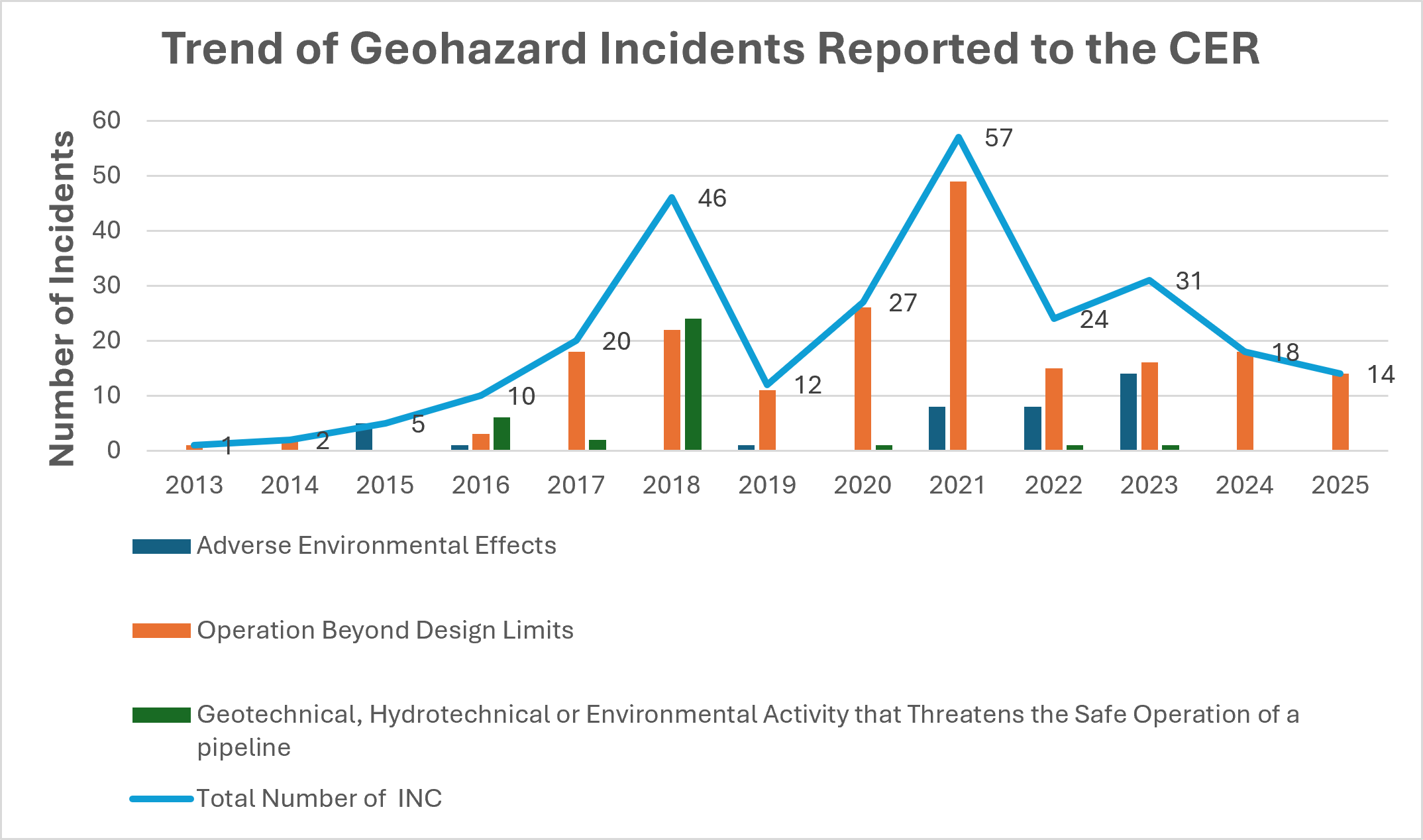
Trend of Geohazard Incidents Reported to the CER
Description
This chart illustrates trends in geohazard incidents reported to the CER between 2013 and 2025. The horizontal axis represents the reporting year, and the vertical axis represents the number of incidents reported. The chart displays incidents in three categories: adverse environmental effects (dark blue bars), operation beyond design limits (orange bars), and geotechnical, hydrotechnical or environmental activity that threatens the safe operation of a pipeline (dark green bars). A blue line represents the total number of incidents reported each year.
Overall, the total number of reported incidents increased from 1 incident in 2013 to major peaks of 46 incidents in 2018 and 57 incidents in 2021, before declining to 14 incidents in 2025. Operation beyond design limits accounted for the largest number of incidents in most years and reached its highest level in 2021 with 49 incidents. Geotechnical, hydrotechnical or environmental activity that threatens the safe operation of a pipeline peaked in 2018 with 24 incidents and was matched by 22 operation-beyond-design-limits incidents reported that year. Adverse environmental effects remained comparatively low throughout the reporting period, with the highest reported value occurring in 2023 at 14 incidents.
Chart note: The data in this chart show the year to year variability in reported exposure and slope movement incidents, with notable increases in 2018 and 2021. These increases were due to changes in the CER reporting requirements and climate related events. The results demonstrate that geohazard related incidents continue to occur across the CER regulated pipeline system.
CER staff reviewed geohazard related incidents previously reported to the CER. The presentation reviewed reporting requirements, statistics of previously reported incidents, and types of incidents reported since 2013. Finally, CER staff discussed a previously reported incident and included a description of the incident, the cause and how it was mitigated.
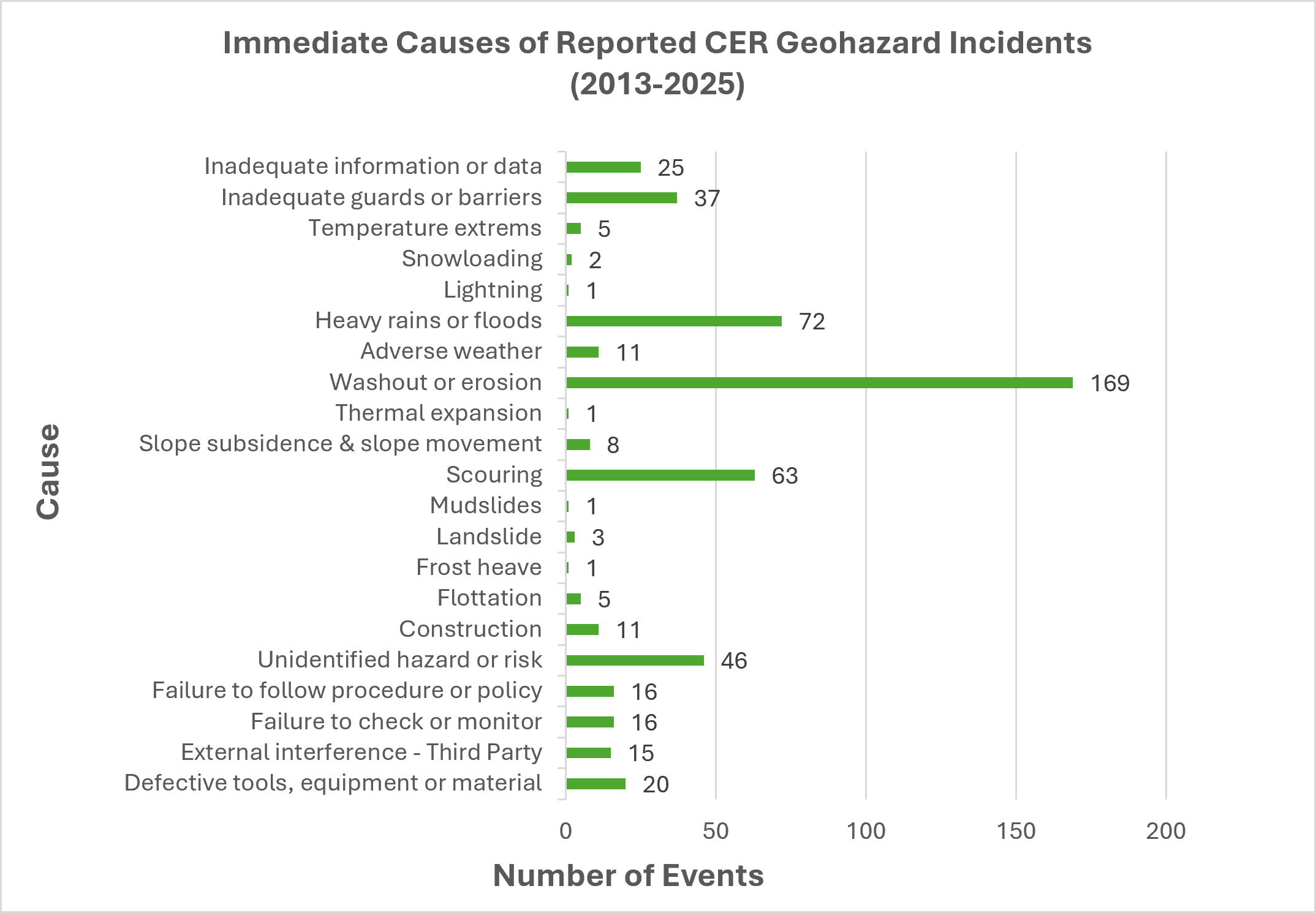
Immediate Causes of Reported CER Geohazard Incidents (2013-2025)
Description
This image is a horizontal bar chart showing the number of geohazard-related incidents reported to the CER between 2013 and 2025. Causes are listed on the vertical axis, and the number of reported events is shown on the horizontal axis. The length of each horizontal bar represents the number of incidents associated with that cause.
The most common cause is washout or erosion with 169 incidents, represented by the longest bar. This is followed by heavy rains or floods with 72 incidents and scouring with 63 incidents. Other notable causes include unidentified hazard or risk (46 incidents) and inadequate guards or barriers (37 incidents). Most of the remaining causes account for fewer than 25 incidents each. The least common causes are lightning, thermal expansion, mudslides, and frost heave, each with one reported incident. Overall, the chart shows that erosion and water-related processes were the dominant immediate causes of reported CER geohazard incidents between 2013 and 2025.
Chart note: The CER Geohazard reported incidents are associated with a range of immediate causes as identified in the chart. Some of the causes have higher frequency of occurrences than others. The data highlights the prevalence of different identified immediate causes.
Trans Northen Pipelines Presentation
Speaker: Pardeep Dalpatadu is a senior asset Integrity Program Engineer at Trans Northern Pipelines (TNPI). Pardeep has been working at TNPI for approximately 9 years managing the company’s geohazards management program.
Title: Introduction to Geohazards management program
TNPI presentation: This presentation reviewed regulatory requirements and TNPI’s approach to geohazard management including their program, process, monitoring, challenges and opportunities.
TNPI shared information on its experience with the geohazards management program, outlined the company’s risk rating approach, and presented a flowchart showing its typical geohazards management program process. TNPI also shared three examples of pipeline exposures and the corresponding mitigation approaches. These exposure incidents were based on incidents that occurred along TNPI pipeline ROW.
Trans Mountain
Speaker: Sean Sullivan is the team lead of right of way hazards and a hydrotechnical hazard subject matter expert at Trans Mountain. Part of Sean’s experience was working as a hydrotechnical consultant focused on water crossing assessments and flood mitigations.
Title: Considerations of Extreme Climate Events
Trans Mountain Presentation: Trans Mountain provided an overview of its pipeline system, the geohazards relevant to its operations, and its experience during the 2021 British Columbia (BC) flood event, including climate related considerations. Trans Mountain also discussed hydrotechnical, geotechnical and seismic hazards and introduced a unique concept of progressive and episodic geohazards. Trans Mountain described episodic geohazards events that occur suddenly and progressive geohazards that occur gradually and can be monitored.
During the recap of the 2021 BC flood event, Trans Mountain described the affected areas and provided examples of the event’s impact on the pipeline. Additionally, Trans Mountain shared the flood response successes, challenges, and lessons learned. The company presented its model for climate vulnerability assessment and the assumption made. It also provided some information regarding wildfires and the impact on hydrotechnical and geotechnical aspects of pipeline operations.
Session 3
Date: Nov 19, 2025
CER Presentation:
Title: Introduction to Geohazards
Summary: CER staff presentation focused on Operations and Maintenance (O&M) activities and case studies. The filing requirements for O&M submissions and the information needed for the CER staff to properly assess O&M notifications were reviewed. CER staff also shared the review process and information requirements. CER staff shared that since 2012, over 9000 O&M submissions, of which 2273 were geohazards related have been processed by staff. These numbers highlight the frequency of geohazards related events and implementation of mitigations.
CER staff reviewed three previously submitted O&M case studies and discussed what led to the O&M submission, the information submitted, the review process, gaps in the submissions and the assessment outcomes.
Presentation by Doug Dewar
Speaker: Doug Dewar has been working for over 29 years in the pipeline industry managing geohazards. Currently he manages Pembina Pipeline’s geohazards management program.
Title: IMU Considerations in geohazard Management
Presentation: Doug noted that his presentation alone does not give justice to the information he shares and that attending his talks or watching the videos he posts on YouTube would provide better understanding of the topic presented. Doug described in his presentation the pig unit used to obtain the ILI data, and how the location for horizontal strain, vertical strain and curvature are obtained. Doug also discussed the blind spots of the currently used technologies, landslide hazards, pipeline features, and reviewed a couple of case studies.
Presentation by Dr. Jim Oswell
Speaker: Dr. Jim Oswell has extensive experience in soil-pipeline interaction and geotechnical aspects of pipelines in permafrost and has worked on diverse projects in a range of international landscapes.
Title: Managing creeping landslide hazards through consequence-based decision making in high reliability organizations.
Presentation: Dr. Oswell expressed concern that addressing slow moving landslides and some other geohazards through consequence-based decisions may be falling short in two key aspects. These are the “failure to learn” from other events and thus improve our practices, and the application of risk-based decision making for hazard management.
While some pipeline companies and practitioners recognize this, there are some that would benefit from reflection on how to make buried pipelines less prone to so-called unexpected or “black swan” geohazard events. The reduction in negative soil-pipeline interaction occurrences can also be improved by operators implementing the concepts of a “high reliability organization” with respect to pipeline integrity.
Conclusion and Feedback
Across the three-day workshop, between 70 and 80 attendees participated. Participants from other regulatory agencies, pipeline operators and their subcontractors attended the workshop. Presenters from four major pipeline operators and technical experts provided insight into their geohazards management programs and analytic assessments. The workshop outcomes were achieved through:
- Knowledge sharing of geohazards management programs across industry, including monitoring programs and techniques, and geohazards mitigation approaches.
- Increasing awareness of pipeline geohazards among CER regulated pipeline operators. This was achieved through presenters sharing pipeline monitoring techniques and risk identification. Presenters also shared mitigation methods that may be applied to each of the identified risks.
- CER staff also shared three presentations that covered an introduction to geohazards, incident reporting and operation and maintenance activities reported to the CER and related examples.
- Seeking to identify gaps in regulations, standards, and construction practices from the operators’ perspective. There were no major gaps identified in CER regulation and standards by the operators.
Questions raised during the workshop were answered by the presenters. The workshop was intended to support open discussion and information sharing platforms among CER regulated companies.
The CER sent surveys after the first and third days of the workshop to gain insight regarding the topics discussed and the level of interest in future similar workshops and potential topics for discussion. Overall, respondents indicated that the workshop was useful, particularly the CER case studies and operator presentations. Respondents appreciated the opportunity to hear both regulator and industry perspectives on geohazard management. Several respondents also indicated that they have applied or expect to apply information from the workshop in their work. Survey responses identified interest in future discussions on:
- Axial strain tools, ILI and IMU application techniques.
- Monitoring and instrumentation programs and interacting threats.
- Non-steel pipeline geohazard mitigation.
- Early landslide detection, and geohazard risk evaluation.
Overall, the feedback supports continued knowledge-sharing on pipeline geohazards and provides direction for improving future workshop sessions.
- Date modified: