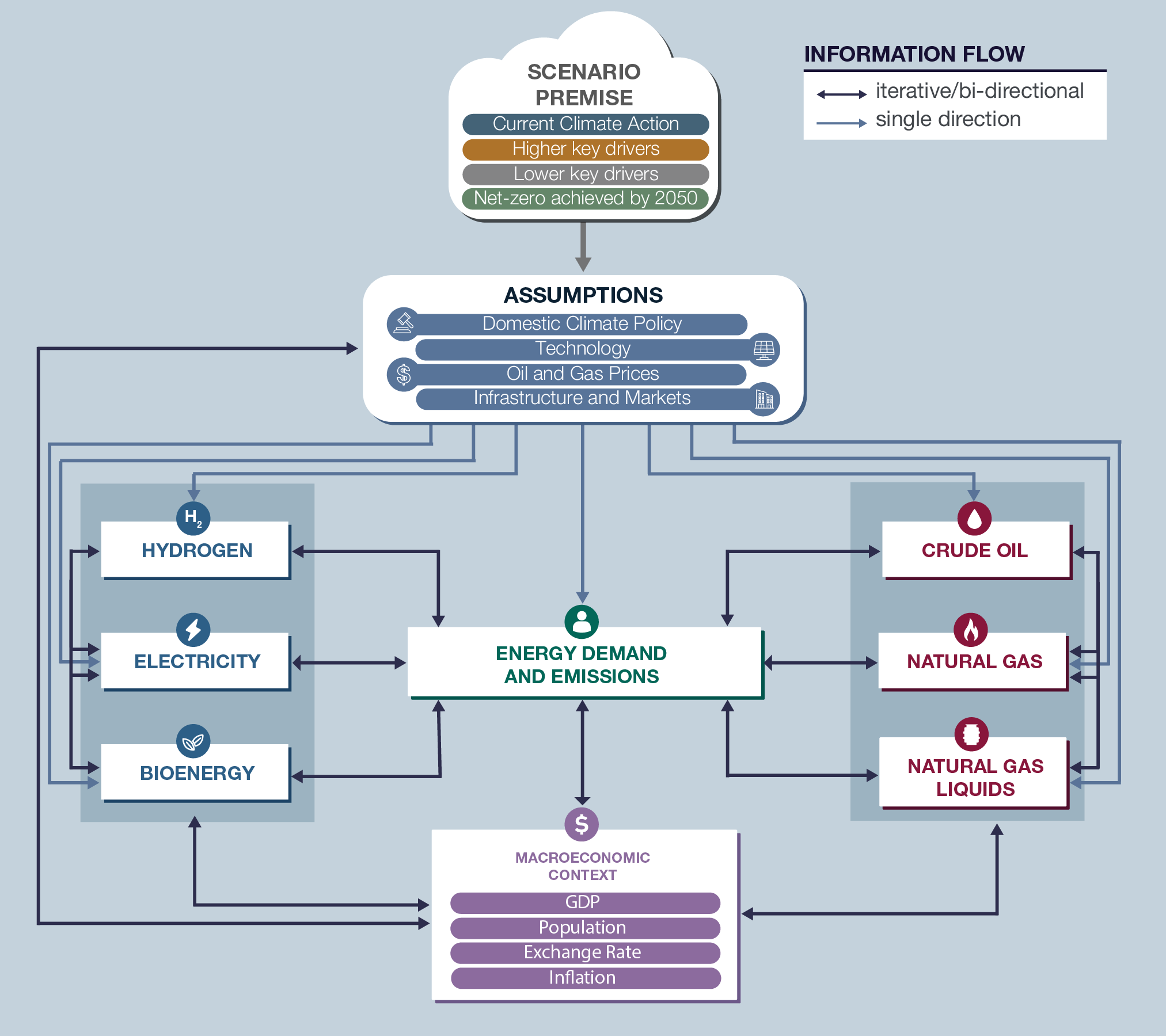
The Canada’s Energy Future series explores how possible energy futures might unfold for Canadians over the long term. We use economic and energy models to explore how supply and demand for energy could evolve. Figure A5.1 outlines the modelling system in a simplified diagram. These models start with a set of input assumptions which are based on the scenario that we are modeling and interact by passing key pieces of information back and forth to ensure a consistent set of projections. The results in Canada’s Energy Future 2026 are not predictions about the future. Rather, they are the product of stylized scenarios based on a specific premise and set of assumptions.
A scenario is a premise for the future that we want to explore, such as a world where the globe meets its climate commitments, or a world where trends are similar to today.
Assumptions take the idea behind the scenario and turn it into numbers the energy models can use. They include factors like policy trends and technology costs.
Text Alternative: This flow diagram provides a simplified overview of the information flow in the Canada’s Energy Futures modeling system. It starts with a given scenario premise. The scenario Premise is turned into assumptions on factors like domestic climate policy, technology, oil and natural gas prices, and infrastructure and markets. These assumptions feed into the six main models: energy demand, hydrogen, electricity, crude oil, natural gas, and natural gas liquids. The models exchange information with each other. All models exchange information with energy demand. The hydrogen and electricity models exchange information with each other, as do the crude oil, natural gas, and natural gas liquids models.
Source: CER
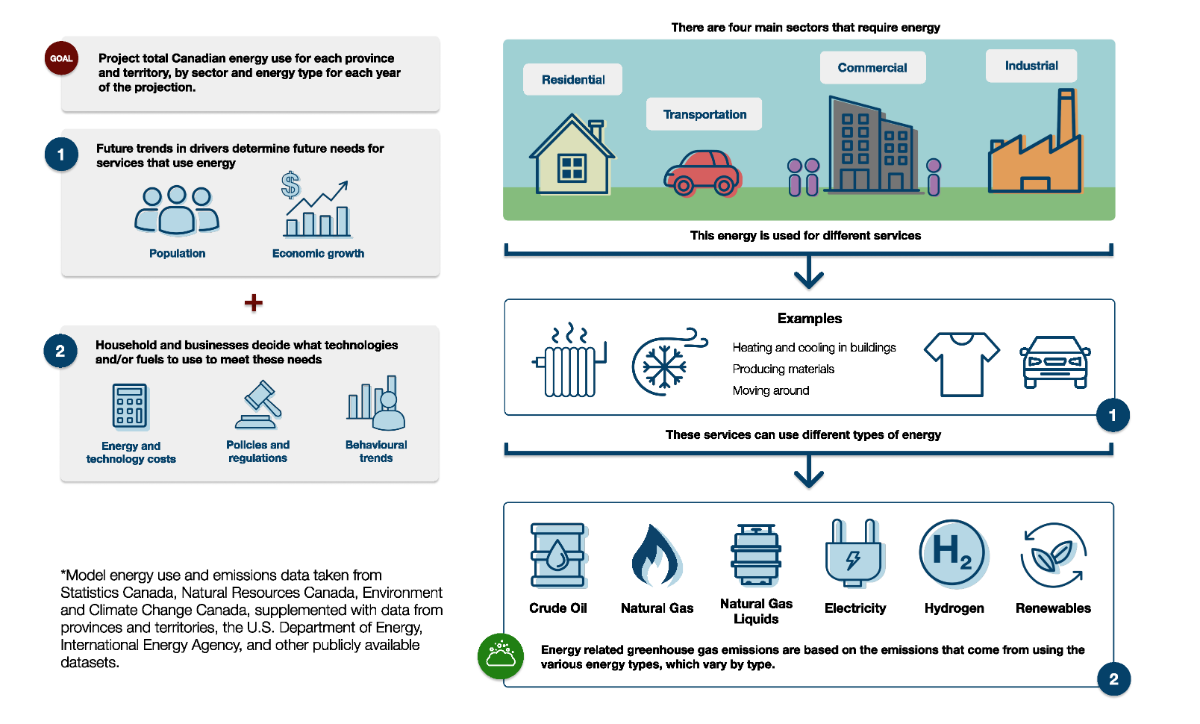
Text Alternative: The infographic displays the steps and components in the Energy Demand model. The goal of the model is to project total Canadian energy use for each province and territory, by sector and energy type for each year of the projection. The model analyses future trends, which determine future needs for services that use energy, such as population and economic growth. It also analyses household and business trends, which decide what technologies or fuels to use to meet these needs, including energy and technology costs, policies and regulations, and human behaviour trends.
The demand projections are developed using the ENERGY2020 model: a hybrid energy-economy model created by Systematic Solutions Incorporated. It simulates how capital stocks of energy supply and demand technologies change over time in response to many factors, including economic activity, energy prices, household and business decision-making, and climate policy. It incorporates many types of historical data, such as energy supply and demand, technology and market characteristics, energy prices, and consumer preferences, and then creates projections on how the energy system evolves under different scenarios. A key driver of energy use projections is macroeconomic trends, such as population and economic growth. These trends are provided by an external macroeconomic expert, Stokes Economics, who creates custom economic projections that are consistent with our energy and emission assumptions and results.
Source: CER
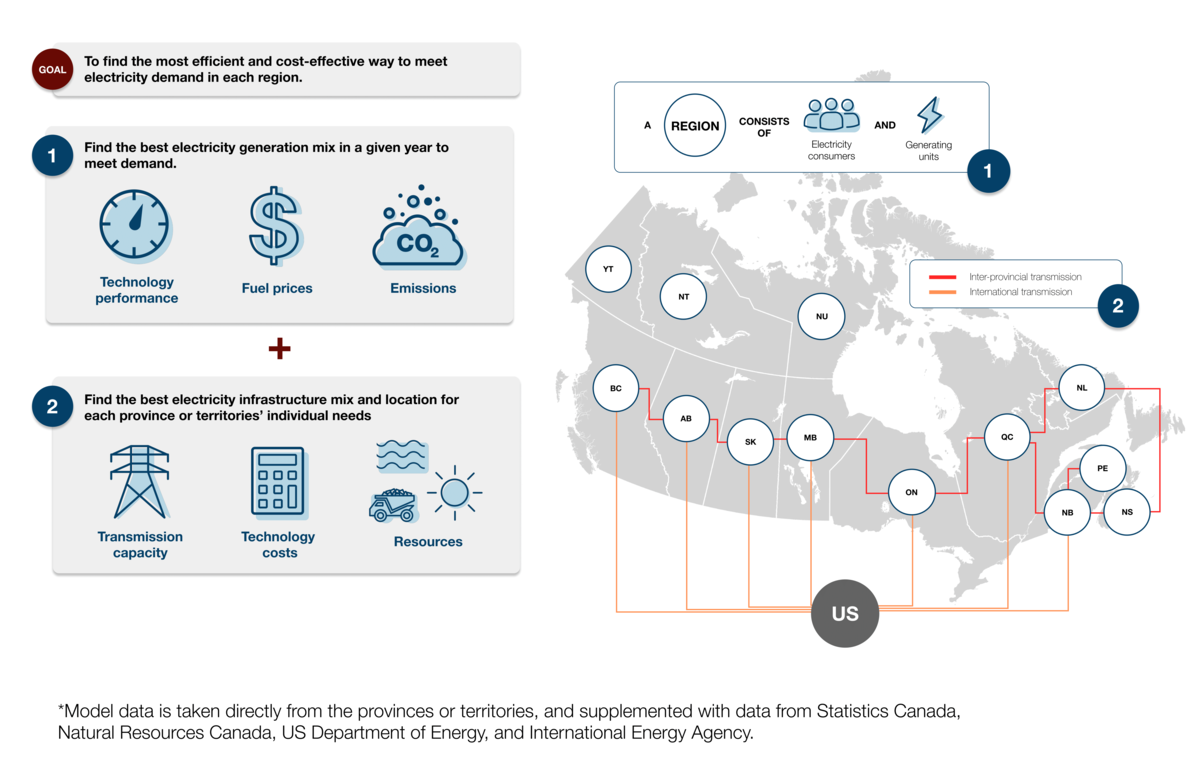
Text Alternative: The infographic displays a simplified version of how the Electricity Supply Model (ESM) works. The goal of the model is to find the most efficient and cost-effective way to meet electricity demand in each region. The model finds the optimal fuel mix in a given year to meet demand, including costs, prices, and emission generation. It also finds the best generating unit type and location for each province or territory’s individual needs, including generating unit distance and production limits. A map of Canada displays inter-provincial and international transmission lines. The lines are connected to regions comprising of population and generating units.
The electricity projections are created using a CER developed model. The core model is developed based on Python for Power System Analysis (PyPSA), an open-source, electric power system planning and simulation model. The CER model simulates how the future electricity demand of different Canadian economic sectors is satisfied by a combination of electricity-generating units and delivery systems. It models electricity-generating and storage units (including their technical and economic attributes), electricity transmission infrastructure, energy resource availability, electricity demand, and applicable regulations. The model simulates the operation of electric power systems at hourly intervals.
Source: CER
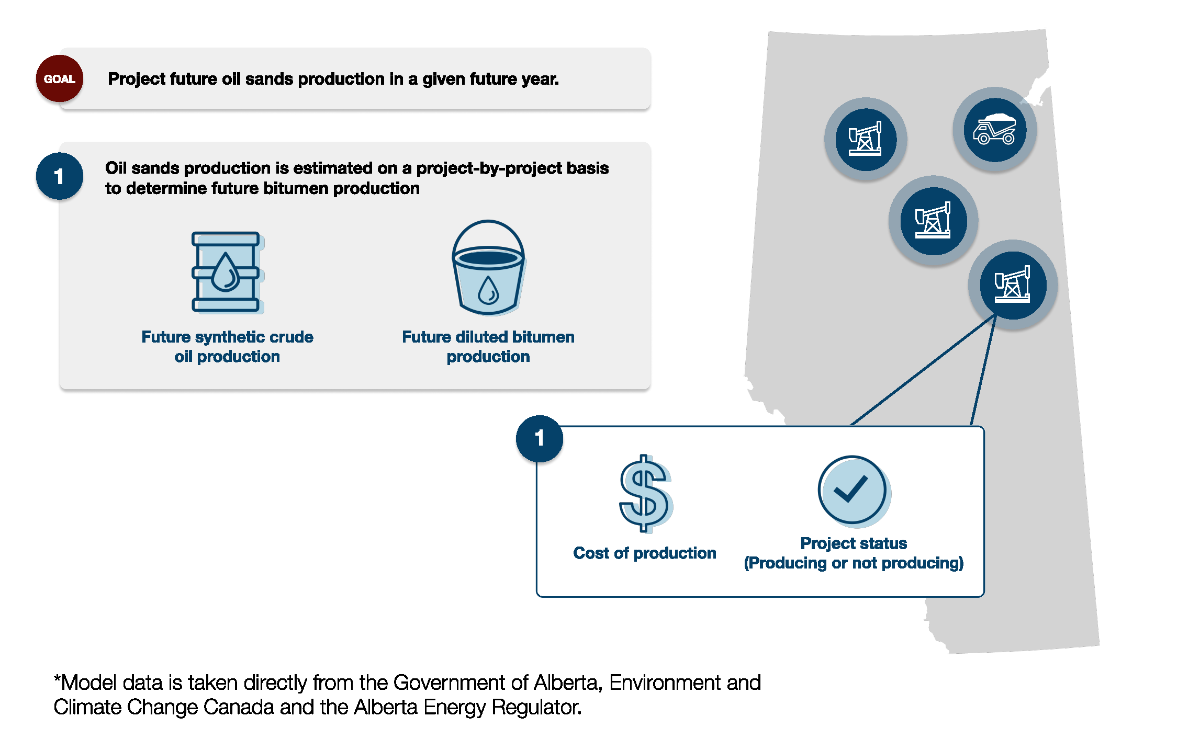
Text Alternative: The infographic provides a simplified visual overview of the Crude oil model. The goal of the model is to project total oil sands production in a given year. Oil sands production is estimated on a project-by-project basis to determine future bitumen production, including future synthetic crude oil production and future diluted bitumen production. The model breaks these down into cost of production and status (producing or shut in).
Source: CER
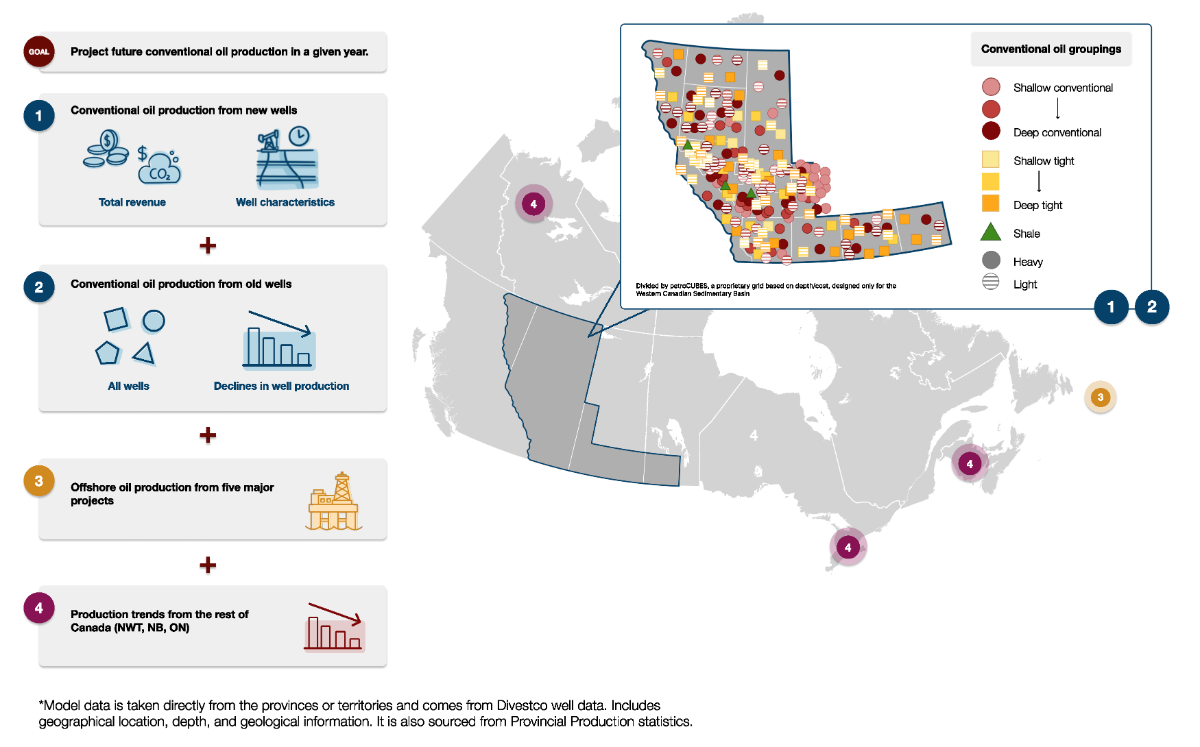
Text Alternative: The infographic displays a simplified explanation of the model used to project total Canadian conventional, tight, and shale oil production in a given year. The model components include:
The infographic also displays PetroCUBE groupings in western Canada, which display conventional oil groupings by categories: by heavy and light class; by conventional, tight, and shale types; and by shallow to deep zones.
This CER-developed model provides crude oil production projections for the various regions and crude types in Canada, based on our price assumptions and other factors, such as carbon pricing and technological improvements. It includes an oil sands module, a non-oil sands deliverability module for western Canada, and analysis of other regions in Canada including east coast offshore.
Source: CER
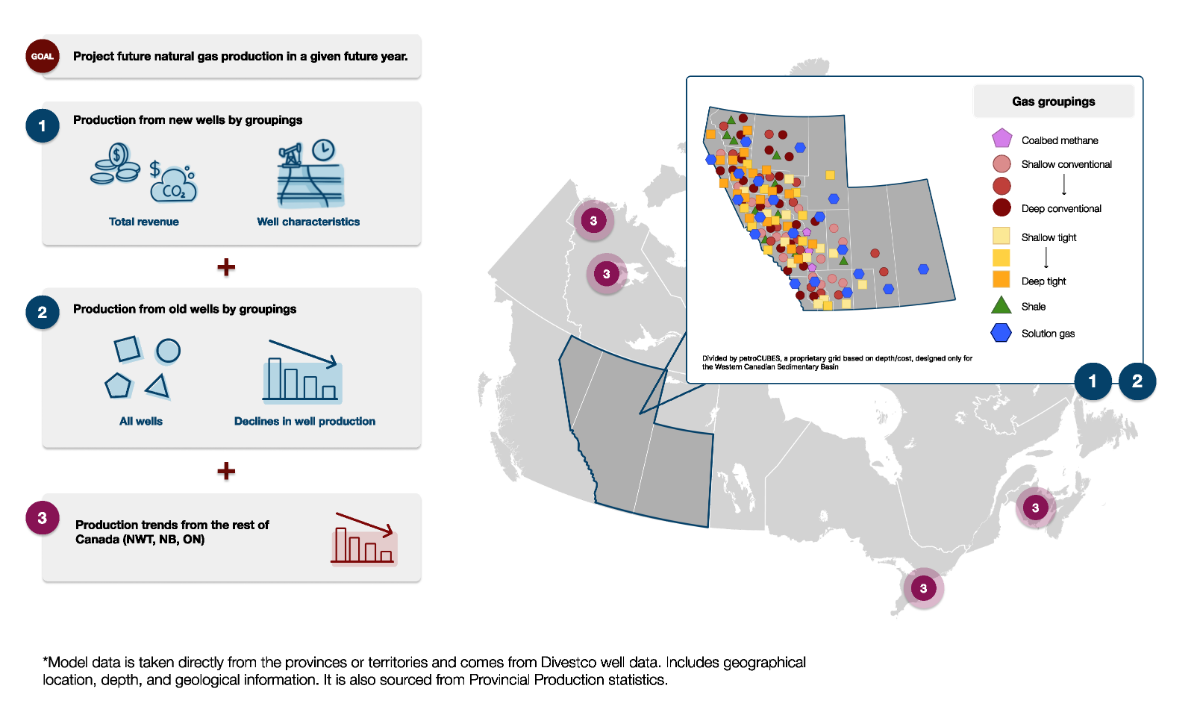
Text Alternative: The infographic displays a simplified explanation of the model used to determine total Canadian natural production in a given year. The model components include:
This CER developed model estimates the production of natural gas throughout Canada. It relies upon oil and natural gas price assumptions, LNG export assumptions, crude oil production estimated from the oil supply module, and other factors like technological change and policies. The module includes the Western Canadian Sedimentary Basin natural gas deliverability model, as well as trend analysis for other producing regions (e.g. New Brunswick).
Source: CER
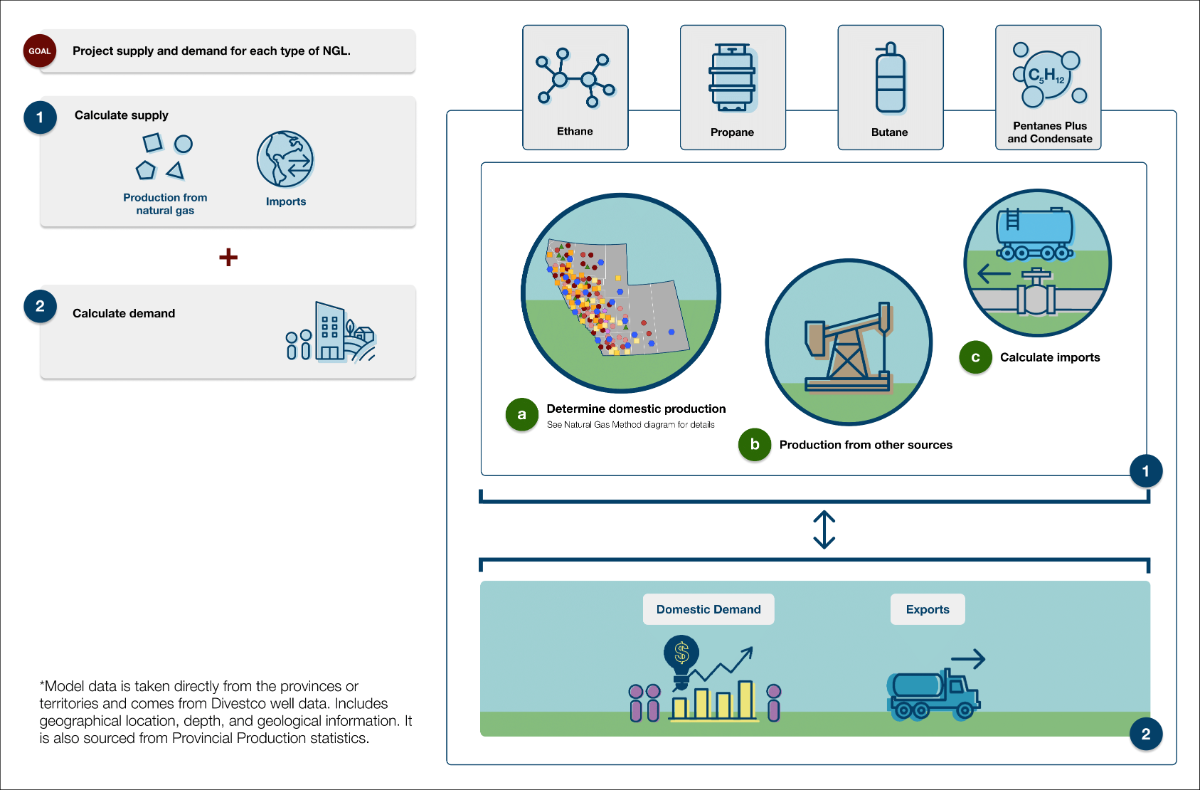
Text Alternative: The infographic provides a simplified visual overview of the natural gas liquids (NGL) supply and disposition model. The model is used to determine projected Canadian production and demand by type of NGL in a given year.
This CER developed model module provides estimates of NGL supply and demand in Canada. The module simulates various categories of liquids: ethane, butane, propane, condensate, and pentanes plus. For each liquid, the module provides estimates of production and supply and demand at the provincial or territorial level.
Source: CER
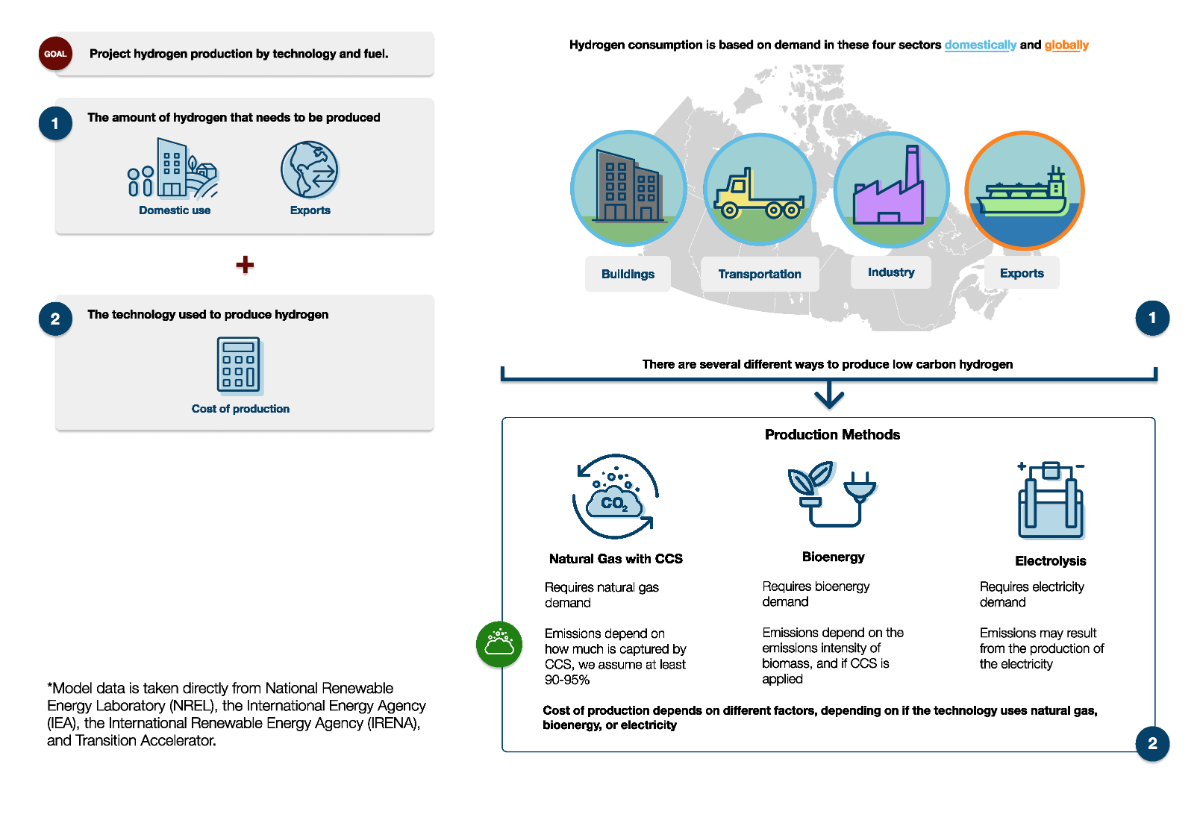
Text Alternative: This infographic shows an overview of the hydrogen supply model. Each technology is assigned production costs: capital, fuel, feedstock, emission, operation and maintenance, transportation, distribution, and storage. Production costs are used as an input to the model’s consumer choice equations, which determine market share for each production technology, imports, exports, and marginal price. The resulting hydrogen prices are calculated by area and economic sector. The model further calculates energy demand and emissions from hydrogen production, including energy consumption from combustion and feedstock in addition to any emissions that are sequestered (from carbon capture and storage technologies).
This CER-developed model, which is based on PyPSA, determines low and non-emitting hydrogen production by technology type, based on domestic demand and export assumptions. The production technology choice is largely based on relative costs of the technology. Costs are based on the specific characteristics of each production technology, including capital costs, fuel use, capacity, access to carbon sequestration (if applicable), and emissions profiles.
Source: CER
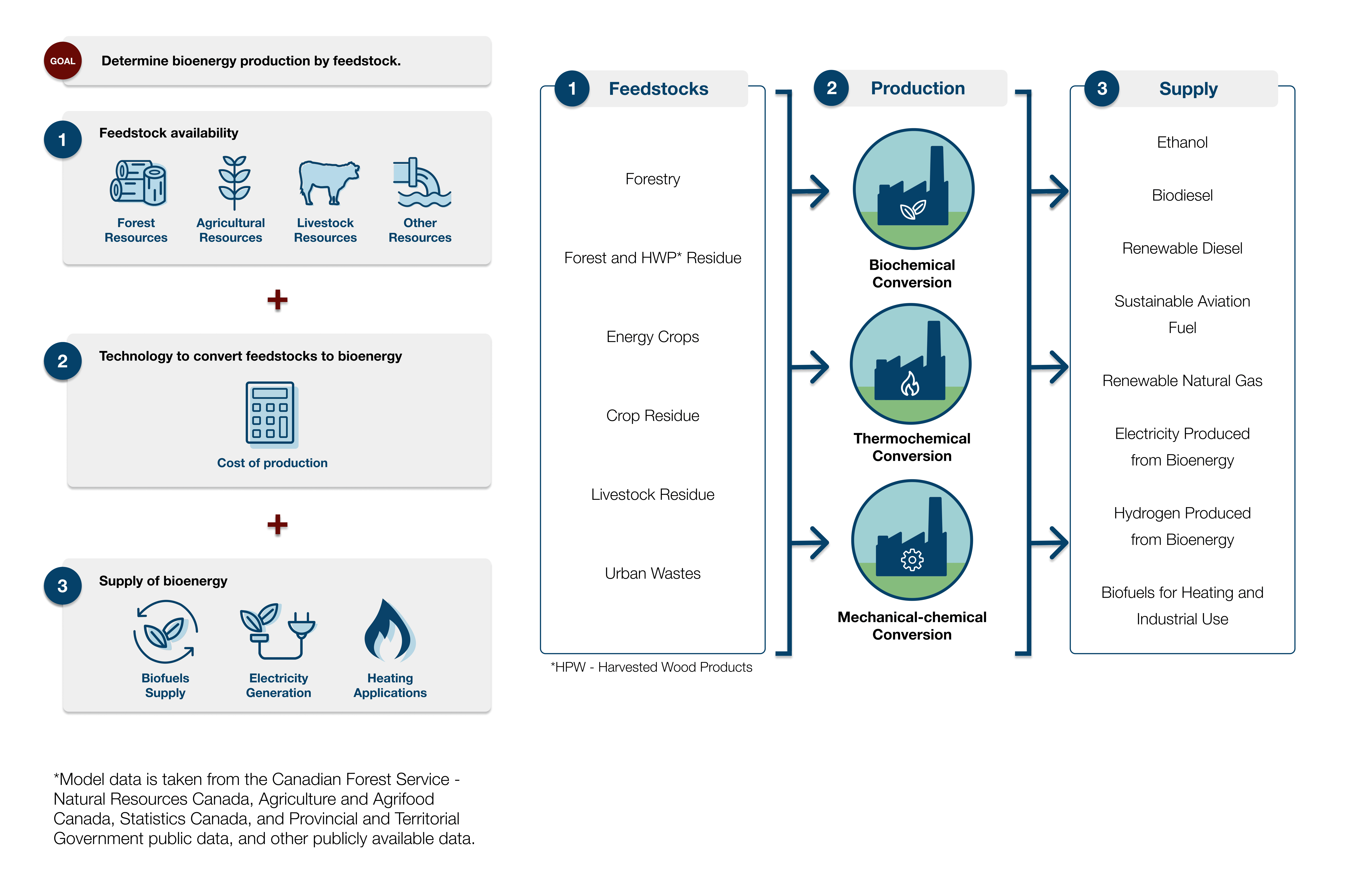
Text Alternative: Bioenergy is analyzed using the CER‑developed Bioenergy Supply Model (CER‑BSM). CER‑BSM is an integrated supply model that accounts for energy demand across multiple types of bioenergy, including biodiesel, renewable diesel, ethanol, renewable natural gas, and electricity and hydrogen produced from biomass. The model includes more than 30 different biomass feedstocks and optimizes how these feedstocks are allocated to various bioenergy types in each province. Feedstock choices depend on several factors, such as suitability and availability, biofuel demand and prices, preprocessing requirements, land‑use needs, and production technologies.
This CER-developed model estimates bioenergy supply by considering over 30 different biomass feedstocks and optimizes feedstock use for different bioenergy types in each province. The feedstock used for each bioenergy type depends on several things, such as feedstock suitability and availability, demand and price of the biofuels, preprocessing requirements, required land use, and production technology.