
YT NT NU BC AB SK MB ON QC NB NL NS PE
On this page:
- Key Takeaways
- Electricity and Renewable Energy Trends
- Recent and Planned Renewable Electricity and Energy Storage Projects
New Brunswick
New Brunswick has a regulated electricity system, with NB Power—a Crown corporation—responsible for generation, transmission, and distribution. The province has a diverse generation mix including nuclear, fossil fuels, hydroelectricity, and other renewable sourcesFootnote 1.
Key Takeaways
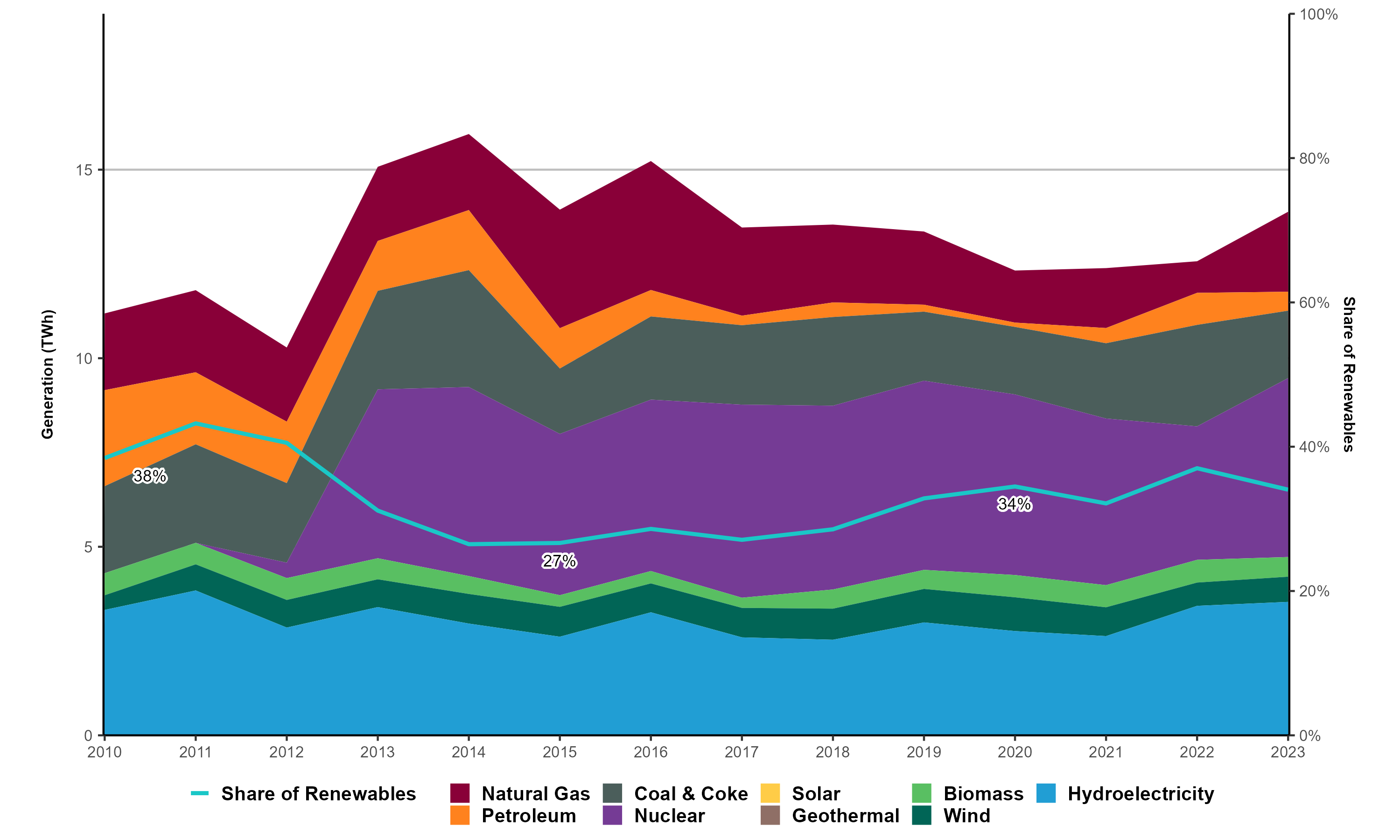
- In 2023, New Brunswick generated 13.9 terawatt-hours (TWh) of electricity, with 4.7 TWh (34%) coming from renewable sources.
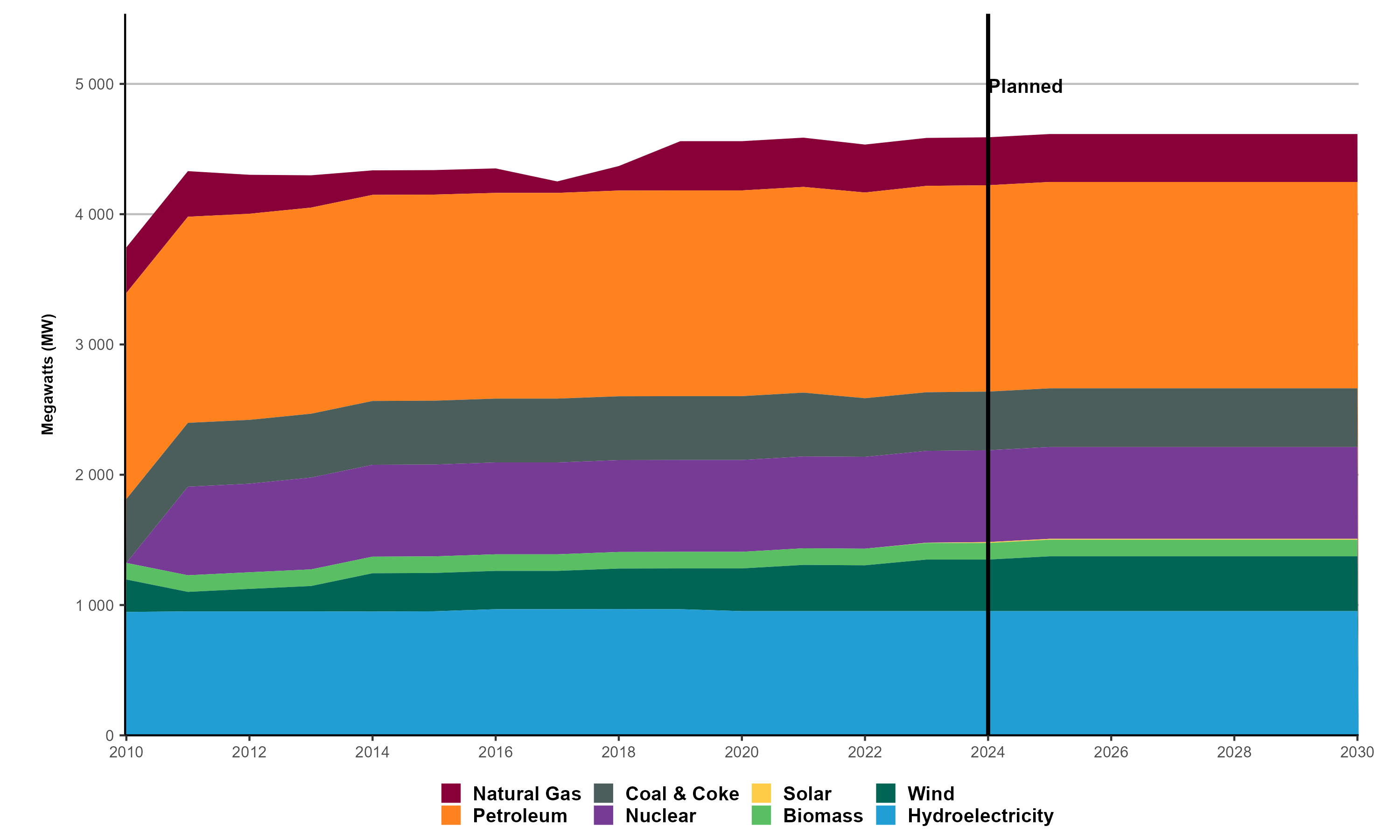
- Renewable capacity grew from 1,323 megawatts (MW) in 2010 to 1,478 MW in 2023, an 11.7% increase. This increase was almost entirely due to increased wind capacity (147 MW).
Electricity and Renewable Energy Trends
New Brunswick's hydroelectric infrastructure includes seven major NB Power dams, like the Mactaquac and Grand Falls stations, as well as other smaller facilities operated by municipalities and joint ventures, which support both generation and grid stability.Footnote 2 In 2023, hydroelectricity accounted for 3.5 TWh, or 25% of the electricity generated in the province.
The province’s electricity mix evolved modestly since 2010, with wind seeing a 72% growth by 2023, to a share of 4.8% of generation.

Nuclear power is New Brunswick’s largest generation source (34% in 2023), following the refurbishment and return to service of the Point Lepreau Nuclear Generating Station in 2012.Footnote 3 Its stable, low-emission output plays a key role in meeting baseload demand.
Petroleum-fired generation declined sharply between 2010 and 2023, going from 2.5 TWh to 0.5 TWh. The 320 MW Dalhousie Generating Station was permanently closed in 2012, and the remaining oil-fired Coleson Cove units have gradually been relegated to emergency or peak-demand service.Footnote 4Footnote 5 As heavy fuel oil and diesel become relatively more expensive and carbon-intensive compared with other sources, NB Power shifted toward lower-cost, lower-emission alternatives.
New Brunswick's strong interprovincial connections also support regional energy integration. The province’s exports represent about 69% of Prince Edward Island's electricity demand.Footnote 6
Figures 1 and 2 show historical trends in generation and installed capacity, respectively. Figure 2 also includes planned capacity additions for 2024–2030. The planned portion of the figure may be conservative; additional projects could be announced and come online before 2030, and some projects in the outlook might not proceed.
Figure 1: Electricity Generation by Type in New Brunswick
Source and Text Alternative
Source: The primary source for electricity generation data comes from Statistics Canada. Table 25-10-0020-01, 25-10-0084-01, and 25-10-0028-01 are combined to display data for all categories and years.
Data: Electricity Generation by Type in New Brunswick [XLSX 21 KB]
Text Alternative: This graph illustrates electricity generation from 2010 to 2023 in New Brunswick. In 2010, New Brunswick’s total generation was 11.2 TWh (38.4% renewable). In 2023, total generation was 13.9 TWh (34% renewable). Most generation in 2023 came from nuclear (34.2%), hydroelectricity (25.5%), natural gas (15.3%), coal (12.9%), and wind (4.8%).
Figure 2: Electricity Capacity and Future Changes in New Brunswick
Source and Text Alternative
Source: The primary source for electricity generation capacity data comes from Statistics Canada. Table 25-10-0022-01 and Table 25-10-0023-01 are combined to display data for all of the categories. It is supplemented by additional project-level data for planned capacity from provincial governments, utilities, and system operators, as well as industry associations.
Data: Electricity Capacity and Future Changes in New Brunswick [XLSX 21 KB]
Text Alternative: This graph illustrates historical electricity generation capacity from 2010 to 2030 in New Brunswick. In 2010, the province’s total installed electricity capacity was 3,745 MW (35.3% renewable). In 2023, capacity increased to 4,585 MW (32.2% renewable). In 2030, based on planned capacity additions, capacity reaches 4,615 MW (32.7% renewable).
New Brunswick has 5.8 MW of battery energy storage in service, with no other utility scale projects planned before 2030. However, the SOLSTICE microgrid, which has a small energy-storage component, has been in service since September 2025Footnote 7.
In 2023, the province had 8.4 MW of distributed solar power capacityFootnote 8.
Biomass capacity remained largely the same between 2010 and 2023 at 127 MW. This includes 25 MW of biomass boiler capacity for heat in community, light industrial, institutional, commercial, and agricultural sectors and 38 MW of biomass cogeneration for electricityFootnote 9. The province is exploring the possibility of converting the Belledune coal-fired power plant into a biomass fueled facility.
Recent and Planned Renewable Electricity and Energy Storage Projects
This section highlights selected renewable electricity and energy storage projects in New Brunswick, either recently completed or planned for development between 2025 and 2030. This list is not comprehensive and is based on information available as of September 2025.
- Salmon River Wind Project – A wind project owned by Wolastoqey Resource Developments Inc., representing six Wolastoqey communities, in partnership with Natural Forces, plans to add 200 MW of wind capacity by 2027Footnote 10.
- Paqt'smawei Sipu Wind Project – A wind project owned by L’nui Menikuk First Nation (Indian Island) and the Mi’gmaq United Investment Network, in partnership with Natural Forces, plans to add 100 MW of wind capacity by 2027Footnote 11.
- Astuwicuwon Wind Project – A wind project owned by Sitansisk First Nation (St. Mary’s), in partnership with Eolectric, plans to add 92 MW of wind capacity by 2028Footnote 12.
- Saint John’s Westside Mill NextGen Project – A biomass fueled recovery boiler at the Saint John paper mill, with planned completion in 2028, will generate green energy for pulp manufacturing and is expected to feed 70 MW into the gridFootnote 13.
- Neweg Energy Project – A wind project owned by the Mi’gmaq United Investment Network, representing eight Mi’gmaq First Nations, in partnership with Natural Forces, added 25 MW of wind capacity in 2025Footnote 14.
- Date modified: