
YT NT NU BC AB SK MB ON QC NB NL NS PE
On this page:
Ontario
Ontario operates a hybrid electricity market, where most generation is secured through long-term contracts with the Electricity System Operator (IESO), and a smaller share competes directly in the wholesale market. Wholesale electricity prices are set through the market, while the IESO also manages the system in real time, plans for future energy needs, and ensures system reliability. Transmission and distribution remain regulated, with the Ontario Energy Board overseeing rates and the Ministry of Energy setting overall policy.
Ontario’s growth in renewable energy was largely supported by policy initiatives in the late 2000s and early 2010s, which introduced feed-in tariffs and long-term contracts with guaranteed prices for wind, solar, hydroelectricity, and bioenergy. Additionally, the province committed to, and completed, the full phase-out of coal fired electricity by 2014.
Key Takeaways
- In 2023, Ontario generated 156.9 terawatt-hours (TWh) of electricity, with 55.4 TWh (35%) coming from renewable sources. When including nuclear, 86% of Ontario’s electricity came from low-carbon sources in 2023.
- Renewable capacity grew from 10,099 megawatts (MW) in 2010 to 17,436 MW in 2023, a 73% increase. Most of this growth came from wind (4,154 MW) and solar (2,136 MW), while hydroelectricity grew by 555 MW and bioenergy by 492 MW.
- Ontario leads Canada in ethanol and biodiesel production capacity with a combined capacity of around 1.4 billion liters per year.
Electricity and Renewable Energy Trends
Ontario’s electricity generation mix evolved significantly over the past two decades. The phase-out of coal in 2014, the expansion of renewable power and nuclear refurbishments have shaped the grid. Nuclear remains Ontario’s largest electricity source, supplied by 18 operating reactors, providing the stable, non-emitting backbone of the province’s grid. In 2014, Ontario became the first jurisdiction in North America to fully phase out coal-fired electricity, significantly lowering emissions. This transition created space for renewable energy to grow within the province’s evolving electricity mix.
Hydropower is Ontario’s largest renewable source, representing 21.4% of total installed capacity in 2023. Wind and solar have also expanded substantially, accounting for 13.2% and 5.3% of installed capacity, respectively, giving Ontario the largest installed wind and solar capacity in Canada that year.
Natural gas plays a key supporting role in the electricity system, helping maintain grid reliability by supplying power during peak demand periods, particularly when renewable output is lower. In 2024, Ontario completed a transmission line that eliminated the need for diesel in 16 remote communities and plans to connect additional communities to the provincial grid in the future.
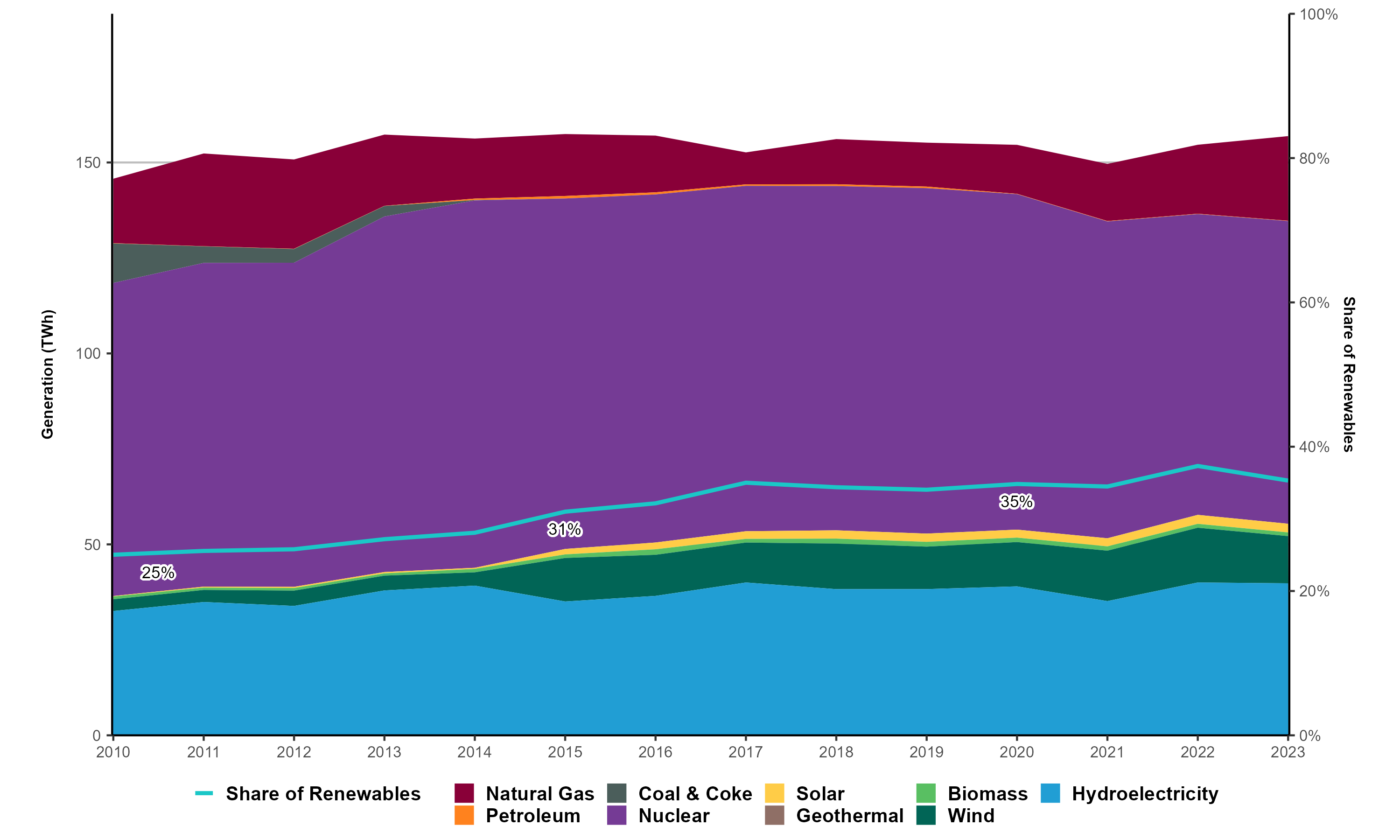
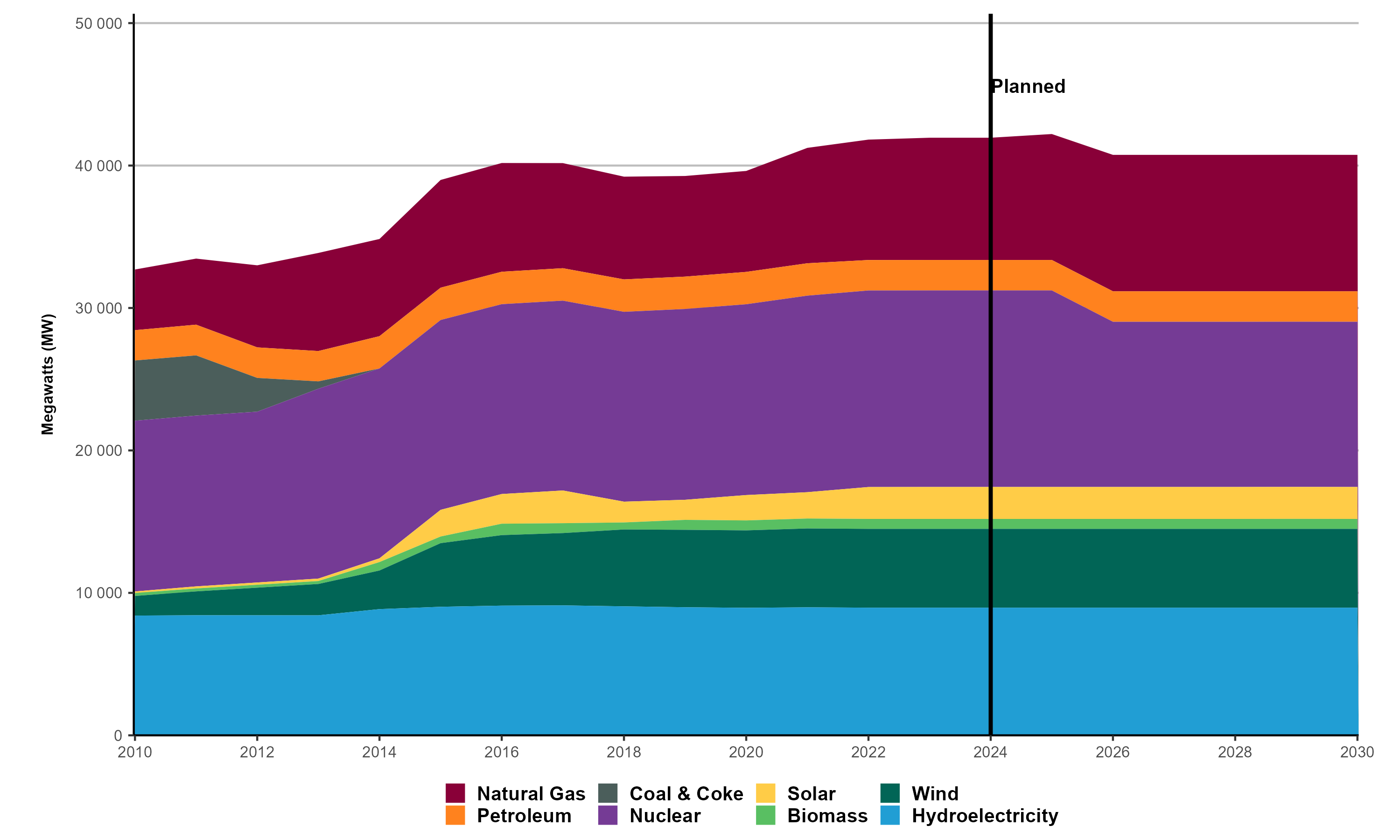
Figures 1 and 2 show historical trends in generation and installed capacity, respectively. Figure 2 also includes planned capacity additions for 2024–2030. The planned portion of the figure may be conservative; additional projects could be announced and come online before 2030, and some projects in the outlook might not proceed.
Figure 1: Electricity Generation by Type in Ontario
Source and Text Alternative
Source: The primary source for electricity generation data comes from Statistics Canada. Table 25-10-0020-01, 25-10-0084-01, and 25-10-0028-01 are combined to display data for all categories and years.
Data: Electricity Generation by Type in Ontario [XLSX 21 KB]
Text Alternative: This graph illustrates electricity generation from 2010 to 2023 in Ontario. In 2010, Ontario’s total generation was 145.7 TWh (25.0% renewable). In 2023, total generation was 156.9 TWh (35.3% renewable). Most generation in 2023 came from nuclear (50.5%), hydroelectricity (25.4%), natural gas (14.1%), wind (7.9%), and solar (1.4%).
Figure 2: Electricity Capacity and Future Changes in Ontario
Source and Text Alternative
Source: The primary source for electricity generation capacity data comes from Statistics Canada. Table 25-10-0022-01 and Table 25-10-0023-01 are combined to display data for all of the categories. It is supplemented by additional project-level data for planned capacity from provincial governments, utilities, and system operators, as well as industry associations.
Data: Electricity Capacity and Future Changes in Ontario [XLSX 21 KB]
Text Alternative: This graph illustrates historical electricity generation capacity from 2010 to 2030 in Ontario. In 2010, the province’s total installed electricity capacity was 32,702 MW (30.9% renewable). In 2023, capacity had grown to 41,952 MW (41.6% renewable). In 2030, based on planned capacity additions, capacity reaches 40,750 MW (42.8% renewable).
Ontario has made significant investments in grid-scale battery storage through the IESO’s competitive procurements. By 2028, almost 3,000 MW of new capacity is planned to come online, adding to the 272 MW already in service. Nearly all these projects are battery energy storage system (BESS).
In 2023, the province had 1,478 MW of distributed solar power capacityFootnote 1.
The province operates a voluntary renewable natural gas (RNG) program, with 4.7 PJ of capacity in 2024. In 2023, Ontario produced 22 PJ of pulping liquor and 39 PJ of other solid biofuels. Wood pellet production capacity is 290,000 tonnes per year.
Planned Energy Storage Projects
This section highlights selected renewable power and energy storage projects in Ontario, either recently completed or planned for development between 2025 and 2030. This list is not comprehensive and is based on information available as of September 2025.
- Skyview 2 Battery Energy Storage Project – A battery storage project by Potentia Renewables and Algonquins of Pikwakanagan First Nation, plans to add 390 MW of capacity by 2026Footnote 2.
- Hagersville Battery Energy Storage Park – A battery storage facility led by Boralex and the Six Nations of the Grand River, set to deliver 285 MW of capacity in Southern Ontario by 2026Footnote 3.
- Napanee Energy Storage – A battery project proposed by Atura Power and Ameresco, intends to add 250 MW of energy storage capacity by 2026Footnote 4.
- South March BESS (formerly Fitzroy BESS) – A battery energy storage project by Brookfield Renewables and Algonquins of Pikwakanagan First Nation, plans to add 250 MW of storage capacity near Ottawa by 2027Footnote 5.
- Date modified: